MCQ
Let a total charge $2Q$ be distributed in a sphere of radius $R$, with the charge density given by $\rho(r) = kr$, where $r$ is the distance from the centre. Two charges $A$ and $B$, of $-Q$ each, are placed on diametrically opposite points, at equal distance, $a$, from the centre. If $A$ and $B$ do not experience any force, then
  • A
    $a = \frac{{3R}}{{{2^{1/4}}}}$
  • B
    $a = {2^{ - 1/4}}R$
  • $a = {8^{ - 1/4}}R$
  • D
    $a = R/\sqrt 3 $

Answer

Correct option: C.
$a = {8^{ - 1/4}}R$
c
$E 4 \pi a^{2}=\frac{\int_{0}^{\theta} k r 4 \pi r^{2} d r}{e_{0}}$

$E=\frac{k 4 \pi a^{4}}{4 \times 4 \pi \varepsilon_{0}}$

$2 \mathrm{Q}=\int_{0}^{\mathrm{R}} \mathrm{kr} 4 \pi \mathrm{r}^{2} \mathrm{dr}$

$\mathrm{k}=\frac{2 \mathrm{Q}}{\pi \mathrm{R}^{4}}$

$\mathrm{QE}=\frac{1}{4 \pi \varepsilon_{0}} \frac{\mathrm{QQ}}{(2 \mathrm{a})^{2}}$

$\mathrm{R}=\mathrm{a} 8^{1 / 4}$

Need a full question paper?

Generate a complete, print-ready paper with questions like this in minutes — across 16+ boards, with answer keys.

Start Generating Free

Similar questions

Which of the following is true
Which photon is more energetic: A red one or a violet one?
The following table provides the set of values of $V$ and $I$ obtained for a given diode. Let the characteristics $\alpha $ be nearly linear, over this range, the forward and reverse bias resistance of the given diode respectively are

  $V$ $I$
Forward biasing $2.0\,V$ $60\,mA$
  $2.4\,V$ $80\,mA$
Reverse biasing $0\,V$ $0\,\mu A$
  $-2\,V$ $-0.25\,\mu A$


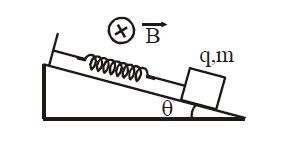
A small block of mass $m$, having charge $q$ is placed on frictionless inclined plane making an angle  $\theta$ with the horizontal. There exists a uniform magnetic field $B$ parallel to the inclined plane but  perpendicular to the length of spring. If $m$ is slightly pulled on the inclined in downward direction and released, the time period of oscillation will be (assume that the block does not leave contact with the plane)
Atomic number of a nucleus is Z and atomic mass is M. The number of neutron is
The earth’s magnetic field at a given point is $0.5 \times {10^{ - 5}}\,Wb{\rm{ - }}{m^{ - 2}}$. This field is to be annulled by magnetic induction at the center of a circular conducting loop of radius $5.0\,cm$. The current required to be flown in the loop is nearly......$A$
Consider the following statements regarding the real images formed with a converging lens.

$I$. Real images can be seen only if the image is projected onto the screen.

$II$. The real image can be seen only from the same side of the lens as that on which the object is positioned.

$III$. Real images produced by converging lenses are not only laterally but also longitudinally inverted as with mirrors.

Which of the above statement(s) is/are incorrect?

Two copper balls, each weighing 10g are kept in air 10 cm apart. If one electron from every $10^6$ atoms is transferred from one ball to the other, the coulomb force between them is (atomic weight of copper is 63.5)
In the diagram, three point charges $($labeled $1, 2$ and $3)$ are shown, along with the electric field around them. Which charge$(s)$ is/ are positive?
The electric potential varies in space according to the relation $V = 3x + 4y$. A particle of mass $0.1\,\, kg$ starts from rest from point $(2, 3·2)$ under the influence of this field. The charge on the particle is $+1\,\, μC$. Assume $V$ and $(x, y)$ are in $S.I.$ $units$ . The time taken to cross the $x-$ axis is.....$s$