Question
Let $\text{A}=\begin{bmatrix}1&2\\-1&3\end{bmatrix},\ \text{B}=\begin{bmatrix}4&0\\1&5\end{bmatrix},$ $\text{C}=\begin{bmatrix}2&0\\1&-2\end{bmatrix},$ a = 4, b = -2, then show that $\text{A}(\text{BC})=(\text{AB})\text{C}.$

Answer

We have, $\text{A}=\begin{bmatrix}1&2\\-1&3\end{bmatrix},\ \text{B}=\begin{bmatrix}4&0\\1&5\end{bmatrix},$ $\text{C}=\begin{bmatrix}2&0\\1&-2\end{bmatrix},$ and a = 4, b = -2

$(\text{BC})=\begin{bmatrix}4&0\\1&5\end{bmatrix}\begin{bmatrix}2&0\\1&-2\end{bmatrix}$

$=\begin{bmatrix}8&0\\7&-10\end{bmatrix}$

and $\text{A}(\text{BC})=\begin{bmatrix}1&2\\-1&3\end{bmatrix}\begin{bmatrix}8&0\\7&-10\end{bmatrix}$

$=\begin{bmatrix}8+14&0-20\\-8+21&0-30\end{bmatrix}=\begin{bmatrix}22&-20\\13&-30\end{bmatrix}$

Also, $(\text{AB})=\begin{bmatrix}1&2\\-1&3\end{bmatrix}\begin{bmatrix}4&0\\1&5\end{bmatrix}$

$=\begin{bmatrix}6&10\\-1&15\end{bmatrix}$

$(\text{AB})\text{C}=\begin{bmatrix}6&10\\-1&15\end{bmatrix}\begin{bmatrix}2&0\\1&-2\end{bmatrix}$

$=\begin{bmatrix}22&-20\\13&-30\end{bmatrix}=\text{A}(\text{BC})$

Hence proved.

Need a full question paper?

Generate a complete, print-ready paper with questions like this in minutes — across 16+ boards, with answer keys.
Start Generating Free

Similar questions

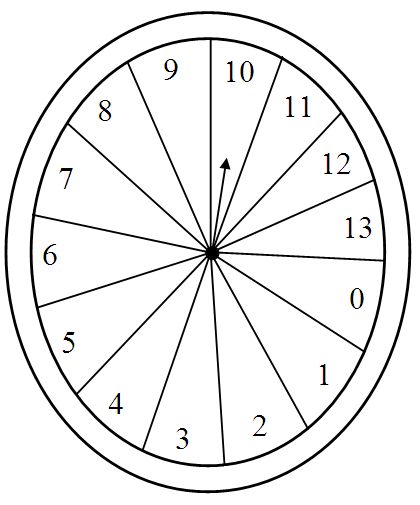
In roulette, Figure, the wheel has 13 numbers 0, 1, 2,...., 12 maked on equally spaced slots. A player sets Rs 10 on a given number. He recieves Rs 100 from the organiser of the game if the ball comes to rest in this slot; otherwise he gets nothing. If X denotes the players net gain/loss, Find E(X).

If $\text{A}=\begin{bmatrix} \cos\theta & \sin\theta \\ -\sin\theta & \cos\theta \end{bmatrix}\text{ and A (adj A =)}\begin{bmatrix} \text{k} & 0 \\ 0 & \text{k} \end{bmatrix},$ then find the value of k.
Show that the normals to the following parirs of planes are perpendicular other.
$\vec{\text{r}}\cdot(2\hat{\text{i}}-\hat{\text{j}}+3\hat{\text{k}})=5$ and $\vec{\text{r}}\cdot(2\hat{\text{i}}-\hat{\text{j}}-2\hat{\text{k}})=5$
Let f : R → R and g : R → R be defined by f(x) = x + 1 and g(x) = x - 1. Show that fog = gof = IR.
Evaluate the following integrals:
$\int\sqrt{\tan\text{x}}\sec^4\text{x}\text{ dx}$
If with reference to the right handed system of mutually perpendicular unit vectors $\hat i,\hat j$ and $\hat k$, $\vec \alpha = 3\hat i - \hat j$, $\vec \beta = 2\hat i + \hat j - 3\hat k$, then express $\vec \beta $ in the form $\vec \beta = {\vec \beta _1} + {\vec \beta _2}$, where ${\vec \beta _1}$ is || to $\vec \alpha $ and ${\vec \beta _2}$ is perpendicular to $\vec \alpha $.
Evaluate $\sin\Big(\frac{1}{2}\sin^{-1}\frac{4}{5}\Big).$
Solve for x:

$\tan^{-1}\Bigg(\frac{\text{x - 1}}{\text{x - 2}}\Bigg)+\tan^{-1}\Bigg(\frac{\text{x + 1}}{\text{x + 2}}\Bigg)=\frac{\pi}{4}.$

Consider the binary operations * : R × R  → R and o : R × R → R defined as a * b = | a – b | and a o b = a for all a, b $\in$ R. Show that '*' is commutative but not associative, 'o' is associative but not commutative.
Evaluate the following integrals:
$\int\text{x}^2\cos2\text{x dx}$