MCQ
Let

$\alpha=\sum_{ k =1}^{\infty} \sin ^{2 k}\left(\frac{\pi}{6}\right)$

Let $g:[0,1] \rightarrow R$ be the function defined by

$g( x )=2^{\alpha x }+2^{\alpha(1- x )}$

Then, which of the following statements is/are $TRUE$?

$(A)$ The minimum value of $g( x )$ is $2^{\frac{7}{6}}$

$(B)$ The maximum value of $g( x )$ is $1+2^{\frac{1}{3}}$

$(C)$ The function $g( x )$ attains its maximum at more than one point

$(D)$ The function $g( x )$ attains its minimum at more than one point

  • A
    $A,B$
  • B
    $A,B,D$
  • C
    $A,C$
  • $A,B,C$

Answer

Correct option: D.
$A,B,C$
d
$\alpha=\left(\frac{1}{2}\right)^2+\left(\frac{1}{2}\right)^4+\left(\frac{1}{2}\right)^6+\ldots$

$\alpha=\frac{\frac{1}{4}}{1-\frac{1}{4}}=\frac{1}{3}$

$\therefore g(x)=2^{x / 3}+2^{1 / 3(1-x)}$

$\therefore g(x)=2^{x / 3}+\frac{2^{1 / 3}}{2^{x / 3}}$

$\text { where } g(0)=1+2^{1 / 3} \& g(1)=1+2^{1 / 3}$

$\therefore g^{\prime}(x)=\frac{1}{3}\left(2^{x / 3}-\frac{2^{1 / 3}}{2^{\pi / 3}}\right)=0$

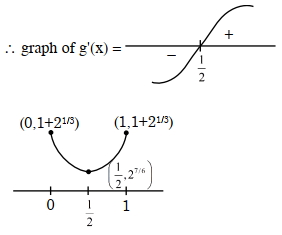
$\Rightarrow 2^{2 x / 3}=2^{1 / 3} \Rightarrow x=\frac{1}{2}=\text { critical point }$

(image)

& $g\left(\frac{1}{2}\right)=2^{\frac{7}{6}}$

$\therefore \text { graph of } g(x) \text { in }[0,1]$

(image)

Need a full question paper?

Generate a complete, print-ready paper with questions like this in minutes — across 16+ boards, with answer keys.

Start Generating Free

Similar questions

The degree of differential equation $\frac{{{d^2}y}}{{d{x^2}}} + {\left( {\frac{{dy}}{{dx}}} \right)^3} + 6y = 0$ is
Two dice are thrown simultaneously. The probability of getting a pair of aces is
If $f(x) = \left\{ \begin{array}{l}\,\,\,\,\,\,\,\frac{{\sin [x]}}{{[x] + 1}},\,\,{\rm{for}}\,\,x > 0\\\frac{{\cos \frac{\pi }{2}[x]}}{{[x]}},\,\,{\rm{for}}\,\,x < 0\\\,\,\,\,\,\,\,\,\,\,\,\,\,\,\,\,k,\,\,{\rm{at}}\,x = 0\end{array} \right.$;   where $[x]$ denotes the greatest integer less than or equal to $x$, then in order that $f$ be continuous at $x = 0$, the value of $k$ is
The solution of the differential equation $\left(x^2+y^2\right) d x-5 x y d y=0, y(1)=0$, is :
Let $\vec{a}$ and $\vec{b}$ be two vectors such that $|\vec{a}+\vec{b}|^{2}=|\vec{a}|^{2}+2|\vec{b}|^{2}, \vec{a} \cdot \vec{b}=3 \quad$ and $\quad|\vec{a} \times \vec{b}|^{2}=75$.Then $|\vec{a}|^{2}$ is equal to $.......$
If $A$ and $B$ are events such that $P(A)>0$ and $P(B) \neq 1$, then $P\left(A^{\prime} \mid B^{\prime}\right)$ equals
Consider the circuit,If the probability that each switch is closed is $p$, then find the probability of current flowing through $AB$
$\int_0^\pi \frac{1}{1+\sin x} dx$ equals
The point $B$ divides the arc $AC$ of a quadrant of a circle in the ratio $1 : 2$. If $O$ is the centre and $\overrightarrow {OA} = a$ and $\overrightarrow {OB} = b,$ then the vector $\overrightarrow {OC} $ is
If $\text{A}_{\text{r}}=\begin{vmatrix}1&\text{r}&2^{\text{r}}\\2&\text{n}&\text{n}^{2}\\\text{n}&\frac{\text{n}(\text{n}+1)}{2}&2^{\text{n}+1} \end{vmatrix},$ then the value of $\sum\limits_{\text{r}=1}^\text{n}\text{A}_\text{r}$ is: