MCQ
Let $\vec{a}$ and $\vec{b}$ be two vectors such that $|\vec{a}+\vec{b}|^{2}=|\vec{a}|^{2}+2|\vec{b}|^{2}, \vec{a} \cdot \vec{b}=3 \quad$ and $\quad|\vec{a} \times \vec{b}|^{2}=75$.Then $|\vec{a}|^{2}$ is equal to $.......$
  • $14$
  • B
    $13$
  • C
    $12$
  • D
    $11$

Answer

Correct option: A.
$14$
a
$|\vec{a}+\vec{b}|^{2}=|\vec{a}|^{2}+2|\vec{b}|^{2} ; \vec{a} \cdot \vec{b}=3$

As $|\vec{a}|^{2}+|\vec{b}|^{2}+2 \vec{a} \cdot \vec{b}=|\vec{a}|^{2}+2|\vec{b}|^{2}$

$|\vec{b}|^{2}=2 \vec{a} \cdot \vec{b}=6$

$|\vec{a} \times \vec{b}|^{2}=75$

$|\vec{a}|^{2}|\vec{b}|^{2}-(\vec{a} \cdot \vec{b})^{2}=75$

$6|\vec{a}|^{2}-9=75 \Rightarrow|\vec{a}|^{2}=14$

Need a full question paper?

Generate a complete, print-ready paper with questions like this in minutes — across 16+ boards, with answer keys.

Start Generating Free

Similar questions

$\int_{\, - \,1}^{\,1} {\log (x + \sqrt {{x^2} + 1} )\,dx = } $
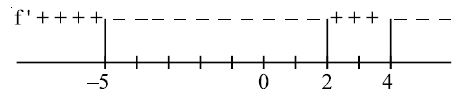
 $(i)$  $f (x)$ is continuous and defined for all real numbers

$(ii)$ $f '(-5) = 0 \,; \,f '(2)$ is not defined and $f '(4)  = 0$

$(iii)$ $(-5, 12)$ is a point which lies on the graph of $f (x)$

$(iv)$ $f ''(2)$ is undefined, but $f ''(x)$ is negative everywhere else.

$(v)$ the signs of  $f '(x)$ is given below

Possible graph of $y = f (x)$ is

Consider the function $f : R \rightarrow R$ defined by $f(x)=\left\{\begin{array}{cc}\left(2-\sin \left(\frac{1}{x}\right)\right)|x|, x \neq 0 \\ 0 & , x=0\end{array} .\right.$ Then $f$ is
The value of $c$ in Rolle's theorem for the function $f(x) = x^3 - 3x$ in the interval $\big[0,\sqrt3\big]$ is:
The equation of the line passing through the points $\text{a}_1\hat{\text{i}}+\text{a}_2\hat{\text{j}}+\text{a}_3\hat{\text{k}}$ and $\text{b}\hat{\text{i}}+\text{b}_2\hat{\text{j}}+\text{b}_3\hat{\text{k}}$ is:
$\int(\text{x}-1)\text{e}^{-\text{x}}\text{ dx}$ is equal to:
$\int_{0}^{\frac{\pi}{2}}\sqrt{1+\sin2\text{x}}\text{dx}$ is equal to:
In which of the following functions Rolle’s theorem is applicable ?
The mean and variance of a binomial distribution are $\alpha$ and $\frac{\alpha}{3}$ respectively. If $P(X=1)=\frac{4}{243}$, then $P ( X =4$ or $5)$ is equal to.
Let $A = \left\{ {{x_1},{x_2},{x_3},.....,{x_7}} \right\}$ and $B = \left\{ {{y_1},{y_2},{y_3}} \right\}$ be two sets containing seven and three distinct elements respectively. Then the total number of functions $f:A \to B$ which are onto, if there exist exactly three elements $x$ in $A$ such that $f(x) = {y_2}$ , is equal to