MCQ
Let $\overrightarrow{\text{E}}$ and $\overrightarrow{\text{B}}$ denote electric and magnetic fields in a frame $S$ and $\overrightarrow{\text{E}}$ and $\overrightarrow{\text{B}}$ in another frame $S$ moving with respect to $S$ at a velocity $\overrightarrow{\text{v}}.$ Two of the following equations are wrong. Identify them.
  1. $\text{B}_\text{y},=\text{B}_\text{y}+\frac{\text{vE}_\text{z}}{\text{c}^2}$
  2. $\text{E}_\text{y},=\text{E}_\text{y}+\frac{\text{vB}_\text{z}}{\text{c}^2}$
  3. $\text{B}'_\text{y}=\text{B}_\text{y}+\text{v}\text{E}_\text{z}$
  4. $\text{E}'_\text{y}=\text{E}_\text{y}+\text{vB}_\text{z}$
  • A
    only $A$
  • B
    $A$ and $B$
  • $B$ and $C$
  • D
    None of these

Answer

Correct option: C.
$B$ and $C$
$\text{qE}=\text{qvB}$
$\Rightarrow\text{e}=\text{vB}$ By dimensionally $b\ \&$ care wrong
$\Rightarrow\text{v}\text{E}=\text{v}^2\text{B}$
$\Rightarrow\text{B}=\frac{\text{vE}}{\text{v} ^2}$

Need a full question paper?

Generate a complete, print-ready paper with questions like this in minutes — across 16+ boards, with answer keys.

Start Generating Free

Similar questions

A body is accelerated by applying a force of $30\,N$. The change in the momentum of the body after $2\,sec$ is ............ $kg-m/s$ 
Dimensions of coefficient of viscosity are
Two sine waves travel in the same direction in a medium. The amplitude of each wave is a and the phase difference between the two waves is $120^\circ.$ The resultant amplitude will be:
A man waves his arms, while walking. This is:
Which of the following parameters is the same for molecules of all gases at a given temperature?
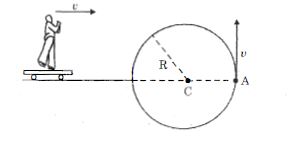
A boy is moving with a constant speed $v$ on a small trolley towards a distant circle as shown in the figure. A point mass is moving on the circle with a constant speed $v$, what is the frequency of change in magnitude of relative velocity of the point mass, as observed by the boy.
$Assertion$ : Angle of repose is equal to the angle of limiting friction.
$Reason$ : When the body is just at the point of motion, the force of friction in this stage is called limiting friction.
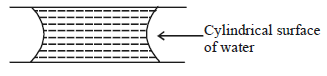
If two glass plates have water between them and are separated by very small distance ( see figure), it is very difficult to pull them apart. It is because the water in between forms cylindrical surface on the side that gives rise to lower pressure in the water in comparison to atmosphere. If the radius of the cylindrical surface is $R$ and surface tension of water is $T$ then the pressure in water between the plates is lower by
In an adiabatic process on a gas with $\gamma=1.4,$ the pressure is increased by 0.5%. The volume decreases by about:
If two soap bubbles of different radii are connected by a tube,