MCQ
Let $E_1(r), E_2(r)$ and $E_3(r)$ be the respective electric fields at a distance $r$ from a point charge $Q$, an infinitely long wire with constant linear charge density $\lambda$, and an infinite plane with uniform surface charge density $\sigma$. if $E_1\left(r_0\right)=E_2\left(r_0\right)=E_3\left(r_0\right)$ at a given distance $r_0$, then
  • A
    $Q =4 \sigma \pi r_0^2$
  • B
    $r_0=\frac{\lambda}{2 \pi \sigma}$
  • $E_1\left(r_0 / 2\right)=2 E_2\left(r_0 / 2\right)$
  • D
    $E_2\left(r_0 / 2\right)=4 E_3\left(r_0 / 2\right)$
Answer

Correct option: C.
$E_1\left(r_0 / 2\right)=2 E_2\left(r_0 / 2\right)$
c
$\frac{Q}{4 \pi \in_0 r_0^2}=\frac{\lambda}{2 \pi \in_0 r_0}=\frac{\sigma}{2 \in_0} $

$Q=2 \pi \sigma r_0^2 $ $\quad$$A$ incorrect

$r_0=\frac{\lambda}{\pi \sigma} $ $\quad$$B$ incorrect

$E_1\left(\frac{r_0}{2}\right)=\frac{4 E_1\left(r_0\right)}{1} $

$E_2\left(\frac{r_0}{2}\right)=2 E_2\left(r_0\right) \Rightarrow $ $\quad$$C$ correct

$E_3\left(\frac{r_0}{2}\right)=E_3\left(r_0\right)=E_2\left(r_0\right)$ $\quad$$D$ incorrect

Need a full question paper?

Generate a complete, print-ready paper with questions like this in minutes — across 16+ boards, with answer keys.

Start Generating Free

Similar questions

A straight conductor carries a current of $5A$. An electron travelling with a speed of $5 \times {10^6}\,m{s^{ - 1}}$ parallel to the wire at a distance of $0.1\,m$ from the conductor, experiences a force of
With increase in frequency of an $a.c.$ supply, the impedance of an $L C R$ series circuit
Electric potential is given by

$V = 6x - 8x{y^2} - 8y + 6yz - 4{z^2}$

Then electric force acting on $2\,C$ point charge placed on origin will be......$N$

An antenna is a device
In a plane $EM$ wave, the electric field oscillates sinusoidally at a frequency of $5 \times 10^{10} \mathrm{~Hz}$ and an amplitude of $50 \mathrm{Vm}^{-1}$. The total average energy density of the electromagnetic field of the wave is :

[Use $\varepsilon_0=8.85 \times 10^{-12} \mathrm{C}^2 / \mathrm{Nm}^2$ ]

Polarised glass is used in sun glasses because
In a region, the potential is represented by $V(x, y, z) = 6x - 8xy - 8y + 6yz$, where $V$ is in volts and $x, y, z$ are in metres. The electric force experienced by a charge of $2$ coulomb situated at point $( 1, 1, 1)$ is
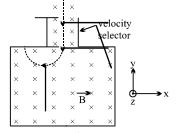
Two charged particle $A$ and $B$ each of charge $+e$ and masses $12$ $amu$ and $13$ $amu$ respectively follow a circular trajectory in chamber $X$ after the velocity selector as shown in the figure. Both particles enter the velocity selector with speed $1.5 \times 10^6 \,ms^{-1}.$ A uniform magnetic field of strength $1.0$ $T$ is maintained within the chamber $X$ and in the velocity selector.
X-rays are not used for radar purpose because
Thermal neutrons are those which