MCQ
Let $f$ be any function continuous on $[\mathrm{a}, \mathrm{b}]$ and twice differentiable on $(a, b) .$ If for all $x \in(a, b)$ $f^{\prime}(\mathrm{x})>0$ and $f^{\prime \prime}(\mathrm{x})<0,$ then for any $\mathrm{c} \in(\mathrm{a}, \mathrm{b})$ $\frac{f(\mathrm{c})-f(\mathrm{a})}{f(\mathrm{b})-f(\mathrm{c})}$ is greater than
  • A
    $\frac{b+a}{b-a}$
  • B
    $\frac{b-c}{c-a}$
  • $\frac{c-a}{b-c}$
  • D
    $1$

Answer

Correct option: C.
$\frac{c-a}{b-c}$
c
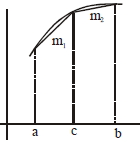
it is clear from graph that $\mathrm{m}_{1}>\mathrm{m}_{2}$

$\Rightarrow \quad \frac{f(\mathrm{c})-f(\mathrm{a})}{\mathrm{c}-\mathrm{a}}>\frac{f(\mathrm{b})-f(\mathrm{c})}{\mathrm{b}-\mathrm{c}}$

$\Rightarrow \quad \frac{f(c)-f(a)}{f(b)-f(c)}>\frac{c-a}{b-c}$

Need a full question paper?

Generate a complete, print-ready paper with questions like this in minutes — across 16+ boards, with answer keys.

Start Generating Free

Similar questions

Choose the correct answer from the given four options.The probability that exactly two of the three balls were red, the first ball being red, is:
The value of the integral $\int \limits_{-\frac{\pi}{4}}^{\frac{\pi}{4}} \frac{x+\frac{\pi}{4}}{2-\cos 2 x} d x$ is :
The system of equation x + y + z = 2, 3x − y + 2z = 6 and 3x + y + z = −18 has:
Let $S=\left\{x \in R: 0 < x < 1\right.$ and $\left.2 \tan ^{-1}\left(\frac{1-x}{1+x}\right)=\cos ^{-1}\left(\frac{1-x^2}{1+x^2}\right)\right\}$. If $n ( S )$ denotes the number of elements in $S$ then:
An urn contains $9$ balls two of which are red, three blue and four black. Three balls are drawn at random. The probability that they are of the same colour is,
If A, B are square matrices of order 3, A is non-singular and AB = 0, then B is a:
Mark the correct alternative in the following question:The probability of guessing correctly at least 8 out of 10 answers of a true false type examination is:
For every point P(x, y, z) on the xy-plane,
Consider the function $\mathrm{f}:\left[\frac{1}{2}, 1\right] \rightarrow \mathrm{R}$ defined by $f(x)=4 \sqrt{2} x^3-3 \sqrt{2} x-1$. Consider the statements

$(I)$ The curve $y=f(x)$ intersects the $x$-axis exactly at one point

$(II)$ The curve $y=f(x)$ intersects the $x$-axis at $\mathrm{x}=\cos \frac{\pi}{12}$

Then

If $A=\left[\begin{array}{cc}0 & 2 \\ 3 & -4\end{array}\right]$ and $k A=\left[\begin{array}{cc}0 & 3 a \\ 2 b & 24\end{array}\right],$ then the values of $k, a$ and $b$ respectively are