MCQ
Let $f: R \rightarrow R$ and $g: R \rightarrow R$ be functions defined by

$f(x)=\left\{\begin{array}{cl}x|x| \sin \left(\frac{1}{x}\right), & x \neq 0, \\ 0, & x=0,\end{array}\right.$ and $g(x)=\left\{\begin{array}{cc}1-2 x, & 0 \leq x \leq \frac{1}{2}, \\ 0, & \text { otherwise }\end{array}\right.$

Let $a, b, c, d \in R$. Define the function $h: R \rightarrow R$ by

$h(x)=a f(x)+b\left(g(x)+g\left(\frac{1}{2}-x\right)\right)+c(x-g(x))+d g(x), x \in R$

Match each entry in $List-I$ to the correct entry in $List-II$.

$List-I$ $List-II$
($P$) If $a=0, b=1, c=0$ and $d=0$, then  ($1$) $h$ is one-one
($Q$) If $a=1, b=0, c=0$ and $d=0$, then  ($2$) $h$ is onto.
($R$) If $a=0, b=0, c=1$ and $d=0$, then  ($3$) $h$ is differentiable on $R$.
($S$) If $a=0, b=0, c=0$ and $d=1$, then ($4$) the range of $h$ is $[0,1]$
  ($5$) the range of $h$ is $\{0,1\}$

The correct option is

  • A
    $(P) \rightarrow(4)( Q ) \rightarrow(3)( R ) \rightarrow(1)( S ) \rightarrow(2)$
  • B
    $(P) \rightarrow (5) (Q) \rightarrow (2) (R) \rightarrow (4) (S) \rightarrow (3)$
  • $(P) \rightarrow (5) (Q) \rightarrow (3) (R) \rightarrow (2) (S) \rightarrow (4)$
  • D
    $(P) \rightarrow (4) (Q) \rightarrow (2) (R) \rightarrow (1) (S) \rightarrow (3)$
Answer

Correct option: C.
$(P) \rightarrow (5) (Q) \rightarrow (3) (R) \rightarrow (2) (S) \rightarrow (4)$
c
$\begin{array}{l}f(x)=\left\{\begin{array}{cl}x|x| \sin \frac{1}{x} ; & x \neq 0 \\ 0 ; & x=0\end{array} \quad g(x)=\left\{\begin{array}{cc}1-2 x ; & 0 \leq x \leq \frac{1}{2} \\ 0 ; & \text { otherwise }\end{array}\right.\right. \\ g\left(\frac{1}{2}-x\right)=\left\{\begin{array}{cc}2 x ; & 0 \leq \frac{1}{2}-x \leq \frac{1}{2} \\ 0 ; & \text { otherwise }\end{array}=\left\{\begin{array}{cc}2 x ; & 0 \leq x \leq \frac{1}{2} \\ 0 ; & \text { otherwise }\end{array}\right\}\right. \\ g(x)+g\left(\frac{1}{2}-x\right)=\left\{\begin{array}{lll}1 ; & 0 \leq x \leq \frac{1}{2} \\ 0 ; & \text { otherwise }\end{array}\right\}\end{array}$

$(P)$ Now a $=0, b=1, c=0, d=0$

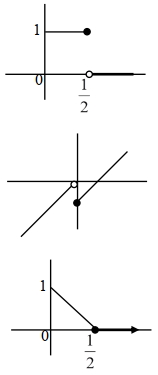
$\because h ( x )= g ( x )+ g \left(\frac{1}{2}- x \right)=\left\{\begin{array}{ll}1 ; & 0 \leq x \leq \frac{1}{2} \\ 0 ; & \text { otherwise }\end{array}\right.$

(image)

Hence Range of $h ( x )$ is $\{0,1\}$

$(Q)a=1, b=0, c=0, d=0$

$h(x)=f(x)=\left\{\begin{array}{ccc}x|x| \sin \frac{1}{x} & ; & x \neq 0 \\ 0 & ; \quad x=0\end{array}\right.$

$R H D=\lim _{x \rightarrow 0} \frac{x^2 \sin \frac{1}{x}-0}{x}=0$

$L H D=\lim _{x \rightarrow 0} \frac{-x^2 \sin \frac{1}{x}-0}{x}=0$

Hence $h(x)$ is differentiable on $R$

$(R)$ $a =0, b =0, c =1, d =0$

$h(x)=x-g(x)=\left\{\begin{array}{cc}3 x-1 ; & 0 \leq x \leq \frac{1}{2} \\ 0 ; & \text { otherwise }\end{array}\right.$

(image)

$\begin{array}{l}\therefore h ( x ) \text { is ONTO } \\ \text { (S) } \quad a =0, b =0, c =0, d =1 \\ h ( x )= g ( x )=\left\{\begin{array}{cl}1-2 x ; & 0 \leq x \leq \frac{1}{2} \\ 0 ; & \text { otherwise }\end{array}\right.\end{array}$

(image)

Need a full question paper?

Generate a complete, print-ready paper with questions like this in minutes — across 16+ boards, with answer keys.

Start Generating Free