MCQ
Let $\mathrm{f}: R \rightarrow R$ be function defined as

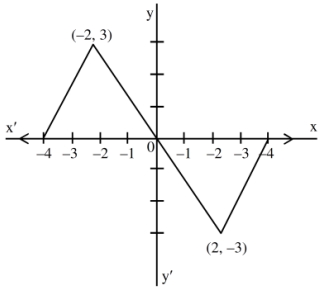
$f ( x )=\left\{\begin{array}{cc}3\left(1-\frac{| x |}{2}\right) & \text { if }| x | \leq 2 \text { } \\ 0 & \text { if }| x |>2 \text { }\end{array}\right.$ Let $g: R \rightarrow R$ be given by $g(x)=f(x+2)-f(x-2)$. If $n$ and $m$ denote the number of points in $R$ where $\mathrm{g}$ is not continuous and not differentiable, respectively, then $\mathrm{n}+\mathrm{m}$ is equal to $....$

  • $4$
  • B
    $3$
  • C
    $2$
  • D
    $1$

Answer

Correct option: A.
$4$
a
$f(x-2)\rightarrow =\frac{3 x}{2} \quad\quad -4 \leq x \leq-2$

$\quad \quad \quad \quad \quad \quad -\frac{3 x}{2} \quad -2\,$

$\quad \quad \quad \quad \quad \quad 0 \quad \quad \quad x \in(-\infty,-4) \cup(0,+\infty)$

$f(x+2)\rightarrow\frac{3 x}{2}+6 \quad \quad 0 \leq x \leq 2$

$\quad \quad \quad \quad \quad -\frac{3 x}{2}+6 \quad 2\,<\,x \leq 4$

$\quad \quad \quad \quad \quad 0 \quad \quad \quad \quad x \in(-\infty, 0) \cup(4,+\infty)$

$g(x)=f(x+2)-f(x-2) \rightarrow\frac{3 x}{2}+6 \quad -4 \leq x \leq-2$

$\quad \quad \quad \quad \quad \quad \quad \quad \quad \quad \quad \quad \quad -\frac{3 x}{2} \quad \quad -2\, < \,x\, < \,2$

$\quad \quad \quad \quad \quad \quad \quad \quad \quad \quad \quad \quad \quad \quad \frac{3 x}{2}-6\quad \quad 2 \leq x \leq 4$

$\quad \quad \quad \quad \quad \quad \quad \quad \quad \quad \quad \quad \quad 0 \quad \quad \quad \quad x \in(-\infty,-4) \cup(4,+\infty)$

$n=0$

$m=4 \Rightarrow(n+m=4)$

Need a full question paper?

Generate a complete, print-ready paper with questions like this in minutes — across 16+ boards, with answer keys.

Start Generating Free

Similar questions

The value of $\int\limits_0^2 {\frac{{dx}}{{{{(1 - x)}^2}}}} $ is
The value of $\int_3^5 {\frac{{{x^2}}}{{{x^2} - 4}}\,dx} $ is
If $f(x)=x^2 g(x)$ and $g(x)$ is twice differentiable, then $f^{\prime \prime}(x)$ is equal to
If $\int\limits_e^x {t\,f(t)dt\, = \,\sin \,\,x - x\,\cos \,\,x - \frac{{{x^2}}}{2},} $ for all $x \in R - \{ 0 \} ,$ then the value of $f(\frac {\pi }{6})$ is
If $\vec{a} = \hat{i} - \hat{j} - \hat{k}$ and $\vec{b} = \lambda\hat{i} - 3\hat{j} + \hat{k}$ and the orthogonal projection of $\vec{b}$ on $ \vec{a} $ is $\frac{4}{3}(\hat{i}- \hat{j} -\hat{k})$,then $\lambda$ is equal to :-
R is a relation on the set Z of integers and it is given by (x, y) ∈ R ⇔ | x - y | ≤ 1. Then, R is:
  1. Reflexive and transitive.
  2. Reflexive and symmetric.
  3. Symmetric and transitive.
  4. An equivalence relation.
Let $f(x) = \left\{ \begin{array}{l}
3 - x,\,\,\,\,\,\,\,\,\,\,\,\,\,\,\,\,\,\,\,0 \le x < 1\\
{x^2} + {\log _e}\,b,\,\,\,\,\,\,\,x \ge 1
\end{array} \right.$ . The set of values of $b$ such that $f(x)$ has a local minimum at $x = 1$ is
Let f: $\mathrm{R} \rightarrow \mathrm{R}$ be defined as

$f(x) \rightarrow \frac{\lambda\left|x^{2}-5 x+6\right|}{\mu\left(5 x-x^{2}-6\right)}, x<2$

$\quad\quad\quad\quad e^{\frac{\tan (x-2)}{x-[x]}}, \quad x>2$

$\quad\quad\quad\quad \mu \quad\quad\quad\quad x=2$

Where $[x]$ is the greatest integer less than or equal to $x$. If $f$ is continuous at $x=2$, then $\lambda+\mu$ is equal to:

The minimum of the function f(x) = 2x3 - 21x2 + 36x - 20 is :
  1. -128
  2. -126
  3. -120
  4. none of these.
If $y = {{{{(1 - x)}^2}} \over {{x^2}}}$, then ${{dy} \over {dx}}$ is