MCQ
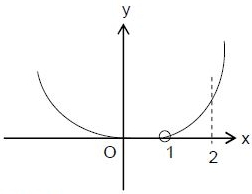
Let $f\,(x)\, = \,\left\{ {\begin{array}{*{20}{c}}
{ - 1\,,\,\,\,\, - 2\, \le x\, < \,0}\\
{{x^2} - 1,\,\,\,0,\, \le \,x\, \le 2}
\end{array}} \right.$ and $g\,(x)\, = \,\left| {f\,(x)\,} \right|\, + \,f\,(\,\left| x \right|\,),$ Then, in the interval $(-2\,,2),\,g$ is
  • A
    differentiable at all points
  • B
    not continuous
  • C
    not differentiable at two points
  • not differentiable at one point

Answer

Correct option: D.
not differentiable at one point
d
$\left| {f\left( x \right)} \right| = \left\{ {\begin{array}{*{20}{c}}
1&{ - 2 \le x < 0}\\
{\left| {{x^2} - 1} \right|}&{0 \le x \le 2}
\end{array}} \right.$

$f\left( {\left| x \right|} \right) = \left\{ {\begin{array}{*{20}{c}}
{ - 1}&{ - 2 \le \left| x \right| < 0}\\
{{x^2} - 1}&{0 \le \left| x \right| \le 2}
\end{array}} \right.$

$ \Rightarrow f\left( {\left| x \right|} \right) = \left\{ {\begin{array}{*{20}{c}}
{{x^2} - 1}&{ - 2 \le x \le 2}
\end{array}} \right\}$

$g\left( x \right) = \left| {f\left( x \right)} \right| + f\left( {\left| x \right|} \right):\left\{ {\begin{array}{*{20}{c}}
{1 + {x^2} - 1}&{ - 2 \le x < 0}\\
{\left| {{x^2} - 1} \right| + {x^2} - 1}&{0 \le x \le 2}
\end{array}} \right.$

$g\left( x \right) = \left\{ {\begin{array}{*{20}{c}}
{{x^2}}&{ - 2 < x < 0}\\
0&{0 \le x < 1}\\
{2\left( {{x^2} - 1} \right)}&{1 \le x < 2}
\end{array}} \right.$

$\therefore g\left( x \right)$ is not differentiable at $x=1$

Need a full question paper?

Generate a complete, print-ready paper with questions like this in minutes — across 16+ boards, with answer keys.

Start Generating Free

Similar questions

Direction ratio of line joining (2, 3, 4) and (-1, -2, 1), are:
  1. (-3, -5, -3)
  2. (-3, 1, -3)
  3. (-1, -5, -3)
  4. (-3, -5, 5)
$\left| {\begin{array}{*{20}{c}}{1 + {{\sin }^2}\theta }&{{{\sin }^2}\theta }&{{{\sin }^2}\theta }\\{{{\cos }^2}\theta }&{1 + {{\cos }^2}\theta }&{{{\cos }^2}\theta }\\{4\sin 4\theta }&{4\sin 4\theta }&{1 + 4\sin 4\theta }\end{array}} \right| = 0$ then $\sin \,4\theta $ equal to
If a curve the $y = f(x)$  passes through point $(1, -1)$ and  satisfies the differential equation $y\left( {1 + xy} \right)dx = xdy$ then $f\left( { - \frac{1}{2}} \right) = $ . . . . . 
Let $A \equiv  (\lambda  + 2, 1 - 2\lambda , \lambda  + 2)$ and $B \equiv  (2k + 1, k, k +1)$ and $ \lambda , k  \in  R.$ Then minimum distance between $A$ and $B$ is -
If the tangent to the curve $y = 1 -x^2$ at $x = \alpha ,$ where $0 < \alpha < 1,$ meets the axes at $P$ and $Q.$ Also $\alpha$ varies, the minimum value of the area of the triangle $OPQ$ is k times the area bounded by the axes and the part of the curve for which $0 < x < 1 ,$ then $k$ is equal to
The area of the triangle whose vertices are $(3,5)$, $(2,2)$ and $(k, 2)$ is 3 sq. unit then, value of $k$ is __________ .
Choose the correct answer from the given four options.
The value of $\cos^{-1}\Big(\cos\frac{3\pi}{2}\Big)$ is equal to:
  1. $\frac{\pi}{2}$
  2. $\frac{3\pi}{2}$
  3. $\frac{5\pi}{2}$
  4. $\frac{7\pi}{2}$
Diffrential coefficient of ${\left( {{x^{\frac{{\ell \, + \,m}}{{m\, - \,n}}}}} \right)^{\frac{1}{{n\, - \,\ell }}}}\,\,\,\,.\,\,\,\,{\left( {{x^{\frac{{\,m + \,n}}{{n\, - \,\ell }}}}} \right)^{\frac{1}{{\,\ell \, - \,m}}}}\,\,\,.\,\,\,{\left( {{x^{\,\frac{{n\, + \,\ell \,}}{{\ell \,\, - \,\,m}}}}} \right)^{\frac{1}{{m\, - \,n\,}}}}\,$ w.r.t. $x$ is
If $u, v$  and $w$  are three non-coplanar vectors, then $(u + v - w)\,.\,[(u - v) \times (v - w)]$ equals
If $\displaystyle \begin{vmatrix}\text{x} &\text{amp; } 1 \\ \text{y} &\text{amp; } 2 \end{vmatrix}-\displaystyle \begin{vmatrix}\text{y} &\text{amp; } 1 \\ 8&\text{amp; } 0\end{vmatrix}=\displaystyle \begin{vmatrix}2 &\text{amp; } 0 \\ \text{-x}&\text{amp; } 2\end{vmatrix}$ then the values of x and y respectively are:
  1. 5 and 1 
  2. 5 and 3
  3. 5 and 2
  4. 3 and 4