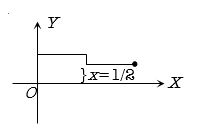
MCQ
Let $f(x) = \left\{ \begin{array}{l}\frac{1}{2},\;if\;0 \le x \le \frac{1}{2}\\\frac{1}{3},\;if\;\frac{1}{2} < x \le 1\end{array} \right.$, then $f$ is
  • A
    A rational function
  • B
    A trigonometric function
  • A step function
  • D
    An exponential function

Answer

Correct option: C.
A step function
c
(c) Which is step function.

Need a full question paper?

Generate a complete, print-ready paper with questions like this in minutes — across 16+ boards, with answer keys.

Start Generating Free

Similar questions

If $\left|\begin{array}{ccc}5 & 3 & -1 \\ -7 & x & -3 \\ 9 & 6 & -2\end{array}\right|=0,$ then the value of $x$ is
If ${\tan ^{ - 1}}2x + {\tan ^{ - 1}}3x = \frac{\pi }{4}$, then $x =$
A plane $P$ is parallel to two lines whose direction ratios are $-2,1,-3$, and $-1,2,-2$ and it contains the point $(2,2,-2)$. Let $P$ intersect the co-ordinate axes at the points $A , B , C$ making the intercepts $\alpha, \beta, \gamma$. If $V$ is the volume of the tetrahedron $OABC$, where $O$ is the origin and $p =\alpha+\beta+\gamma$, then the ordered pair $( V , p )$ is equal to.
Let $f: R \rightarrow R$ and $g: R \rightarrow R$ be functions defined by

$f(x)=\left\{\begin{array}{cl}x|x| \sin \left(\frac{1}{x}\right), & x \neq 0, \\ 0, & x=0,\end{array}\right.$ and $g(x)=\left\{\begin{array}{cc}1-2 x, & 0 \leq x \leq \frac{1}{2}, \\ 0, & \text { otherwise }\end{array}\right.$

Let $a, b, c, d \in R$. Define the function $h: R \rightarrow R$ by

$h(x)=a f(x)+b\left(g(x)+g\left(\frac{1}{2}-x\right)\right)+c(x-g(x))+d g(x), x \in R$

Match each entry in $List-I$ to the correct entry in $List-II$.

$List-I$ $List-II$
($P$) If $a=0, b=1, c=0$ and $d=0$, then  ($1$) $h$ is one-one
($Q$) If $a=1, b=0, c=0$ and $d=0$, then  ($2$) $h$ is onto.
($R$) If $a=0, b=0, c=1$ and $d=0$, then  ($3$) $h$ is differentiable on $R$.
($S$) If $a=0, b=0, c=0$ and $d=1$, then ($4$) the range of $h$ is $[0,1]$
  ($5$) the range of $h$ is $\{0,1\}$

The correct option is

Let $\vec a = 2\hat i + \hat j - 2\hat k,\,\vec b = \hat i + \hat j$ . If $\vec c$ is a vector such that $\vec a.\vec c + 2\left| {\vec c} \right| = 0$ and $\left| {\vec c - \vec a} \right| = \sqrt {14} $ and angle between $\vec a \times \vec b$ and $\vec c$ is $30^o$ , then $\left| {\left( {\vec a \times \vec b} \right) \times \vec c} \right|$ is
If $A$ and $B$ are two independent events such that $P(A) = 0.3$ and $\text{P}(\text{A}\cup\text{B})=0.5,$ then $P(A|B) - P(B|A) =$
Let $N$ be the set of natural numbers. For $n \in N$, define $I_n=\int_0^\pi \frac{x \sin ^{2 n}(x)}{\sin ^{2 n}(x)+\cos ^{2 n}(x)} d x$. Then, for $m, n \in N$
Solution of the differential equation $\sin \frac{{dy}}{{dx}} = a$ with $y(0) = 1$ is
Complete set of values of $'m'$ for which function $f(x) = {e^{\sin x}} + 2m\sin x + 1$ is increasing $\forall x \in \left( {0,\frac{\pi }{2}} \right)$ , is
The corner points of the feasible region determined by the following system of linear inequalities$:\ 2\text{x}+\text{y}\le10,\ \text{x}+3\text{y}\le15,\ \text{x},\ \text{y}\ge0$ are $(0, 0), (5, 0), (3, 4)$ and $(0, 5).$ Let $Z = px + qy,$ where $p, q > 0.$ Condition on $p$ and $q$ .so that the maximum of $Z$ occurs at both $(3, 4)$ and $(0, 5)$ is: