MCQ
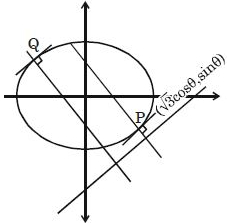
Let $P$ be a variable point on the ellipse $x^2 + 3y^2 = 3$ , then the maximum perpendicular distance of $P$ from the line $x -y = 10$ is
  • A
    $3\sqrt 2 $
  • B
    $4\sqrt 2 $
  • $6\sqrt 2 $
  • D
    $5\sqrt 2 $

Answer

Correct option: C.
$6\sqrt 2 $
c
$\frac{x^{2}}{3}+\frac{y^{2}}{1}=1$

$\frac{d y}{d x}=\frac{-x}{3 y}$

$=\frac{-\sqrt{3} \cos \theta}{3 \sin \theta}$

$=\frac{-\cot \theta}{\sqrt{3}}$

$\frac{-\cot \theta}{\sqrt{3}}=1 \Rightarrow \cot \theta=-\sqrt{3}$

$\Rightarrow \theta=-30^{\circ}$ or $150^{\circ}$

For $Q, \theta=150^{\circ} \Rightarrow Q\left(\frac{-3}{2}, \frac{1}{2}\right)$

Maximum distance $=\left|\frac{\frac{-3}{2}-\frac{1}{2}-10}{\sqrt{2}}\right|=6 \sqrt{2}$
Need a full question paper?

Generate a complete, print-ready paper with questions like this in minutes — across 16+ boards, with answer keys.

Start Generating Free

Similar questions

If the minimum area of the triangle formed by a tangent to the ellipse $\frac{x^{2}}{b^{2}}+\frac{y^{2}}{4 a^{2}}=1$ and the co-ordinate axis is $kab,$ then $\mathrm{k}$ is equal to ..... .
If $\alpha ,\beta $ are the roots of ${x^2} + px + 1 = 0$ and $\gamma ,\delta $are the roots of ${x^2} + qx + 1 = 0$,then ${q^2} - {p^2}$=
If $\frac{{\cos x}}{a} = \frac{{\cos (x + \theta )}}{b} = \frac{{\cos (x + 2\theta )}}{c} = \frac{{\cos (x + 3\theta )}}{d} \, ,$ then $\left( {\frac{{a + c}}{{b + d}}} \right)$ is equal to :-
For any natural number $n, 7^n– 2^n$ is divisible by
Let $\alpha ,\beta $ be the roots of the equation $a{x^2} + 2bx + c = 0$ and $\gamma ,\delta $ be the roots of the equation $p{x^2} + 2qx + r = 0$. If $\alpha ,\beta ,\gamma ,\delta $ are in $G.P.$, then
Let $P$  be a point on the parabola, $x^2 = 4y.$ If the distance of $P$  from the centre of the circle, $x^2 + y^2 + 6x + 8 = 0$ is minimum, then the equation of the tangent to the parabola at $P,$  is
The letter of the word `$ASSASSIN$' are written down at random in a row. The probability that no two $S$ occur together is
$\mathop {Limit}\limits_{x \to \infty } \,\frac{{{{\cot }^{ - 1}}\left( {\sqrt {x + 1} \,\, - \,\sqrt x } \right)}}{{{{\sec }^{ - 1}}\left\{ {{{\left( {\frac{{2x + 1}}{{x - 1}}} \right)}^x}} \right\}}}$ is equal to
$\lim_\limits{\text{x} \rightarrow\infty}\frac{\sqrt{\text{x}^2+1}-^3\sqrt{\text{x}^2+1}}{^4\sqrt{\text{x}^4+1}-^5\sqrt{\text{x}^4+1}}$ is equal to:
The equation of parabola with vertex at origin and directrix $x - 2 = 0$ is: