MCQ
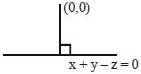
Let the expression $E = 8^a + 8^b -3.2^{a+b}$ takes its minimum value $'p'$ at $a = \alpha$ & $b = \beta $, then perpendicular distance of the point $P(\alpha , \beta )$ from the line $x + y + 2p = 0$ is
  • A
    $1$
  • B
    $0$
  • C
    $\frac{1}{{\sqrt 2 }}$
  • $\sqrt 2 $

Answer

Correct option: D.
$\sqrt 2 $
d
$\mathrm{E}+1=\left(2^{\mathrm{a}}\right)^{3}+(2 \mathrm{b})^{3}+1-3 \cdot 2^{\mathrm{a}} \cdot 2^{\mathrm{b}} \cdot 1$

$\mathrm{E}_{\min }=\mathrm{p}=-1 ; 2^{\mathrm{a}}=2^{\mathrm{b}}=1 \quad \Rightarrow \quad \mathrm{a}=\mathrm{b}=0$

$L = \sqrt 2 $

Need a full question paper?

Generate a complete, print-ready paper with questions like this in minutes — across 16+ boards, with answer keys.

Start Generating Free

Similar questions

Any circle through the points of intersection of the lines $x + \sqrt 3\, y = 1$ and $\sqrt 3\, x -y = 2$ if intersects these lines at points $P$ and $Q$, then the angle subtended by the arc $PQ$ at its centre is- ............. $^o$
If $O$ be the origin and if the coordinates of any two points $Q_1$ and $Q_2$ be $(x_1, y_1)$ and $(x_2, y_2)$ respectively, then $O{Q_1}.O{Q_2}\cos {Q_1}O{Q_2} = $
The partial fraction of ${{6{x^4} + 5{x^3} + {x^2} + 5x + 2} \over {1 + 5x + 6{x^2}}} = $
The general solution of the equation $(\sqrt 3 - 1)\sin \theta + (\sqrt 3 + 1)\cos \theta = 2$ is
If $1,\;{\log _y}x,\;{\log _z}y,\; - 15{\log _x}z$ are in $A.P.$, then
There are two such pairs of non-zero real valuesof $a$ and $b$ i.e. $(a_1,b_1)$ and $(a_2,b_2)$ for which $2a+b,a-b,a+3b$ are three consecutive terms of a $G.P.$, then the value of $2(a_1b_2 + a_2b_1) + 9a_1a_2$ is-
$\mathop {\lim }\limits_{x \to 0} \frac{{{a^x} - {b^x}}}{{{e^x} - 1}} =$
Let $x_1, x_2, ..., x_n$ be $n$ observations. Let $y_i = ax_i + by_i + b$ for $i = 1, 2, 3, ..., n,$ where $a$ and $b$ are constants. If the mean of $x_i's$ is $48$ and their standard deviation is $12,$ the mean of $y_i's$ $55$ and standard deviation of $y_i's$ is $15,$ the values of $a$ and $b$ are:
Let $n \geq 3$ and let $C_1, C_2, \ldots, C_n$, be circles with radii $r_1, r_2, \ldots, r_n$, respectively. Assume that $C_i$ and $C_{i+1}$ touch externally for $1 \leq i \leq n-1$. It is also given that the $X$-axis and the line $y=2 \sqrt{2} x+10$ are tangential to each of the circles. Then, $r_1, r_2, \ldots, r_n$ are in
The equation of the circle which touches the circle ${x^2} + {y^2} - 6x + 6y + 17 = 0$ externally and to which the lines ${x^2} - 3xy - 3x + 9y = 0$ are normals, is