MCQ 11 Mark
If the coordinates of the points $A $ and $B$ be $ (3, 3) $ and $(7, 6)$, then the length of the portion of the line $AB$ intercepted between the axes is
AnswerCorrect option: A. $\frac{5}{4}$
a
(a) Equation of line $AB$is $y - 3 = \frac{{6 - 3}}{{7 - 3}}(x - 3)$
==> $3x - 4y + 3 = 0 \Rightarrow \frac{x}{{ - 1}} + \frac{y}{{3/4}} = 1$
Hence required length is $\sqrt {{{( - 1)}^2} + {{\left( {\frac{3}{4}} \right)}^2}} = \frac{5}{4}$.
View full question & answer→MCQ 21 Mark
If the transversal $y = m_r\, x;\, r = \,1,\, 2, \,3$ cut off equal intercepts on the transversal $x + y = 1,$ then $1 + {m_1},$ $1 + {m_2},$ $1 + {m_3}$ are in
- A
$A. P.$
- B
$G. P.$
- ✓
$H. P.$
- D
AnswerCorrect option: C. $H. P.$
c
(c) Solving $y = {m_r}x$and $x + y = 1$, we get $x = \frac{1}{{1 + {m_r}}}$ and $y = \frac{{{m_r}}}{{1 + {m_r}}}$.
Thus the points of intersection of the three lines on the transversal are $\left( {\frac{1}{{1 + {m_1}}},\frac{{{m_1}}}{{1 + {m_1}}}} \right),$ $\left( {\frac{1}{{1 + {m_2}}},\frac{{{m_2}}}{{1 + {m_2}}}} \right)$ and$\left( {\frac{1}{{1 + {m_3}}},\frac{{{m_3}}}{{1 + {m_3}}}} \right)$
By hypothesis, ${\left( {\frac{1}{{1 + {m_1}}} - \frac{1}{{1 + {m_2}}}} \right)^2} + {\left( {\frac{{{m_1}}}{{1 + {m_1}}} - \frac{{{m_2}}}{{1 + {m_2}}}} \right)^2}$
= ${\left( {\frac{1}{{1 + {m_2}}} - \frac{1}{{1 + {m_3}}}} \right)^2} + {\left( {\frac{{{m_2}}}{{1 + {m_2}}} - \frac{{{m_3}}}{{1 + {m_2}}}} \right)^2}$
==> $\frac{{{m_2} - {m_1}}}{{1 + {m_1}}} = \frac{{{m_3} - {m_2}}}{{1 + {m_3}}}$or $\frac{{1 + {m_2}}}{{1 + {m_1}}} - 1 = 1 - \frac{{1 + {m_2}}}{{1 + {m_3}}}$
==> $\frac{{1 + {m_2}}}{{1 + {m_1}}} + \frac{{1 + {m_2}}}{{1 + {m_3}}} = 2$==> $1 + {m_2} = \frac{{2(1 + {m_1})(1 + {m_3})}}{{(1 + {m_1}) + (1 + {m_3})}}$
==> $1 + {m_1},1 + {m_2},1 + {m_3}$ are in $H.P.$
View full question & answer→MCQ 31 Mark
A line passes through the point $(3, 4)$ and cuts off intercepts from the coordinates axes such that their sum is $14.$ The equation of the line is
- A
$4x - 3y = 24$
- ✓
$4x + 3y = 24$
- C
$3x - 4y = 24$
- D
$3x + 4y = 24$
AnswerCorrect option: B. $4x + 3y = 24$
b
(b) Given $a + b = 14 \Rightarrow a = 14 - b$
Hence the equation of straight line is $\frac{x}{{14 - b}} + \frac{y}{b} = 1$.
Also, it passes through $(3,4)$
$\therefore $ $\frac{3}{{14 - b}} + \frac{4}{b} = 1 \Rightarrow b = 8$ or $7$
Therefore equations are $4x + 3y = 24$ and $x + y = 7$.
Trick : This question can be checked with the options as the line $4x + 3y = 24$ passes through $(3, 4)$ and also cuts the intercepts from the axes whose sum is $14$.
View full question & answer→MCQ 41 Mark
The equations of the lines which pass through the origin and are inclined at an angle ${\tan ^{ - 1}}m$ to the line $y = mx + c,$ are
- A
$x = 0,\;\;2mx + ({m^2} - 1)\;y = 0$
- ✓
$y = 0,\;\;2mx + ({m^2} - 1)\;y = 0$
- C
$y = 0,\;\;2mx + (1 - {m^2})\;y = 0$
- D
AnswerCorrect option: B. $y = 0,\;\;2mx + ({m^2} - 1)\;y = 0$
b
(b) Angle between both the lines is
.${\tan ^{ - 1}}m \pm {\tan ^{ - 1}}m = {\tan ^{ - 1}}\frac{{2m}}{{1 - {m^2}}}$ or ${\tan ^{ - 1}}0$
Therefore equation of lines are $y = 0$, $y = \frac{{2mx}}{{1 - {m^2}}}$.
View full question & answer→MCQ 51 Mark
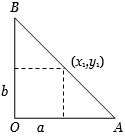
A line meets $x$-axis and y-axis at the points $A$ and $B$ respectively. If the middle point of $AB$ be $({x_1},\;{y_1}),$ then the equation of the line is
- ✓
${y_1}x + {x_1}y = 2{x_1}{y_1}$
- B
${x_1}x + {y_1}y = 2{x_1}{y_1}$
- C
${y_1}x + {x_1}y = {x_1}{y_1}$
- D
${x_1}x + {y_1}y = {x_1}{y_1}$
AnswerCorrect option: A. ${y_1}x + {x_1}y = 2{x_1}{y_1}$
a
(a) Obviously, ${x_1} = \frac{a}{2}$and ${y_1} = \frac{b}{2}$.
Therefore the equation of line $AB$ is $\frac{x}{a} + \frac{y}{b} = 1$
==> $\frac{x}{{2{x_1}}} + \frac{y}{{2{y_1}}} = 1 $
$\Rightarrow x{y_1} + y{x_1} = 2{x_1}{y_1}$.
View full question & answer→MCQ 61 Mark
The equations of the lines passing through the point $(1, 0)$ and at a distance $\frac{{\sqrt 3 }}{2}$ from the origin, are
- ✓
$\sqrt 3 x + y - \sqrt 3 = 0,\;\;\sqrt 3 x - y - \sqrt 3 = 0$
- B
$\sqrt 3 x + y + \sqrt 3 = 0,\;\;\sqrt 3 x - y + \sqrt 3 = 0$
- C
$x + \sqrt 3 y - \sqrt 3 = 0,\;\;x - \sqrt 3 y - \sqrt 3 = 0$
- D
AnswerCorrect option: A. $\sqrt 3 x + y - \sqrt 3 = 0,\;\;\sqrt 3 x - y - \sqrt 3 = 0$
a
(a) The equation of lines passing through $(1, 0)$ are given by $y = m(x - 1)$. Its distance from origin is $\frac{{\sqrt 3 }}{2}$.
$⇒$$\left| {\frac{{ - m}}{{\sqrt {1 + {m^2}} }}} \right| = \frac{{\sqrt 3 }}{2}$
$⇒$ $m = \pm \sqrt 3 $.
Hence the lines are $\sqrt 3 x + y - \sqrt 3 = 0$ and $\sqrt 3 x - y - \sqrt 3 = 0$.
View full question & answer→MCQ 71 Mark
The equation of line, which bisect the line joining two points $(2, -19)$ and $(6, 1)$ and perpendicular to the line joining two points $(-1, 3)$ and $(5, -1)$, is
- ✓
$3x - 2y = 30$
- B
$2x - y - 3 = 0$
- C
$2x + 3y = 20$
- D
AnswerCorrect option: A. $3x - 2y = 30$
a
(a) Mid point $ \equiv (4, - \,9);$ Slope $ = \frac{{ - 1}}{{\frac{{3 + 1}}{{ - 1 - 5}}}} = \frac{3}{2}$
Hence the required line is $3x - 2y = 30$.
View full question & answer→MCQ 81 Mark
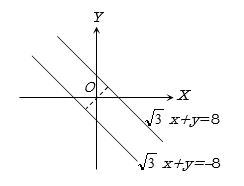
Equation of a straight line on which length of perpendicular from the origin is four units and the line makes an angle of ${120^o}$ with the $x$-axis, is
AnswerCorrect option: A. $x\sqrt 3 + y + 8 = 0$
a
(a) Slope $ = - \sqrt 3 $
$\therefore $ Line is $y = - \sqrt 3 x + c$
==> $\sqrt 3 x + y = c$
Now $\frac{c}{2} = |4|$
$\Rightarrow c = \pm {\rm{ }}8 $
$\Rightarrow x\sqrt 3 + y = \pm \,8$.
View full question & answer→MCQ 91 Mark
Equations of the two straight lines passing through the point $(3, 2)$ and making an angle of ${45^o}$ with the line $x - 2y = 3,$ are
- A
$3x + y + 7 = 0$ and $x + 3y + 9 = 0$
- ✓
$3x - y - 7 = 0$ and $x + 3y - 9 = 0$
- C
$x + 3y - 7 = 0$ and $x + 3y - 9 = 0$
- D
AnswerCorrect option: B. $3x - y - 7 = 0$ and $x + 3y - 9 = 0$
b
(b) Slope of given line is $\frac{1}{2}.$
Thus $\tan {45^o} = \pm \frac{{m - \frac{1}{2}}}{{1 + m.\frac{1}{2}}}$ ==> $m = \pm 3$.
Hence option $(b)$ is correct.
View full question & answer→MCQ 101 Mark
The equations of two lines through $(0,\;a)$ which are at distance ‘$a$’ from the point $(2a,\;2a)$ are
- A
$y - a = 0$ and $4x - 3y - 3a = 0$
- B
$y - a = 0$ and $3x - 4y + 3a = 0$
- ✓
$y - a = 0$ and $4x - 3y + 3a = 0$
- D
AnswerCorrect option: C. $y - a = 0$ and $4x - 3y + 3a = 0$
c
(c) Equation of any line through $(0,a)$is
$y - a = m{\rm{ }}(x - 0)$ or $mx - y + a = 0$ …..$(i)$
If the length of perpendicular from $(2a, 2a)$ to the line $(i)$ is ‘a’, then $a = \pm\frac{{m(2a) - 2a + a}}{{\sqrt {{m^2} + 1} }} \Rightarrow m = 0,\frac{4}{3}$.
Hence the required equations of lines are $y - a = 0$, $4x - 3y + 3a = 0$.
View full question & answer→MCQ 111 Mark
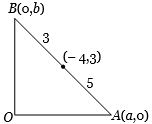
Equation of the line which passes through the point $( - 4,\;3)$ and the portion of the line intercepted between the axes is divided internally in the ratio $5 : 3$ by this point, is
- A
$9x + 20y + 96 = 0$
- B
$20x + 9y + 96 = 0$
- ✓
$9x - 20y + 96 = 0$
- D
AnswerCorrect option: C. $9x - 20y + 96 = 0$
c
(c) By the section formula, we get $a = - \frac{{32}}{3}$ and $b = \frac{{24}}{5}$. Hence the required equation is given by
$\frac{x}{{ - (32/3)}} + \frac{y}{{(24/5)}} = 1$
$ \Rightarrow 9x - 20y + 96 = 0$.
View full question & answer→MCQ 121 Mark
The equations of the lines through the origin making an angle of ${60^o}$ with the line $x + y\sqrt 3 + 3\sqrt 3 = 0$ are
- A
$y = 0,\;x - y\sqrt 3 = 0$
- ✓
$x = 0,\;x - y\sqrt 3 = 0$
- C
$x = 0,\;x + y\sqrt 3 = 0$
- D
$y = 0,\;x + y\sqrt 3 = 0$
AnswerCorrect option: B. $x = 0,\;x - y\sqrt 3 = 0$
b
(b) Since the line $x + y\sqrt 3 + 3\sqrt 3 = 0$makes an angle of ${150^o}$with $x$-axis.
Therefore, the required lines will make angles of ${90^o}$and ${210^o}$ i.e., ${30^o}$with the positive direction of $x$-axis.
Hence the lines are $x = 0$ and $y = \frac{1}{{\sqrt 3 }}x$.
View full question & answer→MCQ 131 Mark
The point $P\,(a,\;b)$ lies on the straight line $3x + 2y = 13$ and the point $Q\;(b,\;a)$ lies on the straight line $4x - y = 5,$ then the equation of line $PQ$ is
- A
$x - y = 5$
- ✓
$x + y = 5$
- C
$x + y = - \;5$
- D
$x - y = - \;5$
AnswerCorrect option: B. $x + y = 5$
b
(b) Point $P(a,b)$ is on $3x + 2y = 13$
So, $3a + 2b = 13$.....$(i)$
Point $Q(b,a)$is on $4x - y = 5$
So, $4b - a = 5$.....$(ii)$
By solving $(i)$ and $(ii)$, $a = 3,b = 2$
$P(a,b) \to (3,\,2)$and $Q(b,a) \to (2,\,3)$
Now, equation of $PQ$ $y - {y_1} = \frac{{{y_2} - {y_1}}}{{{x_2} - {x_1}}}(x - {x_1}) $
$\Rightarrow y - 2 = \frac{{3 - 2}}{{2 - 3}}(x - 3)$
==> $y - 2 = - (x - 3)$
$\Rightarrow x + y = 5$.
View full question & answer→MCQ 141 Mark
For what values of $a$ and $b$ the intercepts cut off on the coordinate axes by the line $ax + by + 8 = 0$ are equal in length but opposite in signs to those cut off by the line $2x - 3y + 6 = 0$ on the axes
- A
$a = \frac{8}{3},\;b = - \;4$
- B
$a = - \frac{8}{3},\;b = - \;4$
- C
$a = \frac{8}{3},\;b = 4$
- ✓
$a = - \frac{8}{3},\;b = 4$
AnswerCorrect option: D. $a = - \frac{8}{3},\;b = 4$
d
(d) The equation of lines in intercept form are $\frac{x}{{ - 8/a}} + \frac{y}{{ - 8/b}} = 1$ .....$(i)$
$\frac{x}{{ - 3}} + \frac{y}{2} = 1$....$.(ii)$
According to the condition, $ - \frac{8}{a} = - ( - 3)$
$ \Rightarrow a = - \frac{8}{3}$ and $ - \frac{8}{b} = - (2) \Rightarrow b = 4$.
View full question & answer→MCQ 151 Mark
The point of intersection of the lines $\frac{x}{a} + \frac{y}{b} = 1$ and $\frac{x}{b} + \frac{y}{a} = 1$ lies on the line
Answerd
(d) Intersection point of the line is $\left( {\frac{{ab}}{{a + b}},\frac{{ab}}{{a + b}}} \right)$, which is satisfying all the equations given in options $(a)$,$(b)$ and $ (c)$. Hence $(d)$ is correct.
View full question & answer→MCQ 161 Mark
The equations $(b - c)x + (c - a)y + (a - b) = 0$ and $({b^3} - {c^3})x + ({c^3} - {a^3})y + {a^3} - {b^3} = 0$ will represent the same line, if
- A
$b = c$
- B
$c = a$
- C
$a = b$
- ✓
Answerd
(d) The two lines will be identical if there exists some real number k such that
${b^3} - {c^3} = k(b - c),$ ${c^3} - {a^3} = k(c - a)$,${a^3} - {b^3} = k(a - b)$
==> $b - c = 0$or ${b^2} + {c^2} + bc = k$
==> $c - a = 0$or ${c^2} + {a^2} + ac = k$
==> $a - b = 0$or ${a^2} + {b^2} + ab = k$
==> $b = c,c = a,a = b$ or ${b^2} + {c^2} + bc = {c^2} + {a^2} + ca$
==> ${b^2} - {a^2} = c(a - b)$
$\Rightarrow b = a$ or $a + b + c = 0$.
View full question & answer→MCQ 171 Mark
The line which is parallel to $x$-axis and crosses the curve $y = \sqrt x $ at an angle of ${45^o}$ is equal to
- A
$x = \frac{1}{4}$
- B
$y = \frac{1}{4}$
- ✓
$y = \frac{1}{2}$
- D
$y = 1$
AnswerCorrect option: C. $y = \frac{1}{2}$
c
(c) Let the equation of line parallel to x-axis be
$y = \lambda $ .....$(i)$
Solving $(i)$ with the cuve $y = \sqrt x $ .....$(ii)$
We get $P({\lambda ^2},\,\,\lambda )$ the point of intersection at $P$
$\therefore $ Slope of $(ii)$ is, m= ${\left( {\frac{{dy}}{{dx}}} \right)_{{\rm{at }}P}} = \frac{1}{{2\lambda }}$
$\therefore $ $(i)$ and $(ii)$ intersect at $P$, at $45^\circ $
$\therefore $ ${\tan ^{ - 1}}\,\left( {\frac{{m - 0}}{{1 + m.0}}} \right) = \pm 45^\circ $.
==> $m = \left( {\frac{1}{{2\lambda }}} \right) = \pm \,1$ ==> $\lambda = \pm \,\frac{1}{2}$
$\therefore $ The equation of line is $y = \frac{1}{2}$ or $y = \frac{{ - 1}}{2}$ but $y = \frac{{ - 1}}{2}$ is not given, hence the required line is $y = \frac{1}{2}$.
View full question & answer→MCQ 181 Mark
In what ratio the line $y - x + 2 = 0$ divides the line joining the points $(3, -1)$ and $(8, 9)$
- A
$1 : 2$
- B
$2 : 1$
- ✓
$2 : 3$
- D
$3 : 4$
AnswerCorrect option: C. $2 : 3$
c
(c) Given, equation of line $y - x + 2 = 0$ and co-ordinates of points $({x_1},\,{y_1}) = (3,\, - 1)$ and $({x_2},\,{y_2}) = (8,\,9)$. We know that if the ratio in which a line $ax + by + c = 0$ is divided by points $({x_1},\,{y_1})$ and $({x_2},\,{y_2})$ is $\lambda :1$,
then intersecting point $\left( {\frac{{\lambda {x_2} + {x_1}}}{{\lambda + 1}},\,\frac{{\lambda {y_2} + {y_1}}}{{\lambda + 1}}} \right)$ lies on $ax + by + c = 0$.
Thus any point on the line joining $(3,\, - 1)$ and $(8,\,9)$ dividing it in the ratio $\lambda :1$ is $\left( {\frac{{8\lambda + 3}}{{\lambda + 1}},\,\frac{{9\lambda - 1}}{{\lambda + 1}}} \right)$ and if it lies on $y - x + 2 = 0,$ then $\frac{{9\lambda - 1}}{{\lambda + 1}} - \frac{{8\lambda + 3}}{{\lambda + 1}} + 2 = 0$
or $9\lambda - 1 - (8\lambda + 3) + 2(\lambda + 1) = 0$
or $3\lambda - 2 = 0,\,\lambda = \frac{2}{3}$ i.e. ratio is $2:3$.
View full question & answer→MCQ 191 Mark
The straight line passing through the point of intersection of the straight lines $x - 3y + 1 = 0$ and $2x + 5y - 9 = 0$ and having infinite slope and at a distance of $2\, units$ from the origin, has the equation
- ✓
$x = 2$
- B
$3x + y - 1 = 0$
- C
$y = 1$
- D
AnswerCorrect option: A. $x = 2$
a
(a) The intersection point of $x - 3y + 1 = 0$ and $2x + 5y - 9 = 0$ is $(2, 1)$ and $m = \frac{1}{0}$. So the required line is $y - 1 = \frac{1}{0}(x - 2) \Rightarrow x = 2$.
View full question & answer→MCQ 201 Mark
If straight lines $\alpha^2x + \alpha y = 9$ and $3x + 2y = 5$ are perpendicular, then the value of $\alpha$ is
AnswerCorrect option: A. $-2/3$
View full question & answer→MCQ 211 Mark
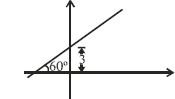
Graph is drawn between $y-x$ axis. Which of the following equation is correct for graph
- A
$y = - \sqrt 3 x + 3$
- ✓
$y = \sqrt 3 x + 3$
- C
$y = \sqrt 3 x - 3$
- D
$\sqrt 3 y = x + 3$
AnswerCorrect option: B. $y = \sqrt 3 x + 3$
View full question & answer→MCQ 221 Mark
If the coordinates of the vertices $ A, B, C$ of the triangle $ABC$ be $( - \;4,\;2),$ $(12,\; - 2)$ and $(8,\;6)$ respectively, then $\angle \;B$=
- A
${\tan ^{ - 1}}\left( { - \frac{6}{7}} \right)$
- B
${\tan ^{ - 1}}\left( {\frac{6}{7}} \right)$
- C
${\tan ^{ - 1}}\left( { - \frac{7}{6}} \right)$
- ✓
${\tan ^{ - 1}}\left( {\frac{7}{6}} \right)$
AnswerCorrect option: D. ${\tan ^{ - 1}}\left( {\frac{7}{6}} \right)$
d
(d) Here equation of $AB$ is $x + 4y - 4 = 0$ .....$(i)$
and equation of $BC$ is $2x + y - 22 = 0$.....$(ii)$
Thus angle between $(i)$ and $(ii)$ is given by
${\tan ^{ - 1}}\frac{{ - \frac{1}{4} + 2}}{{1 + \left( { - \frac{1}{4}} \right){\rm{ }}( - 2)}} = {\tan ^{ - 1}}\frac{7}{6}$.
View full question & answer→MCQ 231 Mark
If the lines $y = 3x + 1$ and $2y = x + 3$ are equally inclined to the line $y = mx + 4,$ then m =
- A
$\frac{{1 + 3\sqrt 2 }}{7}$
- B
$\frac{{1 - 3\sqrt 2 }}{7}$
- C
$\frac{{1 \pm 3\sqrt 2 }}{7}$
- ✓
$\frac{{1 \pm 5\sqrt 2 }}{7}$
AnswerCorrect option: D. $\frac{{1 \pm 5\sqrt 2 }}{7}$
d
(d) ${m_1} = 3,{m_2} = \frac{1}{2}$and ${m_3} = m$
Let the angle between first and third line is ${\theta _1}$and between second and third is ${\theta _2}$, then
$\tan {\theta _1} = \frac{{3 - m}}{{1 + 3m}}$ and $\tan {\theta _2} = \frac{{m - \frac{1}{2}}}{{1 + \frac{m}{2}}}$
But ${\theta _1} = {\theta _2} \Rightarrow \frac{{3 - m}}{{1 + 3m}} = \frac{{m - \frac{1}{2}}}{{1 + \frac{m}{2}}}$
==> $7{m^2} - 2m - 7 = 0$
==> $m = \frac{{1 \pm 5\sqrt 2 }}{7}$.
View full question & answer→MCQ 241 Mark
The ratio in which the line $3x + 4y + 2 = 0$ divides the distance between $3x + 4y + 5 = 0$ and $3x + 4y - 5 = 0$, is
AnswerCorrect option: B. $3 : 7$
b
(b)Lines $3x + 4y + 2 = 0$and $3x + 4y + 5 = 0$ are on the same side of the origin. The distance between these lines is ${d_1} = \left| {\frac{{2 - 5}}{{\sqrt {{3^2} + {4^2}} }}} \right| = \frac{3}{5}$.
Lines $3x + 4y + 2 = 0$ and $3x + 4y - 5 = 0$are on the opposite sides of the origin. The distance between these lines is ${d_2} = \left| {\frac{{2 + 5}}{{\sqrt {{3^2} + {4^2}} }}} \right| = \frac{7}{5}$.
Thus $3x + 4y + 2 = 0$ divides the distance between $3x + 4y + 5 = 0$ and $3x + 4y - 5 = 0$ in the ratio ${d_1}:{d_2}$ i.e., $3:7$.
View full question & answer→MCQ 251 Mark
A point equidistant from the lines $4x + 3y + 10 = 0$, $5x - 12y + 26 = 0$ and $7x + 24y - 50 = 0$ is
- A
$(1,\, - 1)$
- B
$(1,\,1)$
- ✓
$(0,0)$
- D
$(0,\,1)$
AnswerCorrect option: C. $(0,0)$
c
(c)Trick : Clearly, lengths of perpendicular from $(0,0)$ on the given lines are each equal to $2$.
View full question & answer→MCQ 261 Mark
$(\sin \theta ,\cos \theta )$ and $(3,\,2)$ lies on the same side of the line $x + y = 1$, then $\theta $ lies between
- A
$(0,\,\,\pi /2)$
- B
$(0,\,\pi )$
- C
$(\pi /4,\pi /2)$
- ✓
$(0,\,\,\pi /4)$
AnswerCorrect option: D. $(0,\,\,\pi /4)$
d
(d)As $(\sin \theta ,\cos \theta )$and (3, 2) lie on the same side of $x + y - 1 = 0$, they should be of same sign.
$\sin \theta + \cos \theta - 1 > $as $3 + 2 - 1 > 0$
==> $\sqrt 2 \sin \left( {\theta + \frac{\pi }{4}} \right) > 1$
==> $\sin \left( {\theta + \frac{\pi }{4}} \right) > \frac{1}{{\sqrt 2 }} $
$\Rightarrow 0 < \theta < \frac{\pi }{4}$.
View full question & answer→MCQ 271 Mark
Which pair of points lie on the same side of $3x - 8y - 7 = 0$
- A
$(0, -1)$ and $(0, 0)$
- B
$(4, -3)$ and $(0, 1)$
- C
$(-3, -4)$ and $(1, 2)$
- ✓
$(-1, -1)$ and $(3, 7)$
AnswerCorrect option: D. $(-1, -1)$ and $(3, 7)$
d
(d) ${L_{( - 1, - 1)}} = 3( - 1) - 8( - 1) - 7 < 0$
${L_{(3,7)}} = 3 \times 3 - 8 \times 7 - 7 < 0$
Hence $(-1, -1)$ and $(3, 7)$ lie on the same side of line.
View full question & answer→MCQ 281 Mark
Let $\alpha $ be the distance between the lines $ - x + y = 2$ and $x - y = 2$, and $\beta $ be the distance between the lines $4x - 3y = 5$ and $6y - 8x = 1$, then
- ✓
$20\sqrt 2 \beta = 11\alpha $
- B
$20\sqrt 2 \alpha = 11\beta $
- C
$11\sqrt 2 \beta = 20\alpha $
- D
AnswerCorrect option: A. $20\sqrt 2 \beta = 11\alpha $
a
(a) Distance between lines $ - x + y = 2$ and $x - y = 2$ is , $\alpha = \frac{2}{{\sqrt 2 }} + \frac{2}{{\sqrt 2 }} = 2\sqrt 2 $
Distance between lines $4x - 3y = 5$ and $6y - 8x = 1$ is,
$\beta = \frac{1}{{10}} + \frac{5}{5} = \frac{{11}}{{10}}$
Therefore $\frac{\alpha }{\beta } = \frac{{2\sqrt 2 }}{{11/10}} \Rightarrow 20\sqrt 2 \beta = 11\alpha $.
View full question & answer→MCQ 291 Mark
If $a$ and $b$ are two arbitrary constants, then the straight line $(a - 2b)x + (a + 3b)y + 3a + 4b = 0$ will pass through
- ✓
$( - 1,\; - 2)$
- B
$(1, 2)$
- C
$( - 2,\; - 3)$
- D
$(2, 3)$
AnswerCorrect option: A. $( - 1,\; - 2)$
a
(a) $(a - 2b)x + (a + 3b)y + 3a + 4b = 0$
or $a{\rm{ }}(x + y + 3) + b{\rm{ }}( - 2x + 3y + 4) = 0$, which represents a family of straight lines through point of intersection of $x + y + 3 = 0$ and $ - 2x + 3y + 4 = 0 $i.e $, (-1, -2).$
Trick :Point $(-1, -2)$ satisfies the given equation of straight line.
View full question & answer→MCQ 301 Mark
If the lines $ax + 2y + 1 = 0,bx + 3y + 1 = 0$ and $cx + 4y + 1 = 0$ are concurrent, then $a, \,b, \,c$ are in
AnswerCorrect option: A. $A. P.$
a
(a) It is given that the lines $ax + 2y + 1 = 0$, $bx + 3y + 1 = 0$ and $cx + 4y + 1 = 0$ are concurrent, therefore $\left| {\,\begin{array}{*{20}{c}}a&2&1\\b&3&1\\c&4&1\end{array}\,} \right| = 0$
==> $ - a + 2b - c = 0 $.
$\Rightarrow 2b = a + c$
==> $a,b,c$ are in $A. P.$
View full question & answer→MCQ 311 Mark
The solution of equations $x + y = 10,2x + y = 18$ and $4x - 3y = 26$ will be
Answera
(a) $x + y = 10$.....$(i)$
$2x + y = 18$.....$(ii)$
and $4x - 3y = 26$....$(iii)$
are equations of three lines respectively
Solving of equation $(i)$ and $(ii)$, we get $x = 8$ and $y = 2$
Put the values of $x$ and $y$ in equation $(iii)$,
L.H.S $ = 4x - 2y$ $ = 4 \times 8 - 3 \times 2$ $ = 32 - 6$= 26 = R.H.S.
$\therefore $ Point $(8,2)$ lies on line $4x - 3y = 26$, so these three lines are concurrent. Hence, these three equations have one and only one solution.
View full question & answer→MCQ 321 Mark
The equation of the line joining the point $(3, 5)$ to the point of intersection of the lines $4x + y - 1 = 0$ and $7x - 3y - 35 = 0$ is equidistant from the points $(0, 0)$ and $(8, 34)$
Answera
(a) By $P + \lambda Q = 0$, the required line is $12x - y - 31 = 0$ and its distance from both the points is $\frac{{31}}{{\sqrt {145} }}$.
View full question & answer→MCQ 331 Mark
The coordinates of the foot of the perpendicular from the point $(2, 3)$ on the line $y = 3x + 4$ are given by
- A
$\left( {\frac{{37}}{{10}}, - \frac{1}{{10}}} \right)$
- ✓
$\left( { - \frac{1}{{10}},\frac{{37}}{{10}}} \right)$
- C
$\left( {\frac{{10}}{{37}}, - 10} \right)$
- D
$\left( {\frac{2}{3}, - \frac{1}{3}} \right)$
AnswerCorrect option: B. $\left( { - \frac{1}{{10}},\frac{{37}}{{10}}} \right)$
b
(b)$ - y + 3x + 4 = 0$and perpendicular is $\frac{{y - 3}}{{x - 2}} = \frac{{ - 1}}{3}$ or $3y + x - 11 = 0$. Therefore foot is $x = \frac{{ - 1}}{{10}},y = \frac{{37}}{{10}}$.
View full question & answer→MCQ 341 Mark
The coordinates of the foot of the perpendicular from $({x_1},{y_1})$to the line $ax + by + c = 0$ are
- ✓
$\left( {\frac{{{b^2}{x_1} - ab{y_1} - ac}}{{{a^2} + {b^2}}},\frac{{{a^2}{y_1} - ab{x_1} - bc}}{{{a^2} + {b^2}}}} \right)$
- B
$\left( {\frac{{{b^2}{x_1} + ab{y_1} + ac}}{{{a^2} + {b^2}}},\frac{{{a^2}{y_1} + ab{x_1} + bc}}{{{a^2} + {b^2}}}} \right)$
- C
$\left( {\frac{{a{x_1} + b{y_1} + ab}}{{a + b}},\frac{{a{x_1} - b{y_1} - ab}}{{a + b}}} \right)$
- D
AnswerCorrect option: A. $\left( {\frac{{{b^2}{x_1} - ab{y_1} - ac}}{{{a^2} + {b^2}}},\frac{{{a^2}{y_1} - ab{x_1} - bc}}{{{a^2} + {b^2}}}} \right)$
a
(a)It is a fundamental concept.
View full question & answer→MCQ 351 Mark
The foot of the coordinates drawn from $(2, 4)$ to the line $x + y = 1$ is
- A
$\left( {\frac{1}{3},\frac{3}{2}} \right)$
- ✓
$\left( { - \frac{1}{2},\frac{3}{2}} \right)$
- C
$\left( {\frac{4}{3},\frac{1}{2}} \right)$
- D
$\left( {\frac{3}{4},\,\, - \frac{1}{2}} \right)$
AnswerCorrect option: B. $\left( { - \frac{1}{2},\frac{3}{2}} \right)$
b
(b) Applying the formula, the required foot is
$\left( {\frac{{{1^2} \times 2 - 1 \times 1 \times 4 + 1}}{{{1^2} + {1^2}}},\frac{{{1^2} \times 4 - 1 \times 1 \times 2 + 1}}{{{1^2} + {1^2}}}} \right) = \,\left( { - \frac{1}{2},\frac{3}{2}} \right)$.
Trick : Here, in options only point $\left( { - \frac{1}{2},\frac{3}{2}} \right)$ is satisfying the given equation of line.
View full question & answer→MCQ 361 Mark
The co-ordinates of the foot of perpendicular from the point $(2, 3)$ on the line $x + y - 11 = 0$are
- A
$( - 6,\,5)$
- ✓
$(5,\,6)$
- C
$( - 5,\,6)$
- D
$(6,\,5)$
AnswerCorrect option: B. $(5,\,6)$
b
(b) Equation of perpendicular on the line $x + y - 11 = 0$ is $x - y + \lambda = 0$, but it passes through $(2, 3)$, so $\lambda = 1$.
Equation of perpendicular is $x - y + 1 = 0$. Now the coordinates of the foot of the perpendicular are the intersection point of the lines, hence point is $(5, 6)$.
Aliter : Apply the formula given in the theory part of this book, we get required foot as
$\left( {\frac{{{1^2} \times 2 - 1 \times 1 \times 3 - 1 \times ( - 11)}}{{{1^2} + {1^2}}},\frac{{{1^2} \times 3 - 1 \times 1 \times 2 - 1( - 11)}}{{{1^2} + {1^2}}}} \right)$
$ = \left( {\frac{{2 - 3 + 11}}{2},\frac{{3 - 2 + 11}}{2}} \right) = (5,\,6)$.
View full question & answer→MCQ 371 Mark
The image of a point $A(3,\,8)$ in the line $x + 3y - 7 = 0$, is
- ✓
$( - 1, - 4)$
- B
$( - 3\,,\,\, - 8)$
- C
$(1, - 4)$
- D
$(3,\,8)$
AnswerCorrect option: A. $( - 1, - 4)$
a
(a) Equation of the line passing through $(3, 8)$ and perpendicular to $x + 3y - 7 = 0$is $3x - y - 1 = 0$. The intersection point of both the lines is $(1, 2)$.
Now let the image of $A(3,8)$ be $A'({x_1},{y_1}),$then point $(1, 2)$ will be the mid point of $AA'$.
==> $\frac{{{x_1} + 3}}{2} = 1$
$\Rightarrow {x_1} = - 1$ and $\frac{{{y_1} + 8}}{2} = 2$
==> ${y_1} = - 4$.
Hence the image is $(-1, -4)$.
View full question & answer→MCQ 381 Mark
The reflection of the point $(4,-13)$ in the line $5x + y + 6 = 0$ is
- ✓
$( - 1, - 14)$
- B
$(3 ,4)$
- C
$(1, 2)$
- D
$(-4, 13)$
AnswerCorrect option: A. $( - 1, - 14)$
a
(a) Let $Q(a,b)$ be the reflection of $P(4, - 13)$ in the line $5x + y + 6 = 0$.
Then the mid-point $R{\rm{ }}\left( {\frac{{a + 4}}{2},\frac{{b - 13}}{2}} \right)$ lies on $5x + y + 6 = 0$.
$5\left( {\frac{{a + 4}}{2}} \right) + \frac{{b - 13}}{2} + 6 = 0$
$\Rightarrow 5a + b + 19 = 0$ ......$(i)$
Also $PQ$is perpendicular to $5x + y + 6 = 0$.
Therefore $\frac{{b + 13}}{{a - 4}} \times \left( { - \frac{5}{1}} \right) = - 1$
$\Rightarrow a - 5b - 69 = 0$ .....$(ii)$
Solving $(i)$ and $(ii)$, we get $a = - 1,\,\,b = - 14$.
View full question & answer→MCQ 391 Mark
If $(-2, 6)$ is the image of the point $(4, 2)$ with respect to line $L = 0$, then $ L =$
- ✓
$3x -2y + 5$
- B
$3x -2y + 10$
- C
$2x + 3y -5$
- D
$6x -4y -7$
AnswerCorrect option: A. $3x -2y + 5$
a
(a) The mid point of $P( - 2,\,6)$ and $Q(4,\,2)$ is $\left( {\frac{{ - 2 + 4}}{2},\,\frac{{6 + 2}}{2}} \right)$ i.e., $(1,\,4)$ and the gradient of line
$PQ = \frac{{2 - 6}}{{4 + 2}} = \frac{{ - 2}}{3}$
The slope of $L = \frac{3}{2}$
Hence the equation of line which passes through point $(1,\,4)$ is $y - 4 = \frac{3}{2}(x - 1)$
==> $3x - 2y + 5 = 0$ .
View full question & answer→MCQ 401 Mark
A straight line passes through a fixed point $(h,k)$. The locus of the foot of perpendicular on it drawn from the origin is
- ✓
${x^2} + {y^2} - hx - ky = 0$
- B
${x^2} + {y^2} + hx + ky = 0$
- C
$3{x^2} + 3{y^2} + hx - ky = 0$
- D
AnswerCorrect option: A. ${x^2} + {y^2} - hx - ky = 0$
a
(a) $y - k = m{\rm{ }}(x - h)$ and $y - 0 = - \frac{1}{m}(x - 0)$. Eliminate $m$ and replace $(h,k)$ by $(x,\,y)$, we get
${x^2} + {y^2} - hx - ky = 0$, which is the required locus of the point.
View full question & answer→MCQ 411 Mark
The image of the point $(4, \,-3)$ with respect to the line $y = x$ is
- A
$(-4, \,-3)$
- B
$(3, \,4)$
- C
$(-4,\, 3)$
- ✓
$(-3, \,4)$
AnswerCorrect option: D. $(-3, \,4)$
d
The image of $(4,-3)$ w.r.t. the line mirror $x=y$ is $(-3,4)$ (When $(x, y)$ is reflected in $x=y$, we get $(y, x)$
View full question & answer→MCQ 421 Mark
If the coordinates of the points $A,\, B,\, C$ be $(-1, 5),\, (0, 0)$ and $(2, 2)$ respectively and $D$ be the middle point of $BC$, then the equation of the perpendicular drawn from $B$ to the line $AD$ is
- A
$x + 2y = 0$
- B
$2x + y = 0$
- ✓
$x - 2y = 0$
- D
$2x - y = 0$
AnswerCorrect option: C. $x - 2y = 0$
c
(c) Here $D(1, 1)$ therefore equation of line $AD$ is given by $2x + y - 3 = 0$. Thus the line perpendicular to $AD$ is $x - 2y + k = 0$and it passes through $B$, so $k = 0$. Hence required equation is $x - 2y = 0$.
View full question & answer→MCQ 431 Mark
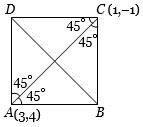
The opposite angular points of a square are $(3,\;4)$ and $(1,\; - \;1)$. Then the co-ordinates of other two points are
- A
$D\,\left( {\frac{1}{2},\,\,\frac{9}{2}} \right)\,,\,\,B\,\left( { - \frac{1}{2},\,\,\frac{5}{2}} \right)$
- B
$D\,\left( {\frac{1}{2},\,\,\frac{9}{2}} \right)\,,\,\,B\,\left( {\frac{1}{2},\,\,\frac{5}{2}} \right)$
- ✓
$D\,\left( {\frac{9}{2},\,\,\frac{1}{2}} \right)\,,\,\,B\,\left( { - \frac{1}{2},\,\,\frac{5}{2}} \right)$
- D
AnswerCorrect option: C. $D\,\left( {\frac{9}{2},\,\,\frac{1}{2}} \right)\,,\,\,B\,\left( { - \frac{1}{2},\,\,\frac{5}{2}} \right)$
c
(c) Obviously, slope of $AC = 5/2$.
Let m be the slope of a line inclined at an angle of ${45^o}$ to $AC$, then $\tan {45^o} = \pm \frac{{m - \frac{5}{2}}}{{1 + m.\frac{5}{2}}} \Rightarrow m = - \frac{7}{3},\frac{3}{7}$.
Thus, let the slope of $AB$ or $DC$ be $3/7$ and that of $AD$ or $BC$ be $ - \frac{7}{3}$ . Then equation of $AB$ is $3x - 7y + 19 = 0$.
Also the equation of $BC$ is $7x + 3y - 4 = 0$.
On solving these equations, we get, $B\,\,\,\left( { - \frac{1}{2},\frac{5}{2}} \right)$.
Now let the coordinates of the vertex $D$ be $(h, k)$. Since the middle points of $AC$ and $BD$ are same,
therefore $\frac{1}{2}\left( {h - \frac{1}{2}} \right)\, = \frac{1}{2}(3 + 1) \Rightarrow h = \frac{9}{2}$, $\frac{1}{2}\left( {k + \frac{5}{2}} \right) = \frac{1}{2}(4 - 1)$
==> $k = \frac{1}{2}$. Hence, $D = \left( {\frac{9}{2},\,\frac{1}{2}} \right)$.
View full question & answer→MCQ 441 Mark
The equation of the lines on which the perpendiculars from the origin make ${30^o}$ angle with $x$-axis and which form a triangle of area $\frac{{50}}{{\sqrt 3 }}$ with axes, are
- A
$x + \sqrt 3 y \pm 10 = 0$
- ✓
$\sqrt 3 x + y \pm 10 = 0$
- C
$x \pm \sqrt 3 y - 10 = 0$
- D
AnswerCorrect option: B. $\sqrt 3 x + y \pm 10 = 0$
b
(b) Let $p$ be the length of the perpendicular from the origin on the given line. Then its equation in normal form is $x\cos {30^o} + y\sin {30^o} = p$ or $\sqrt 3 x + y = 2p$
This meets the coordinate axes at $A\left( {\frac{{2p}}{{\sqrt 3 }},0} \right)$ and $B(0,\,2p)$.
Area of $\Delta OAB = \frac{1}{2}\left( {\frac{{2p}}{{\sqrt 3 }}} \right){\rm{ }}2p = \frac{{2{p^2}}}{{\sqrt 3 }}$
By hypothesis $\frac{{2{p^2}}}{{\sqrt 3 }} = \frac{{50}}{{\sqrt 3 }} \Rightarrow p = \pm 5$.
Hence the lines are $\sqrt 3 x + y \pm 10 = 0$.
View full question & answer→MCQ 451 Mark
The base $BC$ of a triangle $ABC$ is bisected at the point $(p, q)$ and the equations to the sides $AB$ and $AC$ are respectively $px+qy= 1$ and $qx + py = 1.$ Then the equation to the median through $A$ is
- ✓
$(2pq - 1)(px + qy - 1) = ({p^2} + {q^2} - 1)(qx + py - 1)$
- B
$({p^2} + {q^2} - 1)(px + qy - 1) = (2p - 1)(qx + py - 1)$
- C
$(pq - 1)(px + qy - 1) = ({p^2} + {q^2} - 1)(qx + py - 1)$
- D
AnswerCorrect option: A. $(2pq - 1)(px + qy - 1) = ({p^2} + {q^2} - 1)(qx + py - 1)$
a
(a) Since the median passes through $A$, the intersection of the given lines. Its equation is given by $(px + qy - 1) + \lambda (qx + py - 1) = 0$, where $\lambda $ is some real number. Also, since the median passes through the point $(p, q)$, we have $({p^2} + {q^2} - 1) + \lambda (qp + pq - 1) = 0$
==> $\lambda = - \frac{{{p^2} + {q^2} - 1}}{{2pq - 1}}$ and the equation of median through $A$ is $(px + qy - 1) - \frac{{{p^2} + {q^2} - 1}}{{2pq - 1}}(qx + py - 1) = 0$
==> $(2pq - 1)(px + qy - 1) = ({p^2} + {q^2} - 1)(qx + py - 1)$.
View full question & answer→MCQ 461 Mark
The equation of the line which makes right angled triangle with axes whose area is $6$ sq. units and whose hypotenuse is of $5$ units, is
- ✓
$\frac{x}{4} + \frac{y}{3} = \pm \;1$
- B
$\frac{x}{4} - \frac{y}{3} = \pm \;3$
- C
$\frac{x}{6} + \frac{y}{1} = \pm \;1$
- D
$\frac{x}{1} - \frac{y}{6} = \pm \;1$
AnswerCorrect option: A. $\frac{x}{4} + \frac{y}{3} = \pm \;1$
a
(a) If the line is $\frac{x}{a} + \frac{y}{b} = 1$, then the intercepts on the axes are $a$ and $b$.
Therefore the area is $\frac{1}{2}|a \times b| = 6 \Rightarrow |ab| = 12$ …..$(i)$
and hypotenuse is $5$, therefore ${a^2} + {b^2} = 25$ …..$(ii)$
On solving $(i)$ and $(ii)$, we get
$a = \pm 4$or $ \pm 3$and $b = \pm 3$or $ \pm 4$
Hence equation of line is $ \pm \frac{x}{4} \pm \frac{y}{3} = 1$or $ \pm \frac{x}{3} \pm \frac{y}{4} = 1$.
Trick: Check with options. Obviously, the line $\frac{x}{4} + \frac{y}{3} = \pm 1$ satisfies both the conditions.
View full question & answer→MCQ 471 Mark
$A(-1, 1)$, $B(5, 3)$ are opposite vertices of a square in $xy$-plane. The equation of the other diagonal (not passing through $(A, B)$ of the square is given by
- A
$x - 3y + 4 = 0$
- B
$2x - y + 3 = 0$
- ✓
$y + 3x - 8 = 0$
- D
$x + 2y - 1 = 0$
AnswerCorrect option: C. $y + 3x - 8 = 0$
c
(c) The required diagonal passes through the mid-point of $AB$ and is perpendicular to $AB$. So its equation is $y - 2 = - 3(x - 2)$ or $3x + y - 8 = 0$.
View full question & answer→MCQ 481 Mark
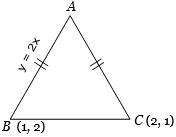
In an isosceles triangle $ABC$, the coordinates of the points $B$ and $C$ on the base $BC$ are respectively $(1, 2)$ and $(2, 1)$. If the equation of the line $AB$ is $y = 2x$, then the equation of the line $AC$ is
- A
$y = \frac{1}{2}(x - 1)$
- ✓
$y = \frac{x}{2}$
- C
$y = x - 1$
- D
$2y = x + 3$
AnswerCorrect option: B. $y = \frac{x}{2}$
b
(b) $\angle ABC = \tan \theta = \frac{{\frac{1}{2} - 1}}{{1 + \frac{1}{2}}} = - \frac{1}{3}$ (Here ${m_1} = \frac{1}{2},\,{m_2} = 1)$
$AB = AC$; $\angle ABC = \angle ACB$
Hence $ - \frac{1}{3} = \frac{{m - 1}}{{1 + m}}$ ==> $m = \frac{1}{2}$
(Here m is the gradient of line $AC$)
Equation of line AC is,$y - 1 = \frac{1}{2}(x - 2)$ ==> $y = \frac{x}{2}$.
View full question & answer→MCQ 491 Mark
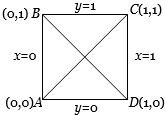
Equations of diagonals of square formed by lines $x = 0,$ $y = 0,$$x = 1$ and $y = 1$are
AnswerCorrect option: A. $y = x,\;y + x = 1$
a
(a)Co-ordinates of the vertices of the square are $A(0,\,0),$ $B(0,\,1),$ $C(1,\,1)$ and $D(0,\,1)$.
Now the equation of $AC$ is $y = x$ and of $BD$ is $y - 1 = - \frac{1}{1}(x - 0)$ $ \Rightarrow x + y = 1$.
View full question & answer→MCQ 501 Mark
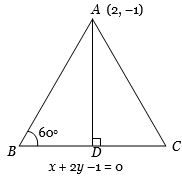
The vertex of an equilateral triangle is $(2,-1)$ and the equation of its base in $x + 2y = 1$. The length of its sides is
- A
$4/\sqrt {15} $
- ✓
$2/\sqrt {15} $
- C
$4/3\sqrt 3 $
- D
$1/\sqrt 5 $
AnswerCorrect option: B. $2/\sqrt {15} $
b
(b) $|AD|\, = \left| {\frac{{2 - 2 - 1}}{{\sqrt {{1^2} + {2^2}} }}} \right| = \frac{1}{{\sqrt 5 }}$
$\tan 60^\circ = \frac{{AD}}{{BD}}$
==> $\sqrt 3 = \frac{{1\,/\sqrt 5 }}{{BD}}$
==> $BD = \frac{1}{{\sqrt {15} }}$
$BC = 2BD = 2\,/\sqrt {15} $.
View full question & answer→