MCQ
Let there be a spherically symmetric charge distribution with charge density varying as $\rho (r)=\;\rho _0\left( {\frac{5}{4} - \frac{r}{R}} \right)$, upto $r = R$ ,and $\rho (r) = 0$ for $r > R$ , where $r$ is the distance from the origin. The electric field at a distance $r(r < R)$ from the origin is given by
  • A
    $\frac{{{\rho _o}r}}{{3{\varepsilon _0}}}\;\left( {\frac{5}{4} - \frac{r}{R}} \right)\;\;\;\;\;\;$
  • B
    $\frac{{4\pi {\rho _0r}}}{{3{\varepsilon _0}}}\;\left( {\frac{5}{3} - \frac{r}{R}} \right)$
  • $\frac{{{\rho _o}r}}{{4{\varepsilon _0}}}\;\left( {\frac{5}{3} - \frac{r}{R}} \right)$
  • D
    $\frac{{4\pi {\rho _0r}}}{{3{\varepsilon _0}}}\;\left( {\frac{5}{4} - \frac{r}{R}} \right)$
Answer

Correct option: C.
$\frac{{{\rho _o}r}}{{4{\varepsilon _0}}}\;\left( {\frac{5}{3} - \frac{r}{R}} \right)$
c
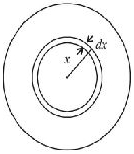
Let us consider a spherical shell of radius $x$ and thickness $dx$

Charge on this shell

$d q=\rho \cdot 4 \pi x^{2} d x=\rho_{0}\left(\frac{5}{4}-\frac{x}{R}\right) .4 \pi x^{2} d x$

$\therefore$ Total charge in the spherical region from centre to $r$ $(r < R)$ is

$q=\int d q=4 \pi \rho_{0} \int_{0}^{r}\left(\frac{5}{4}-\frac{x}{R}\right) x^{2} d x$

$=4 \pi \rho_{0}\left[\frac{5}{4} \cdot \frac{r^{3}}{3}-\frac{1}{R} \cdot \frac{r^{4}}{4}\right]=\pi \rho_{0} r^{3}\left(\frac{5}{3}-\frac{r}{R}\right)$

Electric field at $r, E=\frac{1}{4 \pi \in_{0}} \cdot \frac{q}{r^{2}}$

$=\frac{1}{4 \pi \in_{0}} \cdot \frac{\pi \rho_{0} r^{3}}{r^{2}}\left(\frac{5}{3}-\frac{r}{R}\right)=\frac{\rho_{0} r}{4 \in_{0}}\left(\frac{5}{3}-\frac{r}{R}\right)$

Need a full question paper?

Generate a complete, print-ready paper with questions like this in minutes — across 16+ boards, with answer keys.

Start Generating Free

Similar questions

A barometer kept in an elevator reads 76cm when it is at rest. If the elevator goes up with increasing speed, the reading will be:
As shown in the figure a metal rod makes contact and complete the circuit. The circuit is perpendicular to the magnetic field with B = 0.15 tesla. If the resistance is 3Ω, force needed to move the rod as indicated with a constant speed of 2m/sec is
A $5.0\, \mu F$ capacitor is charged to a potential difference $800\, V$ and discharged through a conductor. The energy(in $J$) given to a conductor during the discharge is
C and Si both have the same lattice structure, having 4 bonding electrons in each. However, C is an insulator whereas Si is an intrinsic semiconductor. This is because
A. In case of C the valence band is not completely filled at absolute zero temperature.
B. In case of C the conduction band is partly filled even at absolute zero temperature.
C. The four bonding electrons in the case of C lie in the second orbit, whereas in the case of Si they lie in the third.
D. The four bonding electrons in the case of C lie in the third orbit, whereas for Si they lie in the fourth orbit.
A radio-isotope has a half- life of 5 years. The fraction of the atoms of this material that would decay in 15 years will be
A light ray incident normally on one face of an equilateral prism and emerges out grazingly at the other face. The refractive index of the prism is
Which of the following phenomena can explain quantum nature of light
If a current is passed through a spring then the spring will:
The critical angle between an equilateral prism and air is $45^o $. If the incident ray is perpendicular to the refracting surface, then
The radius of the smallest electron orbit in hydrogen-like ion is $(0.51\times10^{-10}/4)$ $metre$ ; then it is