MCQ
Let $V$ and $E$ are potential and electric field intensity at a point then
  • A
    if $V = 0$ then $E$ must be zero
  • B
    if $V  \ne  0$ then $E$ can not be zero
  • C
    if $E \ne 0$ then $V$ can not be zero
  • if $V = 0$ then $E$ may be zero

Answer

Correct option: D.
if $V = 0$ then $E$ may be zero
d
if $v = 0\, E$ may or may not be zero
if $E = 0\, v$ may or may not be zero

Need a full question paper?

Generate a complete, print-ready paper with questions like this in minutes — across 16+ boards, with answer keys.
Start Generating Free

Similar questions

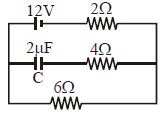
Find the charge on the capacitor $C$ in the following circuit ............. $\mu C$
Assume a hypothetical wire in which free electron density changes with temperature in proportionality $n\ \alpha \ T$ assuming $\tau $(Relaxation time of collision) and dimensions of wire remain unchanged with increasing temperature. Which one of the resistance $v/s$ temperature graph is true
A giant refracting telescope at an observatory has an objective lens of focal length $15\,m$. If an eye piece of focal length $1.0\,cm$ is used what is the angular magnification of telescope ?
A hydrogen atom in is ground state absorbs $10.2\;eV$ of energy. The angular momentum of electron of the hydrogen atom will increase by the value of ............... $\times 10^{-34} \; J {s}$ (Given, Plank's constant $\left.=6.6 \times 10^{-34} Js \right)$
$5 \%$ of the power of $100\, W$ bulb is converted to visible radiation. Average intensity of visible radiation at a distance of $10 \,m$ from the bulb is .......... $watt / m ^2$
A copper wire of length 1 m and radius 1 mm is joined in series with an iron wire of length 2 m and radius 3 mm and a current is passed through the wires. The ratio of the current density in the copper and iron wires is
The self produced $emf$ of a coil is $25\,volts$. When the current in it is changed at uniform rate from $10\,A$ to $25\, A$ in $1\,s$, the change in the energy of the inductance is......$J$
Ratio of thermal energy released in two resistor $R$ and $3 R$ connected in parallel in an electric circuit is :
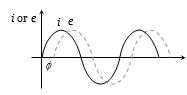
When an ac source of $e.m.f$. $e = {E_0}$$\sin (100\,t)$ is connected across a circuit, the phase difference between the $e.m.f$. $e$ and the current $i$ in the circuit is observed to be $\pi /4$, as shown in the diagram. If the circuit consists possibly only of $RC$ or $LC$ in series, find the relationship between the two elements
Two electrons are moving with non-relativistic speeds perpendicular to each other. If corresponding de Broglie wavelengths are ${\lambda _1}$ and ${\lambda _2}$, their de Broglie wavelength in the frame of reference attached to their centre of mass is