MCQ
Let $\vec{a}$ be a unit vector and $\vec{b}$ is a nonzero vector not parallel to $\vec{a}$ . The angles of the triangle, two of whose sides are represented by $\sqrt 3 (\vec{a} \times \vec{b} )$ and $\vec{b} - (\vec{a} . \vec{b}) \vec{a}$ are
  • A
    $\frac{\pi }{4}$ , $\frac{\pi }{4}$ , $\frac{\pi }{2}$
  • B
    $\frac{\pi }{4}$ , $\frac{\pi }{3}$ , $\frac{5\pi }{12}$
  • $\frac{\pi }{6}$ , $\frac{\pi }{3}$ , $\frac{\pi }{2}$
  • D
    $\frac{\pi }{3}$ , $\frac{\pi }{3}$ , $\frac{\pi }{3}$
Answer

Correct option: C.
$\frac{\pi }{6}$ , $\frac{\pi }{3}$ , $\frac{\pi }{2}$
c
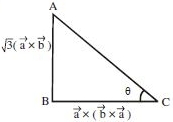
$\vec b - (\vec a \cdot \vec b)\vec a = (\vec a \cdot \vec a)\vec b - (\vec a \cdot \vec b)\vec a = \vec a \times (\vec b \times \vec a)$

here $\vec a \times \vec b \bot \vec a \times (\vec b \times \vec a)$

$\angle \mathrm{ABC}=90^{\circ}$

$\tan \theta  = \frac{{\sqrt 3 |\vec a \times \vec b|}}{{|\vec a||\vec b \times \vec a|}} = \sqrt 3 $

$\theta=\pi / 3$

$\angle \mathrm{ABC}=\pi / 2: \angle \mathrm{BAC}=\pi / 6$

$\angle \mathrm{ACB}=\pi / 3$

Need a full question paper?

Generate a complete, print-ready paper with questions like this in minutes — across 16+ boards, with answer keys.

Start Generating Free

Similar questions

A random variable $X$ has the following probability distribution:
$X:$ $1$ $2$ $3$ $4$ $5$ $6$ $7$ $8$
$P(X):$ $0.15$ $0.23$ $0.12$ $0.10$ $0.20$ $0.08$ $0.07$ $0.05$
Find the events $E = \{X : X$ is a prime number$\}, F\{X :X < 4\},$ the probability $\text{P}(\text{E}\cup\text{F})$ is:
If $p, q, r$ are $3$ real numbers satisfying the matrix equation, $[p\,q\,r]\,\left[ {\begin{array}{*{20}{c}}
3&4&1\\
3&2&3\\
2&0&2
\end{array}} \right] = [3\,\,\,0\,\,\,1]$ then $2p + q - r$ equals
If $A = \left[ {\begin{array}{*{20}{c}}1&0&1\\2&1&0\\3&2&1\end{array}} \right],$then $\det A$=
Solution of $\cos x\frac{{dy}}{{dx}} + y\sin x = 1$ is
If $f(x)$ defind by $\text{f(x)}=\begin{cases}\frac{|\text{x}^2-\text{x}|}{\text{x}^2-\text{x}},&\text{x}\neq0,1\\1,&\text{x}=0\\-1,&\text{x}=1\end{cases}$ then $f(x)$ is continuse for all :
Solution of differential equation x dy - yx = 0 represents:
Let $S$ be the set of real numbers $p$ such that there is no non-zero continuous function $f: R \rightarrow R$ satisfying $\int_0^x f(t) d t=p f(x)$ for all $x \in R$. Then, $S$ is
Two points are randomly chosen on the circumference of a circle of radius $r$. The probability that the distance between the two points is at least $r$ is equal to
$\int_{}^{} {\frac{{\sin x\;dx}}{{{a^2} + {b^2}{{\cos }^2}x}}} = $
In a class, 40% of the students study math and science. 60% of the students study math. What is the probability of a student studying science given he/she is already studying math?