MCQ
Let $y$ be the function which passes through $(1, 2)$ having slope $(2x + 1)$. The area bounded between the curve and $x -$ axis is
  • A
    $6\,\, sq. \,unit$
  • B
    $5/6\,\, sq. \,unit$
  • $1/6\,\, sq. \,unit$
  • D
    None of these

Answer

Correct option: C.
$1/6\,\, sq. \,unit$
c
(c) $\frac{{dy}}{{dx}} = 2x + 1$ 

==> $y = {x^2} + x + c$

==> $y = {x^2} + x$, [ $\because$ $c = 0$ by putting $x = 1, y = 2$)

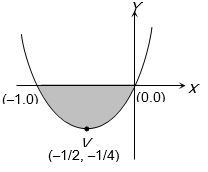
==> ${\left( {x + \frac{1}{2}} \right)^2} = y + \frac{1}{4}$, 

which is a equation of parabola, whose vertices is, $V \left( {\frac{{ - 1}}{2},\,\frac{{ - 1}}{4}} \right)$

$\therefore $ Required area $ = \left. {\left| {\int_{ - 1}^0 {({x^2} + x)\;dx} } \right.} \right|$

$ = \left( {\frac{{{x^3}}}{3} + \frac{{{x^2}}}{2}} \right)_{ - 1}^0$

$\left. { = \left| {\frac{{ - 1}}{3} + \frac{1}{2}} \right.} \right| = \frac{1}{6}\,\, sq. \,unit$.
Need a full question paper?

Generate a complete, print-ready paper with questions like this in minutes — across 16+ boards, with answer keys.

Start Generating Free

Similar questions

On Z an operation * is defined by a * b = a2 + b2 for all a, b ∈ Z. The operation * on Z is:
  1. Commutative and associative.
  2. Associative but not commutative.
  3. Not associative.
  4. Not a binary operation.
Let the sum of two positive integers be $24$ . If the probability, that their product is not less than $\frac{3}{4}$ times their greatest positive product, is $\frac{\mathrm{m}}{\mathrm{n}}$, where $\operatorname{gcd}(\mathrm{m}, \mathrm{n})=1$, then $\mathrm{n}-\mathrm{m}$ equals :
$\int\limits_{ - 1}^1 {[x + [x + [x]]]\,\,dx = } $ (where $[·] =$ greatest integer function)
Let $"A"$ he the area bounded by the curve $y = {\cos ^{ - 1}}\sqrt {1 - {x^2}}$ ,  tangent to the curve $y = {\sin ^{ - 1}}x$ at $x = 0$ and the line $x = 1$ then the value of $2 (\{A\} + sgn (A))$ is ( where $\{.\}$ is a fractional patfunction and $sgnx$ is signum function )
Let $f ( x )=\left[2 x ^{2}+1\right]$ and $g ( x )=\left\{\begin{array}{ll}2 x -3, & x < 0 \\ 2 x +3, & x \geq 0\end{array}\right.$, where $[t]$ is the greatest integer $\leq t$ છે. Then, in the open interval $(-1,1)$, the number of points where fog is discontinuous is equal to
The area of triangle whose vertices are $(1,\,2,\,3),\,(2,\,5,\, - 1)$ and $( - 1,\,1,\,2)$ is
The area between the parabola ${y^2} = 4ax$ and ${x^2} = 8ay$ is
Let $f(x)=(x+3)^2(x-2)^3, x \in[-4,4]$. If $M$ and $m$ are the maximum and minimum values of $f$, respectively in $[-4,4]$, then the value of $M-m$ is :
The vector equation of the line through the points $A(3,4,-7)$ and $B(1,-1,6)$ is
The solution of the differential equation $\frac{{dy}}{{dx}} + \frac{{1 + {x^2}}}{x} = 0$ is