MCQ
Lewis acid are those substances
  • Which accept electron pair
  • B
    Which provide ${H^ + }$ion in the solution
  • C
    Which give electron pair
  • D
    Which accept $O{H^ - }$ion

Answer

Correct option: A.
Which accept electron pair
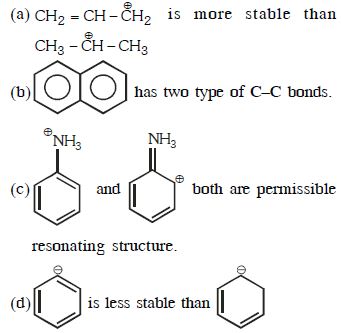
(a)According to the Lewis concept.

Need a full question paper?

Generate a complete, print-ready paper with questions like this in minutes — across 16+ boards, with answer keys.

Start Generating Free

Similar questions

Molecular formula of amyl alcohol is
Among the species : $C{O_2},C{H_3}CO{O^ - },$ $CO,C{O_3}^{2 - },$ $HCHO$ which has the weakest carbon- oxygen bond
Change in entropy is positive for
Decreasing order of $C-C$ bond length is

$I.$ ${C_2}{H_4}$             $II.$ ${C_2}{H_2}$

$III.$ ${C_6}{H_6}$            $IV.$ ${C_2}{H_6}$

For a dilute solution containing $2.5\, g$ of a nonvolatile non-electrolyte solute in $100\, g$ of water, the elevation in boiling point at $1$ atm pressure is $2\,^oC$. Assuming  amount of solute is much lower than the amount of solvent, the vapour pressure ($mm$ of  $Hg$) of the solution is :- 

(take $K_b = 0.76\, K \,kg \,mol^{-1}$)

Which one of the following reactions is most suitable for the preparation of $n-$ propyl benzene
$Zn + 2H^+ \to  Zn^{2+} + H_2$

The half-life period is independent of the concentration of zinc at constant $pH$. For the constant concentration of $Zn$, the rate becomes $100$ times when $pH$ is decreased from $3\, to\, 2$. Identify the correct statements $(pH = -\log [H^{+}])$

$(A)$  $\frac{{dx}}{{dt}}\, = k{[Zn]^0}{[{H^ + }]^2}$

$(B)$  $\frac{{dx}}{{dt}}\, = k{[Zn]}{[{H^ + }]^2}$

$(C)$ Rate is not affected if the concentraton of zinc is made four times and that of $H^+$ ion is halved.

$(D)$ Rate becomes four times if the concentration of $H^+$ ion is doubled at constant $Zn$ concentration
If isobutane and n-butane are present in a gas, then how much oxygen should be required for complete combustion of $5 \,kg$ of this gas ............ $\mathrm{kg}$
Consider following statements Correct statement$(s)$ are
Rotation of plane polarised light is measured by