Question

Answer

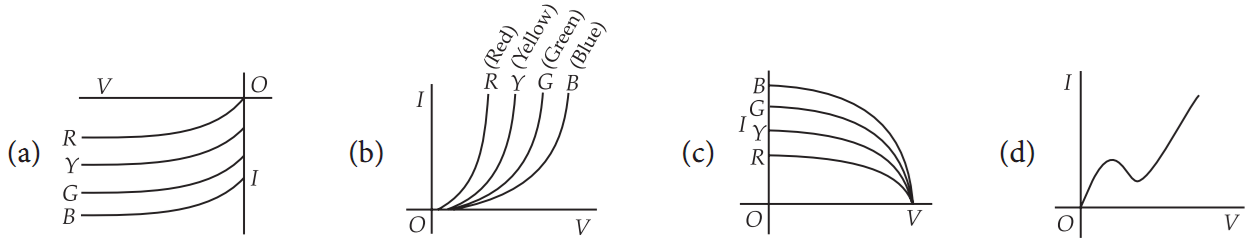
  1. (b)

Explanation:

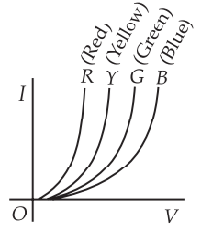
The I-V characteristics of an LED is similar to that of a Si junction diode. But the threshold voltages are much higher and slightly different for each colour.
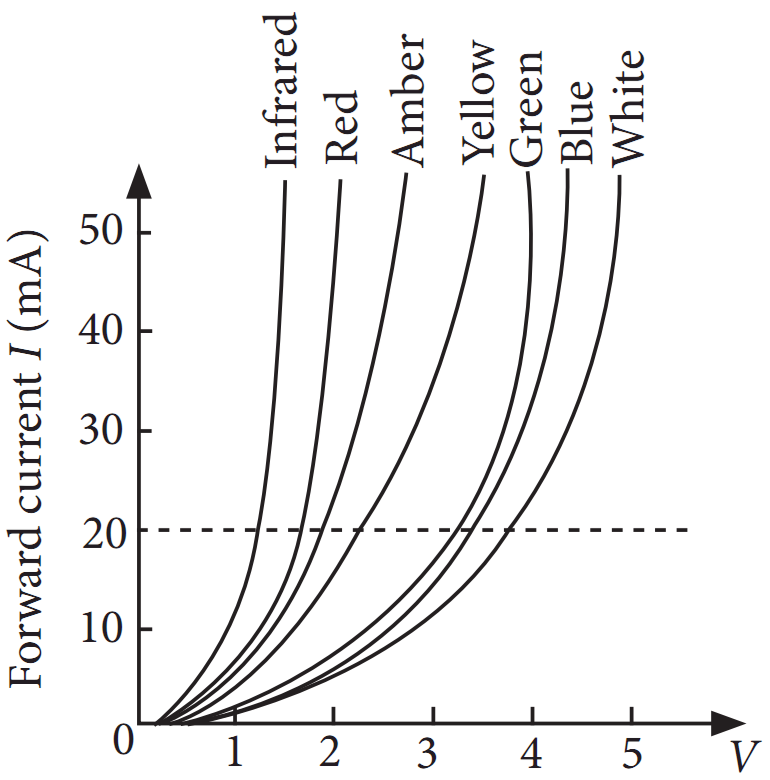
  1. (b)

  1. (b) Red.

Explanation:

As $\text{E}_\text{g}=\frac{\text{hc}}{\lambda}$

$\therefore\lambda=\frac{\text{hc}}{\text{E}_\text{g}}$

Here, E= 1.9ev, hc = 1240eVnm

$\therefore\lambda=\frac{1240\text{eVnm}}{1.9\text{eV}}=652.6\text{nm}$

Hence, the emitted light is of red colour.

  1. (c) It emits light only when it is reverse biased.

​​​​​​​Explanation:

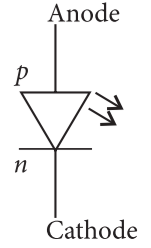
A light emitting diode is a heavily doped p-n junction diode which emits light only when it is forward biased.

  1. (d) Equal to or less than the band gap of the semiconductor used.
Need a full question paper?

Generate a complete, print-ready paper with questions like this in minutes — across 16+ boards, with answer keys.

Start Generating Free

Similar questions

When the frequency of ac supply is such that the inductive reactance and capacitive reactance become equal, the impedance of the series LCR circuit is equal to the ohmic resistance in the circuit. Such a series LCR circuit is known as resonant series LCR circuit and the frequency of the ac supply is known as resonant frequency. Resonance phenomenon is exhibited by a circuit only if both Land Care present in the circuit. We cannot have resonance in a RL or RC circuit.
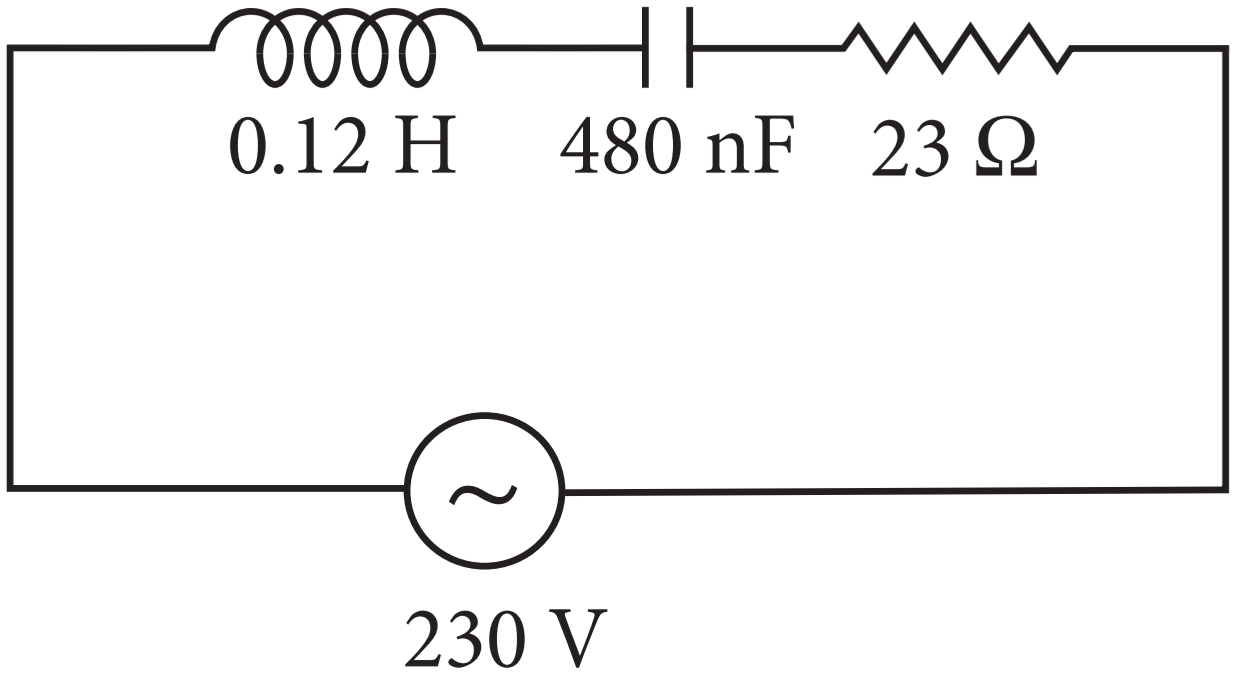
A series LCR circuit with L = 0.12H, C = 480nF, $\text{R} = 23\Omega$ is connected to a 230V variable frequency supply.

  1. Find the value of source frequency for which current amplitude is maximum.
  1. 222.32Hz
  2. 550.52Hz
  3. 663.48Hz
  4. 770Hz
  1. The value of maximum current is:
  1. 14.14A
  2. 22.52A
  3. 50.25A
  4. 47.41A
  1. The value of maximum power is:
  1. 2200W
  2. 2299.3W
  3. 5500W
  4. 4700W
  1. What is the Q-factor of the given circuit?
  1. 25
  2. 42.21
  3. 35.42
  4. 21.74
  1. At resonance which of the following physical quantity is maximum?
  1. Impedance
  2. Current
  3. Both (a) and (b)
  4. Neither (a) nor (b)
Two point charges $5 \mu C$ and $-5 \mu C$ are kept at a distance of 1 cm from each other. Calculate the intensity of the electric field at a distance of 0.30 cm from mid-point (i) in the axial position, (ii) in neutral position.
Show that the magnetic field at a point due to a magnetic dipole is perpendicular to the magnetic axis if the line joining the point with the centre of the dipole makes an angle of $\tan^{-1}(\sqrt{2})$ with the magnetic axis.
Wavefront is a locus of points which vibratic in same phase. A ray of light is perpendicular to the wavefront. According to Huygens principle, each point of the wavefront is the source of a secondary disturbance and the wavelets connecting from these points spread out in all directions with the speed of wave.
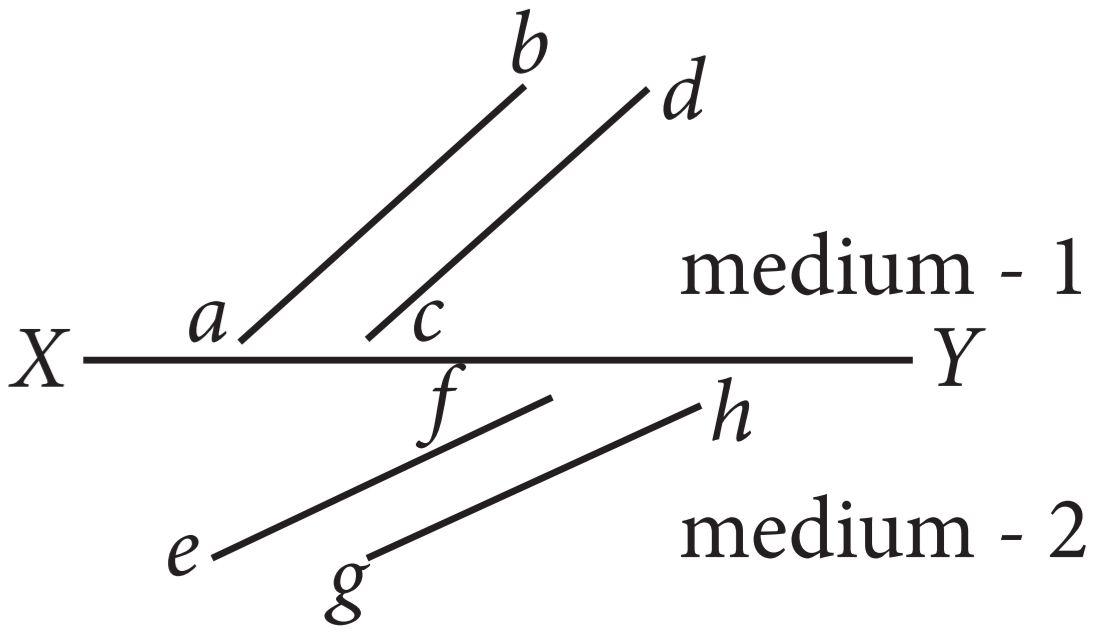
The figure shows a surface XY separating two transparent media, medium-I and medium-2. The lines ab and cd represent wavefronts of a light wave travelling in medium- 1 and incident on XY. The lines ef and gh represent wavefronts of the light wave in medium-2 after refraction.

  1. Light travels as a:
  1. Parallel beam in each medium.
  2. Convergent beam in each medium.
  3. Divergent beam in each medium.
  4. Divergent beam in one medium and convergent beam in the other medium.
  1. The phases of the light wave at c, d, e and f are $\phi_\text{c},\phi_\text{d},\phi_\text{e}$ and $\phi_\text{f}$ respectively. It is given that $\phi_\text{c}\not=\phi_\text{f}$
  1. $\phi_\text{c}$ cannot be equal $\phi_\text{d}$
  2. $\phi_\text{d}$ cannot be equal $\phi_\text{e}$
  3. $(\phi_\text{d}-\phi_\text{f})$ is equal to $(\phi_\text{c}-\phi_\text{e})$
  4. $(\phi_\text{d}-\phi_\text{c})$ is not equal to $(\phi_\text{f}-\phi_\text{e})$
  1. Wavefront is the locus of all points, where the particles of the medium vibrate with the same.
  1. Phase
  2. Amplitude
  3. Frequency
  4. Period
  1. A point source that emits waves uniformly in all directions, produces wavefronts that are:
  1. Spherical
  2. Elliptical
  3. Cylindrical
  4. Planar
  1. What are the types of wavefronts?
  1. Spherical
  2. Cylindrical
  3. Plane
  4. All of these.
Two friends A and B are standing a distance x apart in an open field and wind is blowing from A to B. A beats a drum and B hears the sound t1 time after he sees the event. A and B interchange their positions and the experiment is repeated. This time B hears the drum t2 time after he sees the event. Calculate the velocity of sound in still air v and the velocity of wind u. Neglect the time light takes in travelling between the friends.
Derive $\delta=i+e- A$ for a Prism. Also derive an expression for the refractive index of material of the Prism.
Derive an expression for the magnetic field at any point on the axis of a current carrying loop from Bio-Savart's law. Draw the necessry fig.
When electric dipole is placed in uniform electric field, its two charges experience equal and opposite forces, which cancel each other and hence net force on electric dipole in uniform electric field is zero. However, these forces are not collinear, so they give rise to some torque on the dipole. Since net force on electric dipole in uniform electric field is zero, so no work is done in moving the electric dipole in uniform electric field. However, some work is done in rotating the dipole against the torque acting on it.

  1. The dipole moment of a dipole in a uniform external field $\vec{\text{E}}$ is $\vec{\text{P}}.$ Then the torque 'i acting on the dipole is:
  1. $\vec{\tau}=\vec{\text{P}}\times\vec{\text{E}}$

  2. $\vec{\tau}=\vec{\text{P}}\cdot\vec{\text{E}}$

  3. $\vec{\tau}=2(\vec{\text{P}}+\vec{\text{E}})$

  4. $\vec{\tau}=(\vec{\text{P}}+\vec{\text{E}})$

  1. An electric dipole consists of two opposite charges, each of magnitude $1.0\mu\text{C}$ separated by a distance of 2.0cm. The dipole is placed in an external field of 105N C-1. The maximum torque on the dipole is:
  1. 0.2 × 10-3Nm
  2. 1 × 10⁻³Nm
  3. 2 × 10-3Nm
  4. 4 × 10⁻³Nm
  1. Torque on a dipole in uniform electric field is minimum when $\theta$ is equal to:
  1. 90º
  2. 180º
  3. Both (a) and (c)
  1. When an electric dipole is held at an angle in a uniform electric field, the net force F and torque t on the dipole are:
  1. $\text{F}=0, \tau=0$

  2. $\text{F}\not=0, \tau\not=0$

  3. $\text{F}=0, \tau\not=0$

  4. $\text{F}\not=0, \tau=0$

  1. An electric dipole of moment pis placed in an electric field of intensity E. The dipole acquires a position such that the axis of the dipole makes an angle $\theta$ with the direction of the field. Assuming that the potential energy of the dipole to be zero when $\theta=90^\circ$ the torque and the potential energy of the dipole will respectively be:
  1. $\text{pE}\sin\theta,-\text{pE}\cos\theta$

  2. $\text{pE}\sin\theta,-2\text{pE}\cos\theta$

  3. $\text{pE}\sin\theta,2\text{pE}\cos\theta$

  4. $\text{pE}\cos\theta,-2\text{pE}\sin\theta$

When we rub our hands they become warm. Have we supplied heat to the hands?