Question
When electric dipole is placed in uniform electric field, its two charges experience equal and opposite forces, which cancel each other and hence net force on electric dipole in uniform electric field is zero. However, these forces are not collinear, so they give rise to some torque on the dipole. Since net force on electric dipole in uniform electric field is zero, so no work is done in moving the electric dipole in uniform electric field. However, some work is done in rotating the dipole against the torque acting on it.
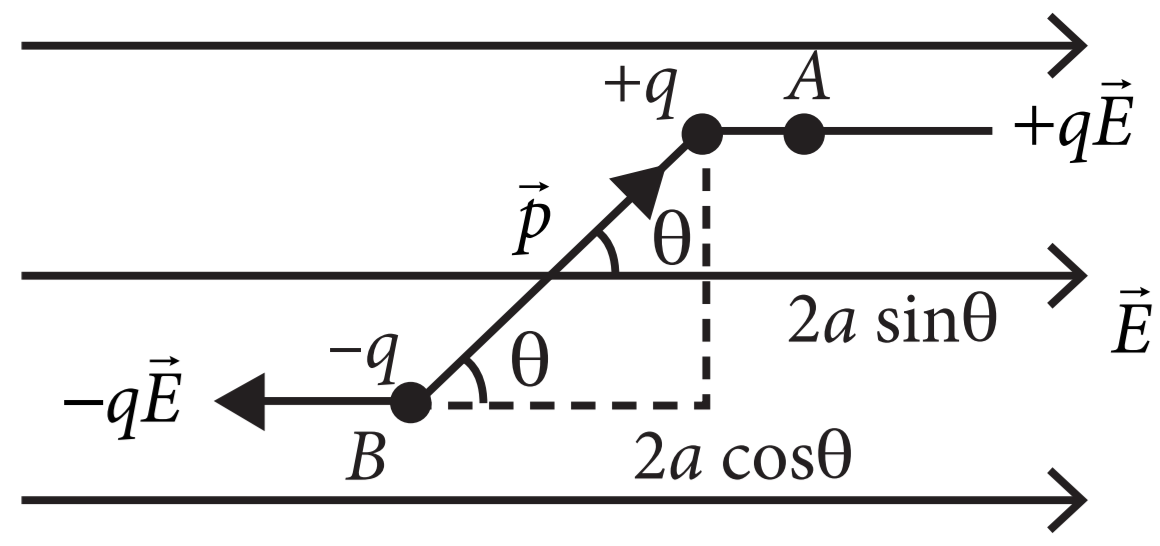
  1. The dipole moment of a dipole in a uniform external field $\vec{\text{E}}$ is $\vec{\text{P}}.$ Then the torque 'i acting on the dipole is:
  1. $\vec{\tau}=\vec{\text{P}}\times\vec{\text{E}}$

  2. $\vec{\tau}=\vec{\text{P}}\cdot\vec{\text{E}}$

  3. $\vec{\tau}=2(\vec{\text{P}}+\vec{\text{E}})$

  4. $\vec{\tau}=(\vec{\text{P}}+\vec{\text{E}})$

  1. An electric dipole consists of two opposite charges, each of magnitude $1.0\mu\text{C}$ separated by a distance of 2.0cm. The dipole is placed in an external field of 105N C-1. The maximum torque on the dipole is:
  1. 0.2 × 10-3Nm
  2. 1 × 10⁻³Nm
  3. 2 × 10-3Nm
  4. 4 × 10⁻³Nm
  1. Torque on a dipole in uniform electric field is minimum when $\theta$ is equal to:
  1. 90º
  2. 180º
  3. Both (a) and (c)
  1. When an electric dipole is held at an angle in a uniform electric field, the net force F and torque t on the dipole are:
  1. $\text{F}=0, \tau=0$

  2. $\text{F}\not=0, \tau\not=0$

  3. $\text{F}=0, \tau\not=0$

  4. $\text{F}\not=0, \tau=0$

  1. An electric dipole of moment pis placed in an electric field of intensity E. The dipole acquires a position such that the axis of the dipole makes an angle $\theta$ with the direction of the field. Assuming that the potential energy of the dipole to be zero when $\theta=90^\circ$ the torque and the potential energy of the dipole will respectively be:
  1. $\text{pE}\sin\theta,-\text{pE}\cos\theta$

  2. $\text{pE}\sin\theta,-2\text{pE}\cos\theta$

  3. $\text{pE}\sin\theta,2\text{pE}\cos\theta$

  4. $\text{pE}\cos\theta,-2\text{pE}\sin\theta$
Answer

  1. (a) $\vec{\tau}=\vec{\text{P}}\times\vec{\text{E}}$

Explanation:

As $\tau=$ either force × perpendicular distance between the two forces.

$=\text{qaE}\sin\theta\text{ or }\tau=\text{PE}\sin\theta$

$(\because\text{qa}=\text{P})$

Or $\vec{\tau}=\vec{\text{P}}\times\vec{\text{E}}$

  1. (c) 2 × 10-3Nm

​​​​​​​​​​​​​​Explanation:

The maximum torque on the dipole in an external electric field is given by

$\tau=\text{pE}=\text{q}(\text{2a})\times\text{E}$

Here, $\text{q}=1\mu\text{C}=10^{-6}\text{C,}$

2a = 2cm = 2 × 10-2m,

E = 105N C-1,

$\tau=?$

$\therefore\tau=10^{-6}\times2\times10^{-2}\times10^5$

$=2\times10^{-3}\text{Nm}$

  1. (d) Both (a) and (c)

​​​​​​​​​​​​​​​​​​​​​​​​​​​​​​​​​​​Explanation:

When $\theta$ is 0 or 180º, the $\tau$ minimum, which means the dipole moment should be parallel to the direction of the uniform electric field.

  1. (c) $\text{F}=0, \tau\not=0$

​​​​​​​​​​​​​​​​​​​​​​​​​​​​​​​​​​​Explanation:

Net force is zero and torque acts on the dipole, trying to align p with E.

  1. (a) $\text{pE}\sin\theta,-\text{pE}\cos\theta$

​​​​​​​​​​​​​​​​​​​​​​​​​​​​​​​​​​​Explanation:

Torque, $\tau=\text{pE}\sin\theta$ and potential energy, $\text{U}=-\text{pE}\cos\theta.$​​​​​​​

Need a full question paper?

Generate a complete, print-ready paper with questions like this in minutes — across 16+ boards, with answer keys.

Start Generating Free

Similar questions

On a winter day, the outside temperature is 0°C and relative humidity 40%. The air from outside comes into a room and is heated to 20°C. What is the relative humidity in the room? The saturation vapour pressure at 0°C is 4.6mm of mercury and at 20°C it is 18mm of mercury.
A uniform magnetic field of 0.20 × 10-3 T exists in the space. Find the change in the magnetic scalar potential as one moves through 50cm along the field.
A capacitor is a device to store energy. The process of charging up a capacitor involves the transferring of electric charges from its one place to another. This work done in charging the capacitor is stored as its electrical potential energy.

If q is the charge and V is the potential difference across a capacitor at any instant during its charging, then small work done in storing an additional small charge dq against the repulsion of charge q already stored on it is $\text{dW}=\text{V.dq}=(\frac{\text{q}}{\text{C}})\text{dq}.$

  1. A system of 2 capacitors of capacitance $2\mu\text{F}$ and $4\mu\text{F}$ is connected in series across a potential difference of 6 V. The energy stored in the system is:
  1. $3\mu\text{J}$
  2. $24\mu\text{J}$
  3. $30\mu\text{J}$
  4. $108\mu\text{J}$
  1. A capacitor of capacitance of $10\mu\text{F}$ is charged to 10V. The energy stored in it is:
  1. $100\mu\text{J}$
  2. $500\mu\text{J}$
  3. $1000\mu\text{J}$
  4. $1\mu\text{J}$
  1. A parallel plate air capacitor has capacity C farad, potential V volt and energy E joule. When the gap between the plates is completely filled with dielectric:
  1. Both V and E increase.
  2. Both V and E decrease.
  3. V decreases, E increases.
  4. V increases, E decreases.
  1. A capacitor with capacitance $5\mu\text{F}$ s charged to $5\mu\text{C}.$ If the plates are pulled apart to reduce the capacitance to $2\mu\text{F},$ how much work is done?
  1. 6.25 × 10-6J
  2. 3.75 × 10⁻⁶J
  3. 2.16 × 10⁻⁶J
  4. 2.55 × 10⁻⁶J
  1. A metallic sphere ofradius 18cm has been given a charge of 5 × 10-6C. The energy of the charged conductor is:
  1. 0.2J
  2. 0.6J
  3. 1.2J
  4. 2.4J
A child has near point at 10cm. What is the maximum angular magnification the child can have with a convex lens of focal length 10cm?
In the year 1939, German scientist Otto Hahn and Strassmann discovered that when an uranium isotope was bombarded with a neutron, it breaks into two intermediate mass fragments. It was observed that, the sum of the masses of new fragments formed were less than the mass of the original nuclei. This difference in the mass appeared as the energy released in the process. Thus, the phenomenon of splitting of a heavy nucleus (usually A > 230) into two or more lighter nuclei by the bombardment of proton, neutron $\alpha$-particle, etc. with liberation of energy is called nuclear fission.
$\ _{92}\text{U}^{235}+\ _0\text{n}^{1}\rightarrow_{92}\text{U}^{236} \rightarrow\ _{56}\text{B}^{114}+\ _{36}\text{Kr}^{89}\ +3\ _{0}\text{n}^{1} + \text{Q}$
$\big[\because \ _{92}\text{U}^{236}= \text{Unstable nucleus}\big]$
  1. Nuclear fission can be explained on the basis of.
  1. Millikan's oil drop method
  2. Liquid drop model
  3. Shell model
  4. Bohr's model.
  1. For sustaining the nuclear fission chain reaction in a sample (of small size) of $_{92}^{235}\text{U}$ it is desirable to slow down fast neutrons by.
  1. Friction
  2. Elastic damping/ scattering
  3. Absorption
  4. None of these.
  1. Which of the following is/ are fission reaction(s)?
  1. $_0^1\text{n}\ +\ _{92}^{235}\text{U}\rightarrow\ _{92}^{235}\text{U}\rightarrow\ _{51}^{133}\text{Sb}+\ _{41}^{99}\text{nb}+\ 4_1^0\text{n}$
  2. $_0^1\text{n}\ +\ _{92}^{235}\text{U}\rightarrow\ _{54}^{1.40}\text{Xe}+\ _{38}^{94}\text{Sr}\ +2_0^1\text{n}$
  3. $_1^2\text{H}\ +\ _1^2\text{H}\rightarrow\ _2^3\text{He}+\ _0^1\text{n}$
  1. Both II and III
  2. Both I and III
  3. Only II
  4. Both I and II
  1. On an average, the number of neutrons and the energy of a neutron released per fission of a uranium atom are respectively.
  1. 2.5 and 2 keV
  2. 3 and 1 keV
  3. 2.5 and 2 MeV
  4. 2 and 2 keV
  1. In any fission process, ratio of mass of daughter nucleus to mass of parent nucleus is.
  1. Less than I
  2. Greater than I
  3. Equal to I
  4. Depends o the mass of parent nucleus.
When the atomic dipoles are aligned partially or fully, there is a net magnetic moment in the direction of the field in any small volume of the material. The actual magnetic field inside material placed in magnetic field is the sum of the applied magnetic field and the magnetic field due to magnetisation. This field is called magnetic intensity (H).
$\text{H}=\frac{\text{B}}{\mu_0}-\text{M}$
where Mis the magnetisation of the material, flo is the permittivity of vacuum and B is the total magnetic field. The measure that tells us how a magnetic material responds to an external field is given by a dimensionless quantity is appropriately called the magnetic susceptibility: for a certain class of magnetic materials, intensity of magnetisation is directly proportional to the magnetic intensity.
  1. Magnetization of a sample is:
  1. Volume of sample per unit magnetic moment.
  2. Net magnetic moment per unit volume.
  3. Ratio of magnetic moment and pole strength.
  4. Ratio of pole strength to magnetic moment.
  1. Identify the wrongly matched quantity and unit pair.
  1. Pole strength - Am
  2. Magnetic susceptibility - dimensionless number
  3. Intensity of magnetisation - Am-1
  4. Magnetic permeability - Henry m
  1. A closed surface S encloses a magnetic dipole of magnetic moment 2ml. The magnetic flux emerging from the surface is:
  1. 2 × 10⁵A/ m
  2. 3 × 10⁵A/ m
  3. 4 × 10⁵A/ m
  4. 5 × 10⁵A/ m
  1. A solenoid has core of a material with relative permeability 500 and its windings carry a current of 1A. The number of turns of the solenoid is 500 per metre. The magnetization of the material is nearly,
  1. 2.5 × 10³Am-1
  2. 2.5 × 105Am-1
  3. 2.0 × 10³Am-1
  4. 2.0 × 105Am-1
  1. The relative penneability of iron is 6000. Its magnetic susceptibility is:
  1. 5999
  2. 6001
  3. 6000 × 10-7
  4. 6000 × 107
Two blocks of unequal masses are tied by a spring. The blocks are pulled stretching the spring slightly and the system is released on a frictionless horizontal platform. Are the forces due to the spring on the two blocks equal and opposite? If yes, is it an example of Newton's third law?
Suppose in an imaginary world the angular momentum is quantized to be even integral multiples of $\frac{\text{h}}{2\pi}$ What is the longest possible wavelength emitted by hydrogen atoms in visible range in such a world according to Bohr's model?
Explain (/ Discuss) the variation in intensity of the light transmitted through two polaroids. And from that derive Malus' law.
Derive $\delta=i+e- A$ for a Prism. Also derive an expression for the refractive index of material of the Prism.