MCQ
Light from a point source falls on a small area placed perpendicular to the incident light. If the area is rotated about the incident light by an angle of 60 , by what fraction will the illuminance change
  • A
    It will be doubled
  • B
    It will be halved
  • It will not change
  • D
    It will become one-fourth

Answer

Correct option: C.
It will not change
Rotation of area about incident light doesn't change the inclination of the light ray on the area.

Need a full question paper?

Generate a complete, print-ready paper with questions like this in minutes — across 16+ boards, with answer keys.

Start Generating Free

Similar questions

For a material, the refractive indices for red, violet and yellow colour light are respectively $1.52,1.64$ and $1.60.$ The dispersive power of the material is
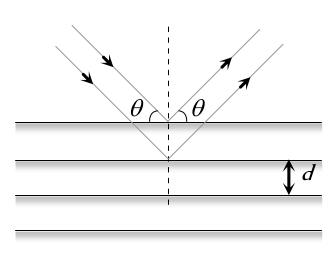
A beam with wavelength $\lambda$ falls on a stack of partially reflecting planes with separation $d$. The angle $\theta$ that the beam should make with the planes so that the beams reflected from successive planes may interfere constructively is (where $n=1,2, \ldots .$. )
Image
When a drop of water is dropped on oil surface, then
When a hydrogen atom is raised from the ground state to an excited state [CBSE PMT 1995; AMU (Med.) 1999]
A voltmeter having a resistance of $998 \mathrm{ohms}$ is connected to a cell of e.m.f. 2 volt and internal resistance $2 \mathrm{ohm}$. The error in the measurement of e.m.f. will be
A uniform chain of length $2 \mathrm{~m}$ is kept on a table such that a length of $60 \mathrm{~cm}$ hangs freely from the edge of the table. The total mass of the chain is $4 \mathrm{~kg}$. What is the work done in pulling the entire chain on the table
The unit of Planck's constant is
A thin prism $P_1$ with angle $6^{\circ}$ and made from glass of refractive index $1.54$ is combined with another thin prism $P$ of refractive index $1.72$ to produce dispersion without deviation. The angle of prism $P_2$ will be
If acceleration due to gravity on the surface of a planet is two times that on surface of earth and its radius is double that of earth. Then escape velocity from the surface of that planet in comparison to earth will be
A $1\  \mu \mathrm{A}$ beam of protons with a cross-sectional area of $0.5 \ \mathrm{sq} . \mathrm{mm}$ is moving with a velocity of $3 \times 10^4 \mathrm{~ms}^{-1}$. Then charge density of beam is