MCQ
Light is:
  • A
    Wave phenomenon.
  • B
    Particle phenomenon
  • Both particle and wave phenomenon.
  • D
    None of these

Answer

Correct option: C.
Both particle and wave phenomenon.
Light shows photoelectric effect and Compton effect, which depicts its particle nature. It also shows interference and diffraction, which depicts the wave nature of light.

Need a full question paper?

Generate a complete, print-ready paper with questions like this in minutes — across 16+ boards, with answer keys.
Start Generating Free

Similar questions

A wooden block of mass $M$  is suspended by a cord and is at rest. A bullet of mass $m,$ moving with a velocity $v$ passes through the block and comes out with a velocity $v/2$  in the same direction. If there is no loss in kinetic energy, then upto what height the block will rise
A air bubble rises from bottom of a lake to surface. If its radius increases by $200 \%$ and atmospheric pressure is equal to water coloumn of height $H$. then depth of lake is ..... $H$
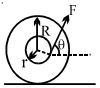
The spool shown in figure is placed on rough horizontal surface and has inner radius $r$ and outer radius $R$. The angle $\theta$ between the applied force and the horizontal can be varied. The critical angle $(\theta )$ for which the spool does not roll and remains stationary is given by 
The mass of a spaceship is $1000\ kg$. It is to be launched from the earth's surface out into free space. The value of $g$ and $R$( radius of earth) are $10\ m/s^2 $ and $6400\ km$ respectively. The required energy for this work will be
Two stones are projected with the same speed but making different angles with the horizontal. Their ranges are equal. If the angle of projection of one is $\pi /3$ and its maximum height is $h_1$ then the maximum height of the other will be
If $m$ mass of a substance undergoes a phase change, then amount of heat required will be:
In order to determine the Young's Modulus of a wire of radius $0.2\, cm$ (measured using a scale of least count $=0.001\, cm )$ and length $1 \,m$ (measured using a scale of least count $=1\, mm$ ), a weight of mass $1\, kg$ (measured using a scale of least count $=1 \,g$ ) was hanged to get the elongation of $0.5\, cm$ (measured using a scale of least count $0.001\, cm$ ). What will be the fractional error in the value of Young's Modulus determined by this experiment? (in $\%$)
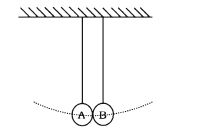
Two pendulums with identical bobs and lengths are suspended from a common support such that in rest position the two bobs are in contact (figure). After being displaced by $5^o $ the bob $A$ is released from rest, at $t = 0$ subsequently it collides elastically head-on with the other bob.The graph showing variation in energy of pendulum $A$ with time, for $0 \leqslant t \leqslant T$ (where $T$ is the period of either pendulum).
The force required to keep a body in uniform circular motion is
$...........$ of a two particle system depends only on the separation between the two particles. The most appropriate choice for the blank space in the above sentence is: