MCQ
Light of different colours propagates through air
  • A
    With the velocity of air
  • B
    With different velocities
  • C
    With the velocity of sound
  • Having the equal velocities

Answer

Correct option: D.
Having the equal velocities
d
(d) In vacuum, the speed of light is independent of wave length.

Thus vacuum (or air) is a non dispersive medium in which all colours travel with the same speed.

Need a full question paper?

Generate a complete, print-ready paper with questions like this in minutes — across 16+ boards, with answer keys.
Start Generating Free

Similar questions

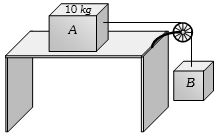
If mass of $A = 10\,\,kg$, coefficient of static friction $= 0.2$, coefficient of kinetic friction = $0.2$. Then mass of $B$ to start motion is
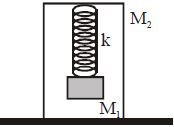
$A$ block of mass $M_1$ is hanged by a light spring of force constant $k$ to the top bar of a reverse Uframe of mass $M_2$ on the floor. The block is pooled down from its equilibrium position by $a$ distance $x$ and then released. Find the minimum value of $x$ such that the reverse $U$ -frame will leave the floor momentarily.
The coefficient of self inductance of a solenoid is $0.18\, mH$. If a crode of soft iron of relative permeability $900$ is inserted, then the coefficient of self inductance will become nearly.....$mH$
If hydrogen gas is heated to a very high temperature, then the fraction of energy possessed by gas molecules correspond to rotational motion ...........
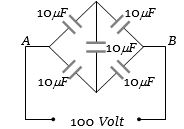
Five capacitors of $10\,\mu F$ capacity each are connected to a $d.c.$ potential of $100\;volts$ as shown in the adjoining figure. The equivalent capacitance between the points $A$ and $B$ will be equal to..........$\mu F$
Velocity at mean position of a particle executing $S.H.M.$ is $v$, they velocity of the particle at a distance equal to half of the amplitude
Silver Mirror test is given by which one of the following compounds?
body radiates energy $5W$ at a temperature of ${127^o}C$. If the temperature is increased to ${927^o}C$, then it radiates energy at the rate of ...... $W$
A particle starts from the origin at $\mathrm{t}=0$ with an initial velocity of $3.0 \hat{\mathrm{i}} \;\mathrm{m} / \mathrm{s}$ and moves in the $x-y$ plane with a constant acceleration $(6.0 \hat{\mathrm{i}}+4.0 \hat{\mathrm{j}}) \;\mathrm{m} / \mathrm{s}^{2} .$ The $\mathrm{x}$ -coordinate of the particle at the instant when its $y-$coordinate is $32\;\mathrm{m}$ is $D$ meters. The value of $D$ is
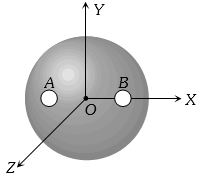
A solid sphere of uniform density and radius $4$ units is located with its centre at the origin $O$ of coordinates. Two spheres of equal radii $1$ unit with their centres at $A(-2, 0, 0)$ and $B(2, 0, 0)$ respectively are taken out of the solid leaving behind spherical cavities as shown in figure