Question
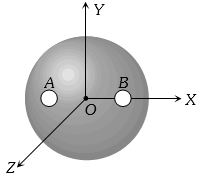
A solid sphere of uniform density and radius $4$ units is located with its centre at the origin $O$ of coordinates. Two spheres of equal radii $1$ unit with their centres at $A(-2, 0, 0)$ and $B(2, 0, 0)$ respectively are taken out of the solid leaving behind spherical cavities as shown in figure
Answer

(d) Since cavities are symmetrical w.r.t. $O$. So the gravitational force at the centre is zero. 

The radius of the circle ${z^2} + {y^2} = 36$ is $6$.

For all points for $r \ge 6,$ the body behaves as if whole of the mass is concentrated at the centre. So the gravitational potential is same. 

Above is true for ${z^2} + {y^2} = 4$ as well.

Need a full question paper?

Generate a complete, print-ready paper with questions like this in minutes — across 16+ boards, with answer keys.

Start Generating Free

Similar questions

A particle is projected from ground in vertical upward direction at $t = 0$, with initial velocity $48\, m/s$ and the distance travelled by particle in $5^{th}$ second is......$m$ $(g = 10\, m/s^2)$
Three identical capacitors are given a charge $Q$ each and they are then allowed to discharge through resistance $R_1, R_2\,$ and $\,R_3$. Their charges, as a function of time shown in the graph below. The smallest of the three resistance is
An aluminium ring $B$ faces an electromagnet $A$. The current $I$ through $A$ can be altered. Then which of the following statement is correct
Which of the following graphs is the magnification of a real image against the distance from the focus of a concave mirror
The specific heat of a gas in a polytropic process is given by
When ultraviolet rays are incident on metal plate, then photoelectric effect does not occurs. It occurs by the incidence of
What is the angle between $\vec A\,\,$ and  $\vec B\,\,$ if $\vec A\,\,$ and  $\vec B\,\,$ are the adjacent sides of a parallelogran drawn from a common point and the area of the parallelogram is $\frac {AB}{2}$
A particle moves in $x-y$ plane with velocity $\vec v = a\widehat i\, + \,bx\widehat j$ where $a$ & $b$ are constants. Initially particle was at origin then trajectory equation is:-
To which region of electromagnetic spectrum the frequency $1\, GHz$ corresponding?
A passenger train of length $60\, m$ travels at a speed of $80\, km/hr$. Another freight train of length $120\, m$ travels at a speed of $30\, km/hr$. The ratio of times taken by the passenger train to completely cross the freight train when:

$(i)$ they are moving in the same direction, and

$(ii)$ in the opposite directions is