MCQ
Light rays falls on a plane mirror and forms a real image, so the incident rays are
  • A
    Parallel
  • B
    Diverging
  • Converging
  • D
    Statement is false

Answer

Correct option: C.
Converging
c
when a object is real plane mirror form a virtual image and when object is virtual image will be real. Thus in this question object is virtual. Virtual object means object is at infinity. So rays (incident) converge on the mirror.

Need a full question paper?

Generate a complete, print-ready paper with questions like this in minutes — across 16+ boards, with answer keys.
Start Generating Free

Similar questions

The concept of displacement current introduced by Maxwell removes asymmetry between.
A solid that transmits light in visible region and has a very low melting point possesses
Einstein got Nobel prize on which of the following works:
An ideal transformer has $100$ turns in the primary and $250$ turns in the secondary. The peak value of the $ac$ is $28 \,V$. The r.m.s. secondary voltage is nearest to.....$V$
A $50\,V$ battery is connected across a $10\, ohm$ resistor. The current is $4.5\, amperes$. The internal resistance of the battery is ............. $ohm$
In Young's double slit experiment when wavelength used is 6000 Å and the screen is 40 cm from the slits, the fringes are 0.012 cm wide. What is the distance between the slits
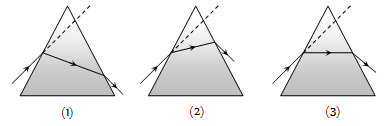
The figures represent three cases of a ray passing through a prism of angle A. The case corresponding to minimum deviation is
A charge $q$  is spread uniformly over an insulated loop of radius $r$ . If it is rotated with an angular velocity $\omega $ with respect to normal axis then the magnetic moment of the loop is
Given below in the left column are different modes of communication using the kinds of waves given in the right column

$A.$ Optical Fiber Communication $P.$ Ultrasound
$B.$ Radar $Q.$ Infrared Light
$C.$ Sonar $R.$ Microwaves
$D.$ Mobile Phones $S.$ Radio Waves

From the options given below, find the most appropriate match between entries in the left and the right column

The path difference between two interfering waves of equal intensities at a point on the screen is $\frac{\lambda }{4}.$ The ratio of intensity at this point and that at the central fringe will be