Question
Light waves can be polarised because they:

Answer

  1. Are transverse
    Explanation:
    Polarisation of light waves is possible only because they can oscillate in more than one orientation i.e., they are transverse in nature. It has no dependence on its wavelength and frequencies.

Need a full question paper?

Generate a complete, print-ready paper with questions like this in minutes — across 16+ boards, with answer keys.

Start Generating Free

Similar questions

A copper ring is kept horizontal and a bar of magnet is dropped in the direction of the axis of the ring. The acceleration of the falling magnet will be:
The length of a conductor is doubled and its radius is halved, its specific resistance is:
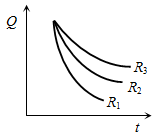
Three identical capacitors are given a charge $Q$ each and they are then allowed to discharge through resistance $R_1, R_2$ and $R_3.$ Their charges, as a function of time shown in the graph below. The smallest of the three resistance is
The dispersive power of the material of lens of focal length 20 cm is 0.08. The longitudinal chromatic aberration of the lens is(a) 0.08 cm(b) 0.08/20 cm(c) 1.6 cm(d) 0.16 cm
       
If L is the coherent length and c the velocity of light, the coherent time is:
Two thick wires and two thin wires, all of the same materials and same length form a square in the three different ways $P, Q$ and $R$ as shown in fig with current connection shown, the magnetic field at the centre of the square is zero in cases
Zener breakdown takes place if(a) Doped impurity is low(b) Doped impurity is high(c) Less impurity in N-part(d) Less impurity in P-type
   
   
An air capacitor is connected to a battery. The effect of filling the space between the plates with a dielectric is to increase(a) The charge and the potential difference(b) The potential difference and the electric field(c) The electric field and the capacitance(d) The charge and the capacitance
   
   
For a chosen non-zero value of voltage, there can be more than one value of current in:
To convert a $800\ mV$ range milli voltmeter of resistance $40\Omega$ into a galvanometer of $100\ mA$ range, the resistance to be connected as shunt is