MCQ
Two thick wires and two thin wires, all of the same materials and same length form a square in the three different ways $P, Q$ and $R$ as shown in fig with current connection shown, the magnetic field at the centre of the square is zero in cases

  • A
    In $P$ only
  • B
    In $P$ and $Q$ only
  • C
    In $Q$ and $R$ only
  • $P$ and $R$ only

Answer

Correct option: D.
$P$ and $R$ only
$P$ and $R$ only

Need a full question paper?

Generate a complete, print-ready paper with questions like this in minutes — across 16+ boards, with answer keys.

Start Generating Free

Similar questions

A conducting rod of length l is falling with a velocity $v$ perpendicular to a uniform horizontal magnetic field $B.$ The potential difference between its two ends will be
The slits in a Young's double slit experiment have equal widths and the source is placed symmetrically relative to the slits. The intensity at the central fringes is $\mathrm{I}_0.$ If one of the slits is closed, the intensity at this point will be
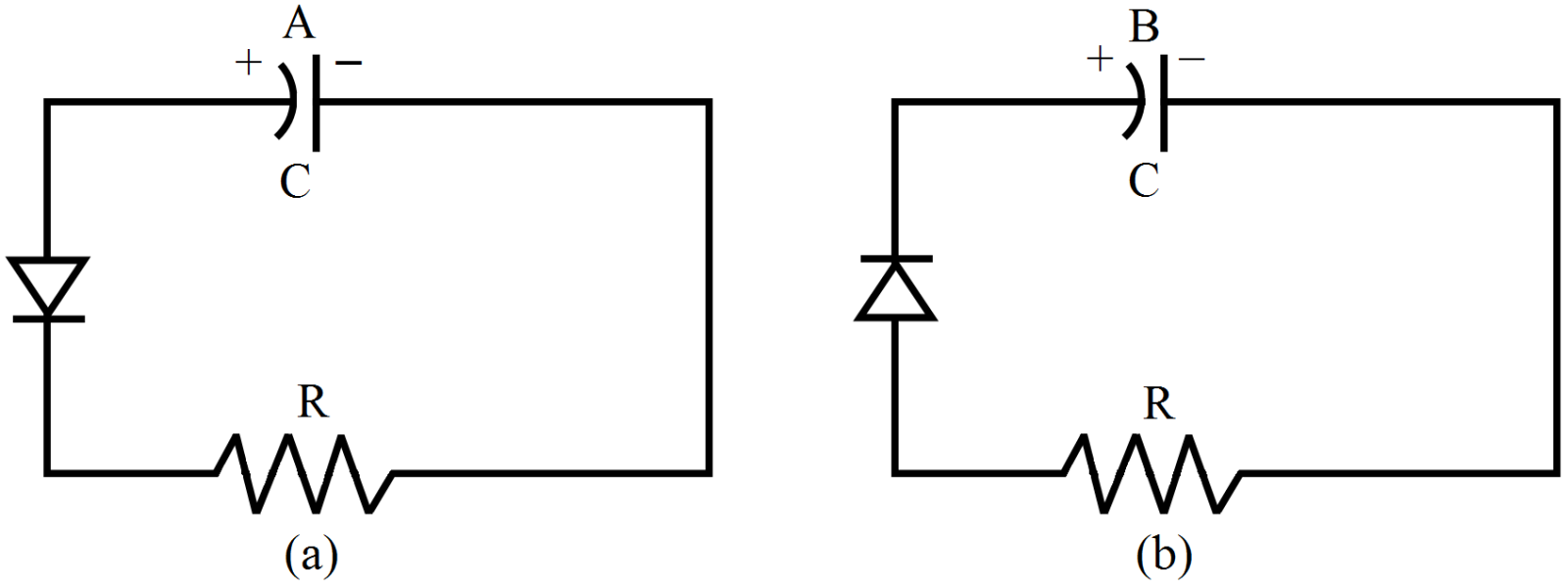
Two identical capacitors A and B are charged to the same potential V and are connected in two circuits at t = 0 as shown in figure. The charges on the capahltors at a time t = CR are, respectively:
  1. $\text{VC}, \text{VC}$
  2. $\frac{\text{VC}}{\text{e}}, \text{VC}$
  3. $\text{VC}, \frac{\text{VC}}{\text{e}}$
  4. $\frac{\text{VC}}{\text{e}}, \frac{\text{VC}}{\text{e}}$
Which theory explained that electrons revolved in circular orbits?
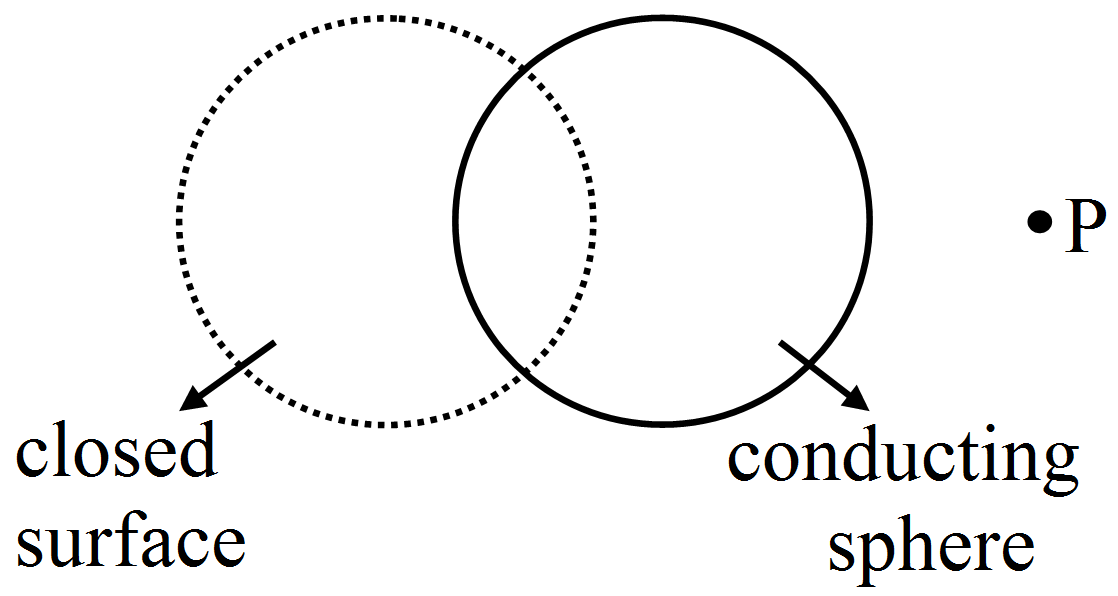
Figure shows a closed surface which intersects a conducting sphere. If a positive charged is placed at the point P, the flux of the electic field through the closed surface:
  1. Will remain zero.
  2. Will become positive.
  3. Will become neagative.
  4. Will become undefined.
The energy stored in a charged capacitor is:
If the frequency of an A.C is made 4 times of its initial value, the inductive reactance will.
The value of Curie temperature for Ni is nearly:
A bar magnet of magnetic moment M is cut into two parts of equal length. The magnetic moment of either part is :
A particle moves in a region having a uniform magnetic field and a parallel, uniform electric field. At some instant, the velocity of the particle is perpendicular to the field direction. The path of the particle will be: