Question
Linear programming model which involves funds allocation of limited investment is classified as:

Answer

  1. Capital budgeting models
Solution:
In linear programming, Capital budgeting models to minimize the total capital cost. 
The solutions from the model are used to decide the best combination of capital resources and best times to start and finish projects and to determine the net capital cost.

Need a full question paper?

Generate a complete, print-ready paper with questions like this in minutes — across 16+ boards, with answer keys.
Start Generating Free

Similar questions

If $\text{A}=\begin{bmatrix} 3 & 4 \\ 2 & 4 \end{bmatrix},\text{B}=\begin{bmatrix} -2 & -2 \\ 0 & -1 \end{bmatrix}$ then $(A + B)^{-1} =$
In a college 30% students fail in Physics, 25% fail in Mathenatics and 10% fail in both. One student is chosen at random. The probability that she fails in Physics if she failed in Mathematics is.
  1. $\frac{1}{10}$
  2. $\frac{1}{3}$
  3. $\frac{2}{5}$
  4. $\frac{9}{20}$
Find the maximum value of $f(x)=\sin (\sin x)$ for all $x \in R$.
Let $\text{A}=\begin{bmatrix} 1 & 2 \\ 3 & -5 \end{bmatrix}\text{ and B}=\begin{bmatrix} 1 & 0 \\ 0 & 2 \end{bmatrix}$ and $X$ be a matrix such that $A = BX,$ then $X$ is equal to :
If $\sin^{-1}\Big(\frac{\text{x}^2-\text{y}^2}{\text{x}^2+\text{y}^2}\Big)=\log\text{a}$ then $\frac{\text{dy}}{\text{dx}}$ is equal to:
  1. $\frac{\text{x}^2-\text{y}^2}{\text{x}^2+\text{y}^2}$
  2. $\frac{\text{y}}{\text{x}}$
  3. $\frac{\text{x}}{\text{y}}$
  4. $\text{None of these.}$
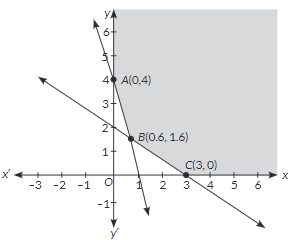
The corner points of the shaded unbounded feasible region of an LPP are $(0,4),(0.6,1.6)$ and $(3,0)$ as shown in the figure. The minimum value of the objective function $Z=4 x+6 y$ occurs at
Image
The function $\text{f(x)}=\begin{cases}\frac{\sin3\text{x}}{\text{x}},&\text{x}\ne0\\\frac{\text{k}}{2},&\text{x}=0\end{cases}$ is continuous at x = 0, then k =
  1. 3
  2. 6
  3. 9
  4. 12
If the direction cosines of a line are $\left(\frac{1}{a}, \frac{1}{a}, \frac{1}{a}\right)$, then:
$\vec{a}+\vec{b}+\vec{c}=0$ such that $|\vec{a}|=3,|\vec{b}|=5$ and $|\vec{c}|=7$.
What is the angle between $\vec{a}$ and $\vec{b}$ ?
The value of $\hat{i} \cdot(\hat{j} \times \hat{k})+\hat{j} \cdot(\hat{i} \times \hat{k})+k \cdot(\hat{i} \times \hat{j})$ is: