Question
  1. List three common refractive defects of vision. Suggest the way of correcting these defects.
  2. About 45 lac people in the developing countries are suffering from corneal blindness. About 30 lac children below the age of 12 years suffering from this defect can be cured by replacing the defective cornea with the cornea of a donated eye. How and why can students of your age involve themselves to create awareness about this fact among people?

Answer

  1. The three defects of vision:
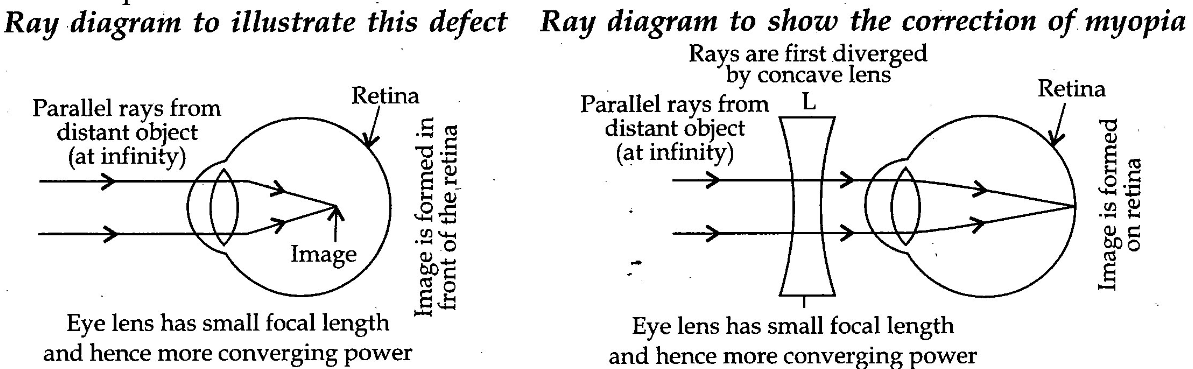
  1. Myopia: Myopia is the defect of the eye vision due to which a person can see the near objects clearly, but he can not see the far objects clearly. Causes of myopia. Myopia is caused due the elongation of the eye ball and due to decrease in the focal length of the eye lens. The eye lens become more convergent. Myopia can corrected by using a concave lens of suitable focal length in the spectacles of such a person.
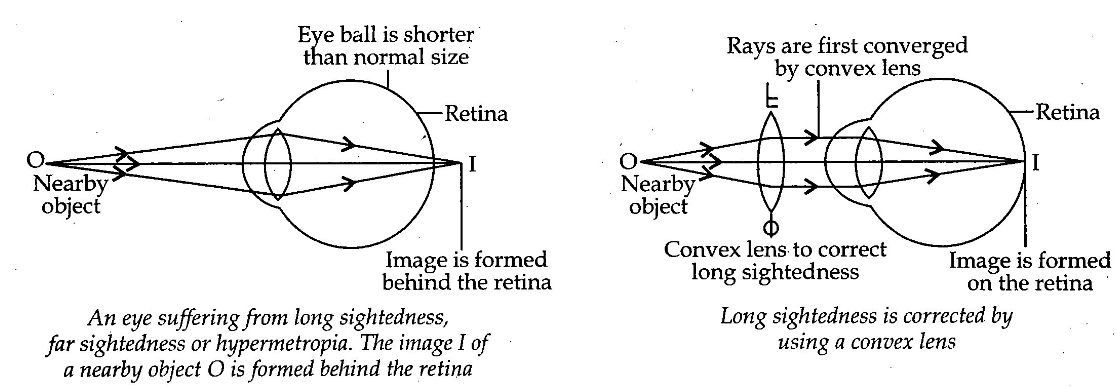
  1. Long-sightedness or hypermetropia: Due to defect, a person is not able to see the nearby objects clearly but can see the distant objects clearly.
Cause of hypermetropia. It is caused due to the following reasons:
  • Normal increase in the focal length of the eye lens. The lens becomes less convergent.
  • Shortening of the eyeball size.
correction. Long sightedness can be corrected by using a convex lens of suitable focal length in the spectacles of such a person.
When a convex lens of suitable power is placed in front of the hypermetropic eye then diverging rays of light coming from the nearby object are the first converged by this convex lens. Due to this, the convex lens from a virtual image of the nearby object at a point near to the hypermetropic eye. Then the hypermetropic eye can easily focus the image formed by convex lens on the retina.
  1. Presbyopia: The power of accommodation of the eye decreases with ageing. It occurs due to the gradual weakening of the ciliary muscles and decreasing flexibility of the crystalline lens. The near point of the eye increases with age. It may reach even 2 metres. This defect is called presbyopia.
Causes of presbyopia. It is mainly caused due to the weakening of the ciliary muscles of the eyes. Such a person may suffer from myopia and hypermetropia. This defect is then corrected by using bifocal lenses of suitable focal lengths. The upper part of the lens is a concave lens for correcting myopia to see the distant objects clearly, while the lower part of the lens has a convex lens to correct the hypermitropia to see the nearby objects clearly.
  1. We have seen advertisements in media persuading people for eye donation. If cornea of the eyes are removed within 6 hours of the death of a person, it can be transplanted to a person suffering from corneal blindness. There are more than 45 lakh cases of corneal blindness and unfortunately out of these a major portion is that of children aged below 12 years. If a person comes forward for eye donation, he can save two corneal blind persons by donating one eye to each.
How exciting it feels to think that after one’s death, he/she can make two blind persons see this wonderful world Therefore it is a must to promote such advertisements to encourage people and make them aware of this noble cause.

Need a full question paper?

Generate a complete, print-ready paper with questions like this in minutes — across 16+ boards, with answer keys.

Start Generating Free

Similar questions

  1. What is meant by saying that the potential difference between two points is 1 volt? Name a device that helps to measure the potential difference across a conductor.
  2. Why does the connecting cord of an electric heater not glow hot while the heating element does?
  3. Electrical resistivities of some substances at $20^{0}\text{C}$ are given below:
Silver $1.60\times10^{-8} \Omega \text{ m}$
Copper $1.62\times10^{-8} \Omega \text{ m}$
Tungsten $5.20\times10^{-8} \Omega \text{ m}$
Iron $10.0\times10^{-8} \Omega \text{ m}$
Mercury $94.0\times10^{-8} \Omega \text{ m}$
Nichrome $100\times10^{-6} \Omega \text{ m}$
Answer the following questions in relation to them:
  1. Among silver and copper, which one is a better conductor? Why?
  2. Which material would you advise to be used in electrical heating devices? Why?
A person buys two electrical devices P and Q for lighting purposes in his house. The device P consumes only 5 units of electricity in a month but device Q consumes 15 units of electricity in a month when used for the same number of hours daily. The device Q wastes a lot of electricity by radiating energy C but P does not do so.
  1. What type of device is (i) P, and (ii) Q?
  2. Name one component which is present in Q but not in P.
  3. Name the energy C.
  4. Which device is more energy efficient: P or Q?
  5. Which fossil fuel is most likely to be conserved if all of us switch over to devices like P?
What is the difference in colours of the Sun observed during sunrise/ sunset and noon? Give explanation for each.
Describe the process of nutrition in Draw labelled diagrams to show the various steps in the nutrition in Amoeba.
'Nervous and hormonal systems together perform the function of control and coordination in human beings.' Justify the statement.
Explain the phenomenon of dispersion of white light through a glass prism, using suitable ray diagram.
  1. The modern periodic table has been evolved through the early attempts of Dobereiner, Newland and Mendeleev. List one advantage and one limitation of all the three attempts.
  2. Name the scientist who first of all showed that atomic number of an element is a more fundamental property than its atomic mass.
  3. State Modern periodic law.
Soaps and detergents are both types of salts. State the difference between the two. Write the mechanism of the cleansing action of soaps. Why do soaps not form lather (foam) with hard water? Mention any two problems that arise due to the use of detergents instead of soaps.
What is the difference between external and internal respiration.
The human body contains a large number of cells A which are very long and branched, and look like electric wires. The longest branch of this cell is B whereas there are many small branches C. Any two A cells do not join to one another completely in the human body. There is a microscopic gap D between every pair of adjacent A cells through which electric impulses can pass by the release of a chemical substance.
  1. What are cells A?
  2. What is the name of (i) branch B, and (ii) branches C?
  3. What is the microscopic gap D known as?
  4. What is the function of cells like A in the human body?
  5. The cells A are of three types. name the three types.