MCQ
Magnetic field at point $'M'$ of given current distribution
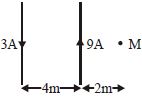
  • A
    $\frac{{2{\mu _0}}}{\pi } \odot $
  • B
    $\frac{{5{\mu _0}}}{{2\pi }} \otimes $
  • $\frac{{2{\mu _0}}}{{\pi }} \otimes $
  • D
    $\frac{{{\mu _0}}}{{2\pi }} \otimes $

Answer

Correct option: C.
$\frac{{2{\mu _0}}}{{\pi }} \otimes $
c
$\overrightarrow{\mathrm{B}}$ at $\mathrm{M}=\frac{\mu_{0} \cdot 9}{2 \pi \cdot 2} \otimes+\frac{\mu_{0} 3}{26} \otimes$

$=\frac{\mu_{0}}{2 \pi} .4 \otimes=\frac{2 \mu_{0}}{\pi}  \otimes$

Need a full question paper?

Generate a complete, print-ready paper with questions like this in minutes — across 16+ boards, with answer keys.

Start Generating Free

Similar questions

The magnetic force acting on a charged particle of charge $-2\, \mu  C$ in a magnetic field of $2\, T$ acting in $y$ direction, when the particle velocity is $(2i + 3 j) \times  10^6\,\, m/s$ is
Magnetic field intensity at the centre of coil of 50 turns, radius 0.5 m and carrying a current of 2 A is
When an electron in a hydrogen atom makes a transition from $2^{nd}$ excited state to ground state, it emits a photon of frequency $f$ . The frequency of photon emitted when an electron of $Li^{++}$ makes a transition from $1^{st}$ excited state to ground state is
The capacitance of a parallel plate capacitor is $C$ when the region between the plate has air. This region is now filled with a dielectric slab of dielectric constant $k$. The capacitor is connected to a cell of $emf$ $E$, and the slab is taken out
In the above question, potential difference across the 40Ω resistance will be
A small rod of length $2\,mm$ lies along principal axis at a distance of $30\, cm$ from a  concave mirror of focal length $20\, cm$ than the axial length of the image of the rod is.....$mm$
Consider a uniform spherical volume charge distribution of radius $R$. Which of the following graphs correctly represents the magnitude of the electric field $E$ at a distance $r$ from the centre of the sphere?
The total charge of the isolated system is always:
For a substance the average life for a-emission is 1620 years and for b emission is 405 years. After how much time the 1/4 of the material remains after a and b emission
Gauss’s law states that