MCQ
Mark out the incorrect statement:
  • A free neutron can transform itself into photon
  • B
    A free proton can transform itself into neutron
  • C
    In beta minus decay, the electron originates from nucleus
  • D
    All of the above

Answer

Correct option: A.
A free neutron can transform itself into photon
In beta minus decay, a neutron decays into a proton, an electron.
A free neutron is unstable, decaying to a proton, electron and antineutrino.
Inside a nucleus, a proton can transform into a neutron via inverse beta.

Need a full question paper?

Generate a complete, print-ready paper with questions like this in minutes — across 16+ boards, with answer keys.

Start Generating Free

Similar questions

A radioactive substance emits
In a Young's double slit experiment if there is no initial phase difference between the light from the two slits, a point on the screen corresponding to the fifth minimum has path difference
Assertion : No interference pattern is detected when two coherent sources are infinitely close to each other.

Reason : The fringe width is inversely proportional to the distance between the two slits.
The distance of an object from the pole of a concave mirror is equal to its radius of curvature . The image must be :
To increase both the resolving power and magnifying power of a telescope
A ray of light is incident on the hypotenuse of a right-angled prism after travelling parallel to the base inside the prism. If $\mu$ is the refractive index of the material of the prism, the maximum value of the base angle for which light is totally reflected from the hypotenuse is
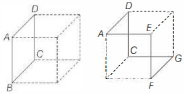
The current in flowing along the path $A B C D$ of a cube (shown in the left figure) produces a magnetic field at the centre of cube of magnitude $B$. Dashed line depicts the non-conducting part of the cube. Consider a cubical shape shown to the right which is identical in size and shape to the left. If the same current now flows in along the path $D A E F G C D$, then the magnitude of magnetic field at the centre will be
In $\gamma\ \text{ray}$ emission from a nucleus:
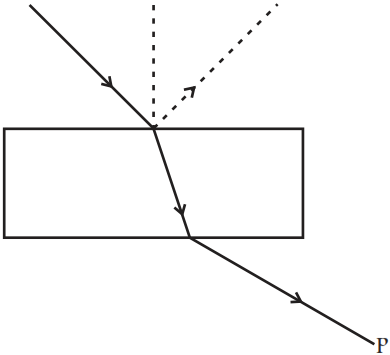
Consider a light beam incident from air to a glass slab at Brewster's angle as shown in Fig. A polaroid is placed in the path of the emergent ray at point $P$ and rotated about an axis passing through the centre and perpendicular to the plane of the polaroid.
A thin prism of angle $15^o$ made of glass of refractive index $\mu_1  = 1.5$ is combined with another prism of glass of refractive index $\mu_2  = 1.75.$ The combination of the prisms produces dispersion without deviation. The angle of the second prism should be ......$^o$