MCQ
Mark the correct options:
  • A
    A system X is in thermal equilibrium with Y but not with Z. System Y and Z may be in thermal equilibrium with each other.
  • B
    A system X is in thermal equilibrium with Y but not with Z. Systems Y and Z are not in thermal equilibrium with each other.
  • C
    A system X is neither in thermal equilibrium with Y nor with Z. The systems Y and Z must be in thermal equilibrium with each other.
  • D
    A system X is neither in thermal equilibrium with Y nor with Z. The system Y and Z may be in thermal equilibrium with each other.
Answer

  1. A system X is in thermal equilibrium with Y but not with Z. Systems Y and Z are not in thermal equilibrium with each other.
  1. A system X is neither in thermal equilibrium with Y nor with Z. The system Y and Z may be in thermal equilibrium with each other.
Explanation:

Key concept: Two bodies are said to be in thermal equilibrium with each otherwhen no heat flows from one body to the other. That is when both the bodies are at the same temperature.

According to the problem,

  1. If two systems X and Y are in thermal equilibrium, i.e., Tx = Ty and x is not in thermal equilibrium with z, i.e., Tx ≠ Tz then clearly, Ty ≠ Tz. Hence, y and z are not in thermal equilibrium.
  2. If X ais not in thermal equilibrium with Y, i.e., Tx ≠ Ty and also X is not thermal equilibrium with Y, i.e., Tx ≠ Tz. Then we cannot say about equilibrium of Y and Z, they may or may not be in equilibrium.

Need a full question paper?

Generate a complete, print-ready paper with questions like this in minutes — across 16+ boards, with answer keys.

Start Generating Free

Similar questions

Two particles A and B, initially at rest, moves towards each other under a mutual force of attraction. At the instant when the speed of A is u and the speed of B is 2u, the speed of centre of mass is:
A gardner waters the plants by a pipe of diameter $1\,mm.$ The water comes out at the rate or $10 \,cm^3/sec$. The reactionary force exerted on the hand of the gardner is
A small bob tied at one end of a thin string of length $1\, m$ is describing a vertical circle so that the maximum and minimum tension in the string are in the ratio $5: 1 .$ The velocity of the bob at the height position is ............. $m / s$ (Take $\left.g=10 \,m / s ^{2}\right)$
A stick has its bottom end attached to a wall by a pivot and is held up by a massless string attached to its other end. Which of the following scenarios has the smallest tension in the string ? (Length of stick is same in all scenarios)
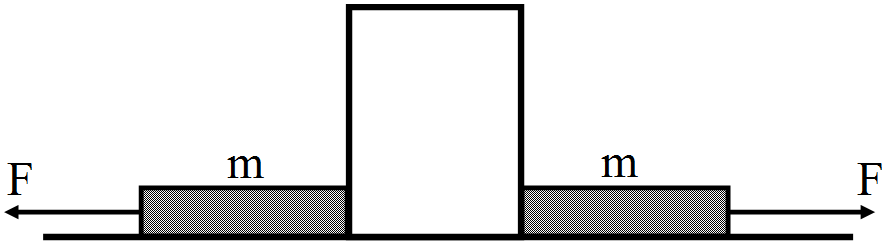
Figure shows a heavy block kept on a frictionless surface and being pulled by two ropes of equal mass m. At t = 0, the force on the left rope is withdrawn but the
force on the right end continues to act. Let F1 and F2 be the magnitudes of the forces by the right rope and the left rope on the block respectively:

  1. F= F2 = F for t < 0.
  2. F1 = F2 = F + mg for t < 0.
  3. F1 = F, F2 = F for t > 0.
  4. F1< F, F2 = F for t > 0.
A block of mass M is hanging over a smooth and light pulley through a light string. T he other end of the string is pulled by a constant force F. The kinetic energy of the block increases by 20J in 1s.
  1. The tension in the string is Mg.
  2. The tension in the string is F.
  3. The work one by the tension on the block is 20J in the above 1s.
  4. The work done by the force of gravity is -20J in the above 1s.
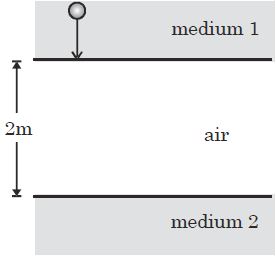
A bead is moving in medium $1$ with a uniform speed of $1\, m \,s^{-1}$ for $2.5\, s$. Then it enters into air and falls freely under gravity for $2\, m$. Finally, it enters medium $2$ and immediately moves with uniform speed for $1.5\, s$. The total distance the bead has traveled, is.........$m$ $(g = 10\, m/s^2$):
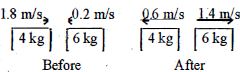
In figure, determine the type of the collision The masses of the blocks, and the velocities before and after the collision are given. The collision is
Ship $A$ is sailing towards north -east with velocity $\vec v = 30\,\hat i + 50\hat j\,km/hr$ where $\hat i$ points east and $\hat j$ , north. Ship $B$ is at a distance of $80\, km$ east and $150\, km$ north of Ship $A$ and is sailing towards west at $10\, km/hr$. $A$ will be at minimum distance from $B$ is.........$hrs$
The liquid meniscus in capillary tube will be convex, if the angle of contact is