MCQ
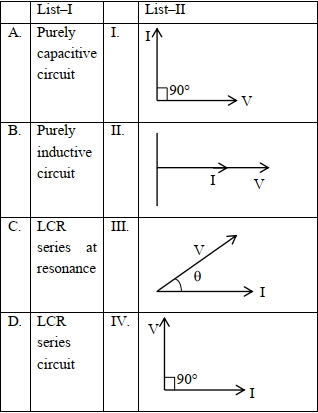
Match List I with List $II$

Choose the correct answer from the options given below:
  • A
    $A-I, B-IV, C-III, D-II$
  • B
    $A-IV, B-I, C-III, D-II$
  • C
    $A-IV, B-I, C-II, D-III$
  • $A-I, B-IV, C-II, D-III$

Answer

Correct option: D.
$A-I, B-IV, C-II, D-III$
d
$A - V$ lags by $90^{\circ}$ from I hence option $(I)$ is correct.

$B - V$ lead by $90^{\circ}$ from $I$ hence option $(IV)$ is correct

$\mathrm{C}-\mathrm{In} \mathrm{LCR}$ resonance $\mathrm{X}_{\mathrm{L}}=\mathrm{X}_{\mathrm{C}}$. Hence circuit is purely resistive so option $(II)$ is correct $D$ - In LCR series $V$ is at some angle from $I$ hence $(III)$ is correct

Hence option $(4)$ is correct.

Need a full question paper?

Generate a complete, print-ready paper with questions like this in minutes — across 16+ boards, with answer keys.

Start Generating Free

Similar questions

Which of the following statements is not true
A transistor is connected in common emitter $(CE)$ configuration. The collector supply is $8$  $V$ and the voltage drop across a resistor of $800$ $\Omega$ in the collector circuit is $0.5$  $V$. If the current gain factor $\alpha$  is $0.96$, find the base current......$μA$
An equiconvex lens of glass of focal length $0.1$ metre is cut along a plane perpendicular to principle axis into two equal parts. The ratio of focal length of new lenses formed is
The example of nuclear fusion is
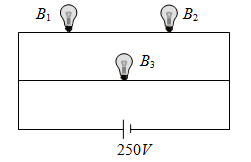
A 100 W bulb $B_1$, and two $60-\mathrm{W}$ bulbs $B_2$ and $B_3$, are connected to a 250 V source, as shown in the figure. Now $W_1$, $W_2$ and $W_3$ are the output powers of the bulbs $B_1, B_2$ and $B_3$, respectively. Then
Those atoms which have the same atomic number but different mass number are called :
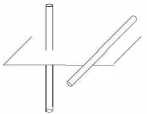
Two mutually perpendicular infinitely long straight conductors carrying uniformly distributed charges of linear densities $\lambda_{1}$ and $\lambda_{2}$ are positioned at a distance $r$ from each other. Force between the conductors depends on $r$ as
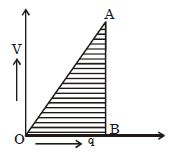
The charge $q$  on a capacitor varies with voltage as shown in figure. The area of the triangle $AOB $ represents
In $R - L - C$ series circuit, the potential differences across each element is $20V$. Now the value of the resistance alone is doubled, then $P.D$. across $R, L$ and $C$ respectively.
The aperture diameter of a telescope is $5\; \mathrm{m} .$ The separation between the moon and the earth is $4 \times 10^{5} \;\mathrm{km} .$ With light of wavelength of $5500\;\mathring A$, the minimum separation between objects on the surface of moon, so that they are just resolved, is close to......$m$