Question
 Match the complex species given in Column I with the possible isomerism given in Column II and assign the correct code:

 
Column I (Complex species)
 
Column II (Isomerism)
a.
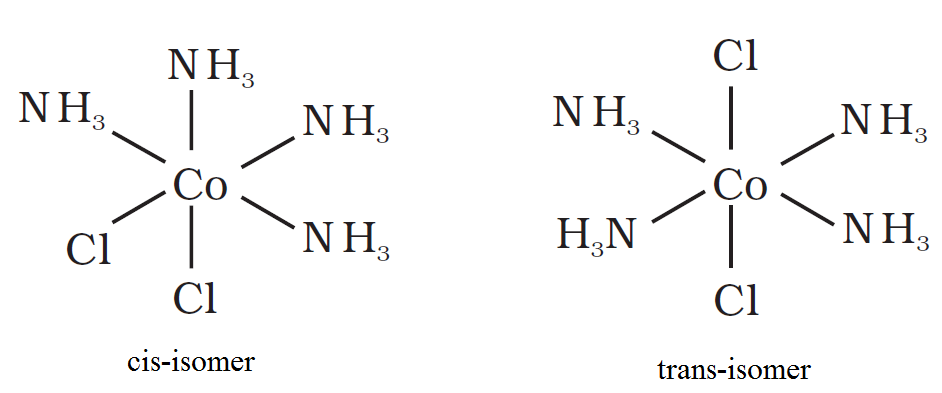
[Co(NH3)4Cl2]+
1.
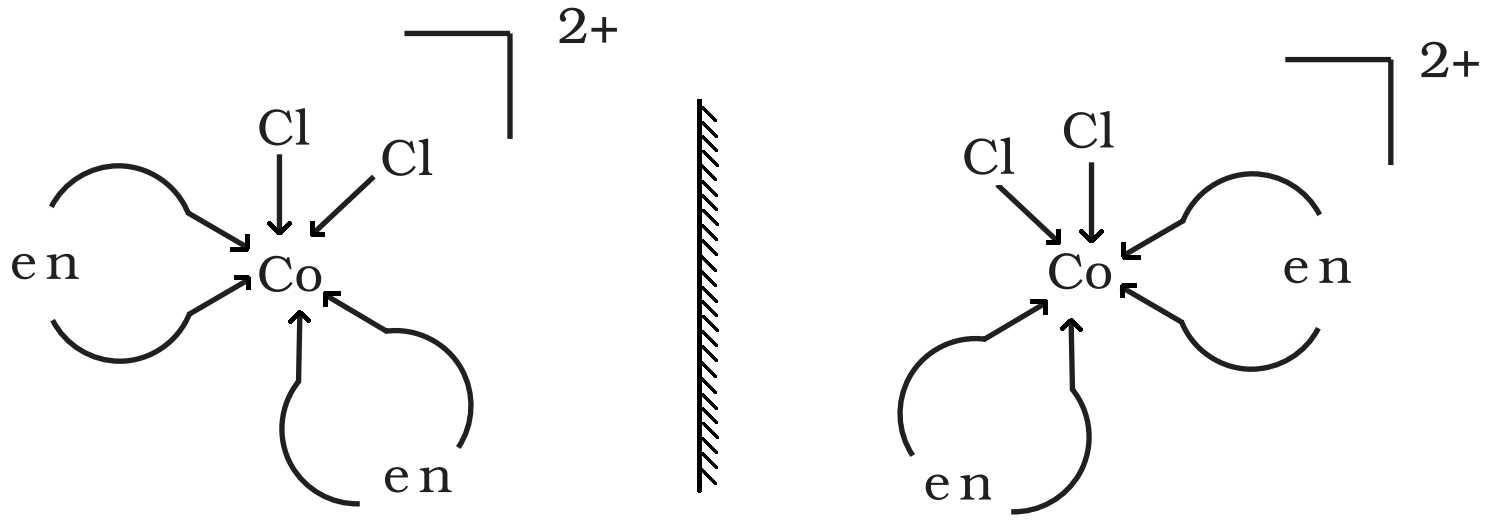
Optical
b.
cis-[Co(en)2Cl2]+
2.
Ionisation
c.
[Co(NH3)5 (NO2)]Cl2
3.
Coordination
d.
[Co(NH3)6][Cr(CN)6]
4.
Geometrical
 
 
5.
Linkage

Code:

  1. A (1), B (2), C (4), D (5).
  2. A (4), B (3), C (2), D (1).
  3. A (4), B (1), C (5), D (3).
  4. A (4), B (1), C (2), D (3).

Need a full question paper?

Generate a complete, print-ready paper with questions like this in minutes — across 16+ boards, with answer keys.

Start Generating Free

Similar questions

CoSO4Cl.5NH3 exists in two isomeric forms ‘A’ and ‘B’. Isomer ‘A’ reacts with AgNO3 to give white precipitate, but does not react with BaCl2. Isomer ‘B’ gives white precipitate with BaCl2 but does not react with AgNO3. Answer the following questions.
  1. Identify ‘A’ and ‘B’ and write their structural formulas.
  2. Name the type of isomerism involved.
  3. Give the IUPAC name of ‘A’ and ‘B’.
Answer the following questions:
Draw the structures of chromate and dichromate ions.
Match the property given in Column I with the element given in Column II.
 
Column I (Property)
 
Column II (Element)
(i)
Lanthanoid which shows +4 oxidation state
(a)
Pm
(ii)
Lanthanoid which can show +2 oxidation state
(b)
Ce
(iii)
Radioactive lanthanoid
(c)
Lu
(iv)
Lanthanoid which has 4felectronic configuration in +3 oxidation state
(d)
Eu
(v)
 Lanthanoid which has 4f14 electronic configuration in +3 oxidation state
(e)
Gd
 
 
(f)
Dy
Explain the mechanism of rusting of iron.
Explain the elimination reaction of haloalkanes.
  1. Answer the following questions briefly:
  1. What are reducing sugars?
  2. What is meant by denaturation of a protein?
  3. How is oxygen replenished in our atmosphere?
  1. Define enzymes.
The air is a mixture of a number of gases. The major components are oxygen and nitrogen with approximate proportion of 20% is to 79% by volume at 298 K. The water is in equilibrium with air at a pressure of 10 atm. At 298 K if the Henry’s law constants for oxygen and nitrogen at 298 K are 3.30 × 107 mm and 6.51 × 107 mm respectively, calculate the composition of these gases in water.
Classify carbohydrates and also give examples of each.