Questions

5 Marks Questions

🎯

Test yourself on this topic

9 questions · timed · auto-graded

Question 15 Marks
What is meant by stability of a coordination compound in solution? State the factors which govern stability of complexes.
Answer
The stability of a complex in a solution refers to the degree of association between the two species involved in a state of equilibrium. Stability can be expressed quantitatively in terms of stability constant or formation constant.

$\text{M}+3\text{L}\leftarrow\rightarrow\text{ML}_{3}$

Stability constant, $\beta=\frac{[\text{ML}_{3}]}{[\text{M}][\text{L}]^{3}}$

For this reaction, the greater the value of the stability constant, the greater is the proportion of ML3 in the solution.

Stability can be of two types:

  1. Thermodynamic stability:

The extent to which the complex will be formed or will be transformed into another species at the point of equilibrium is determined by thermodynamic stability.

  1. Kinetic stability:

This helps in determining the speed with which the transformation will occur to attain the state of equilibrium.

Factors that affect the stability of a complex are:

  1. Charge on the central metal ion: Thegreater the charge on the central metal ion, the greater is the stability of the complex.

  2. Basic nature of the ligand: A more basic ligand will form a more stable complex.

  3. Presence of chelate rings: Chelation increases the stability of complexes.
View full question & answer
Question 25 Marks
 Match the compounds given in Column I with the oxidation state of cobalt present in it (given in Column II) and assign the correct code.

 
Column I (Compound)
 
Column II (Oxidation state of Co)
a.
[Co(NCS)(NH3)5](SO3)
1.
+4
b.
[Co(NH3)4Cl2]SO4
2.
0
c.
Na4[Co(S2O3)3]
3.
+1
d.
[Co2(CO)8]
4.
+2
 
 
5.
+3

Code:

  1. A (1), B (2), C (4), D (5).
  2. A (4), B (3), C (2), D (1).
  3. A (5), B (1), C (4), D (2).
  4. A (4), B (1), C (2), D (3).
Answer
  1. A (5), B (1), C (4), D (2).
 
Column I (Compound)
 
Column II (Oxidation state of Co)
a.
[Co(NCS)(NH3)5](SO3)
5.
+3
b.
[Co(NH3)4Cl2]SO4
1.
+4
c.
Na4[Co(S2O3)3]
4.
+2
d.
[Co2(CO)8]
2.
0

Explanation:

Oxdiation state of CMI (central metal ion) can be calculated by considering the oxidation state of whole molecule is equal to charge present on coordination sphere.

  1. [Co(NCS)(NH3)5]SO3

Let oxidation state of Co be x.

x - 1 + × 0 = +2

x = +2 + 1 = +3

  1. [Co(NH3)4Cl2]SO4

Let oxidation state of Co = x

⇒ x + 4 × 0 + 2 × (-1) = +2

⇒ x - 2 = +2

x = 4

  1. Na4[Co(S2O3)3]

Let oxidation state of Co = x

x + 3 × (-2) = -4

x - 6 = -4

x = -4 + 6 = +2

  1. [Co(CO)8]

Let oxidation state of Co = x

x - 8 × 0 = 0

x = 0

Hence, correct choice is (d).

View full question & answer
Question 35 Marks
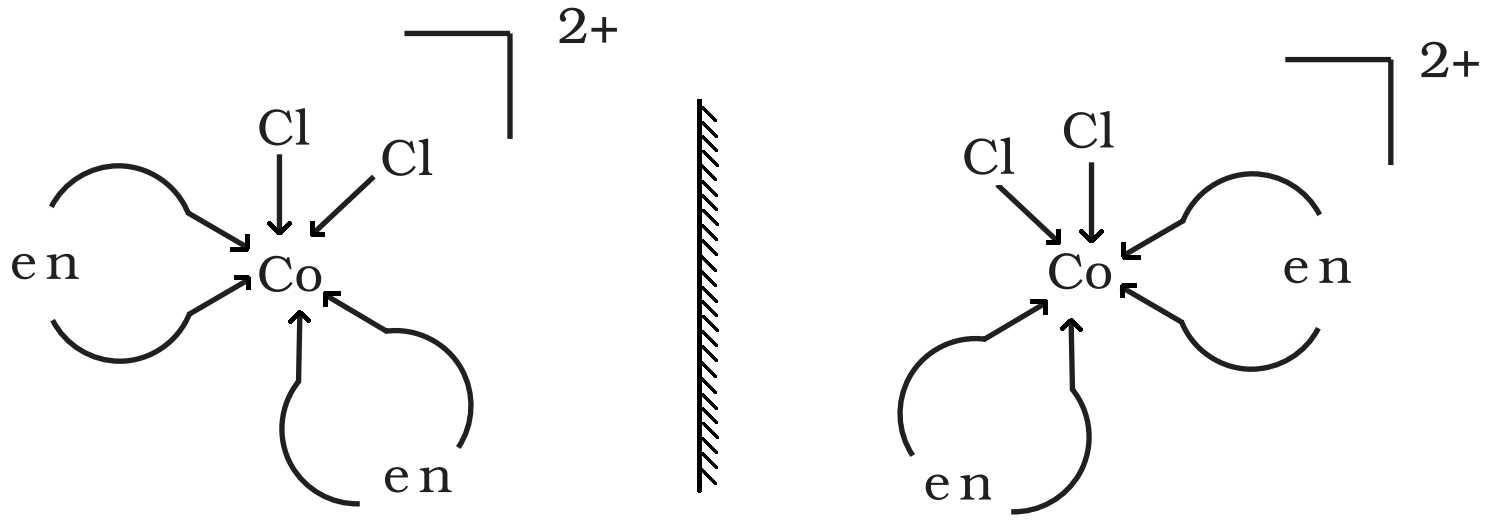
 Match the complex species given in Column I with the possible isomerism given in Column II and assign the correct code:

 
Column I (Complex species)
 
Column II (Isomerism)
a.
[Co(NH3)4Cl2]+
1.
Optical
b.
cis-[Co(en)2Cl2]+
2.
Ionisation
c.
[Co(NH3)5 (NO2)]Cl2
3.
Coordination
d.
[Co(NH3)6][Cr(CN)6]
4.
Geometrical
 
 
5.
Linkage

Code:

  1. A (1), B (2), C (4), D (5).
  2. A (4), B (3), C (2), D (1).
  3. A (4), B (1), C (5), D (3).
  4. A (4), B (1), C (2), D (3).
View full question & answer
Question 45 Marks
CoSO4Cl.5NH3 exists in two isomeric forms ‘A’ and ‘B’. Isomer ‘A’ reacts with AgNO3 to give white precipitate, but does not react with BaCl2. Isomer ‘B’ gives white precipitate with BaCl2 but does not react with AgNO3. Answer the following questions.
  1. Identify ‘A’ and ‘B’ and write their structural formulas.
  2. Name the type of isomerism involved.
  3. Give the IUPAC name of ‘A’ and ‘B’.
Answer
CoSO4Cl.5NH3:

  1. Isomer A reacts with AgN03 but not with BaCl2, it shows it has CP ion outside the coordination sphere.

Hence, A = [Co(NH3)5SO4]Cl
Isomer B reacts with BaCl2 but not with AgNO3 , it shows it has SO4outside the coordination sphere.

Hence, B = [CO(NH3)5Cl]S04

  1. Ionisation isomerism.
  2. A = Pentaamminesulphatocobalt (III) chloride and.

B = Pentaamminesulphatocobalt (III) sulphate.

View full question & answer
Question 55 Marks
Match the complex ions given in Column I with the hybridisation and number of unpaired electrons given in Column II and assign the correct code:
 
Column I (Complex ion)
 
Column II (Hybridisation, number of unpaired electrons)
a.
[Cr(H2O)6]3+
1.
dsp2, 1
b.
[Co(CN)4]2-
2.
sp3d2, 5
c.
[Ni(NH3)6]2+
3.
d2sp3, 3
d.
[MnF6]4-
4.
sp3, 4
 
 
5.
sp3d2, 2
Code:
  1. A (3), B (1), C (5), D (2).
  2. A (4), B (3), C (2), D (1).
  3. A (3), B (2), C (4), D (1).
  4. A (4), B (1), C (2), D (3).
Answer
  1. A (4), B (3), C (2), D (1).
 
Column I (Complex ion)
 
Column II (Hybridisation, number of unpaired electrons)
a.
[Cr(H2O)6]3+
4.
sp3, 4
b.
[Co(CN)4]2-
3.
d2sp3, 3
c.
[Ni(NH3)6]2+
2.
sp3d2, 5
d.
[MnF6]4-
1.
dsp2, 1
View full question & answer
Question 65 Marks
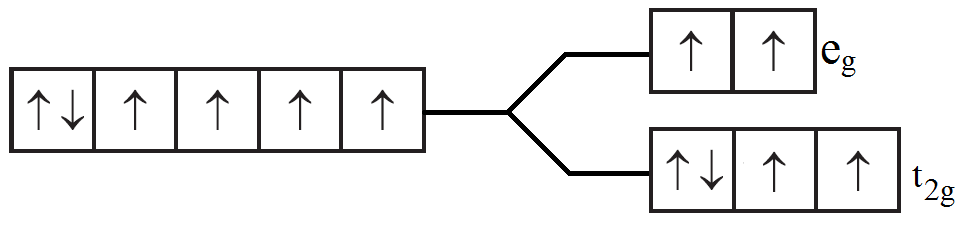
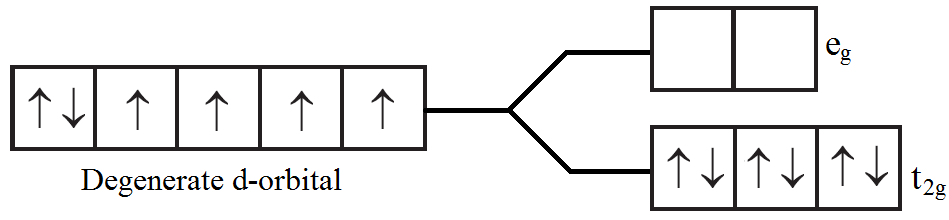
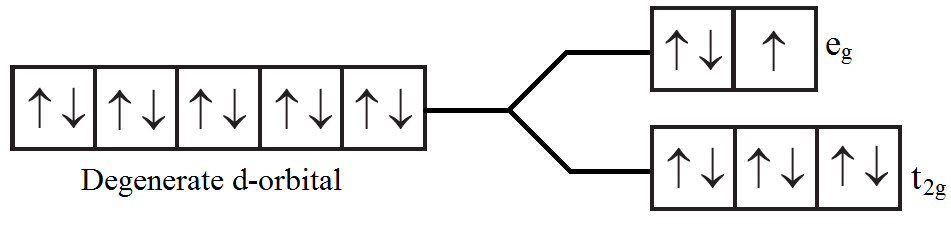
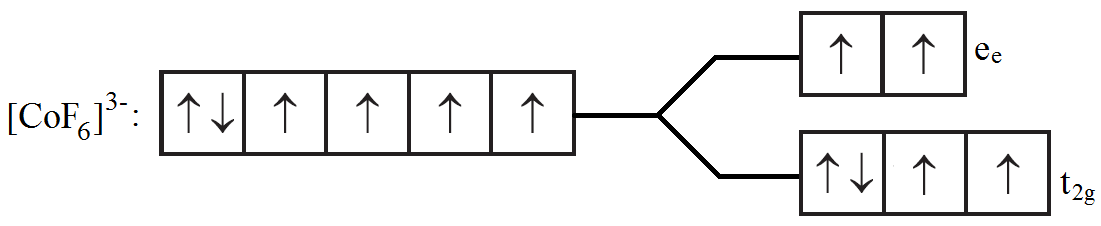
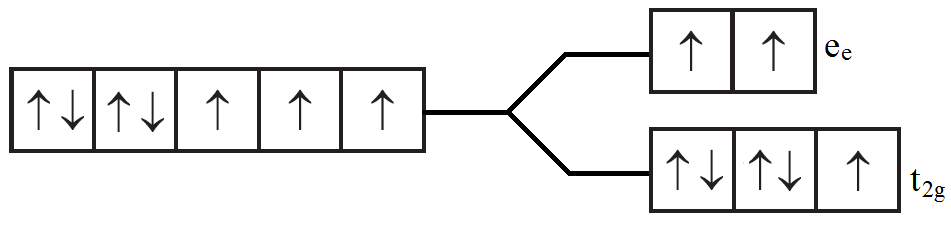
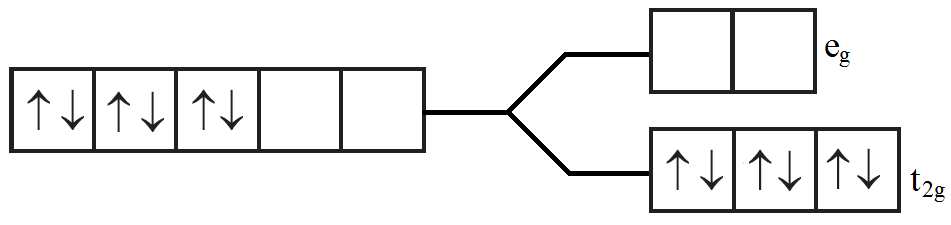
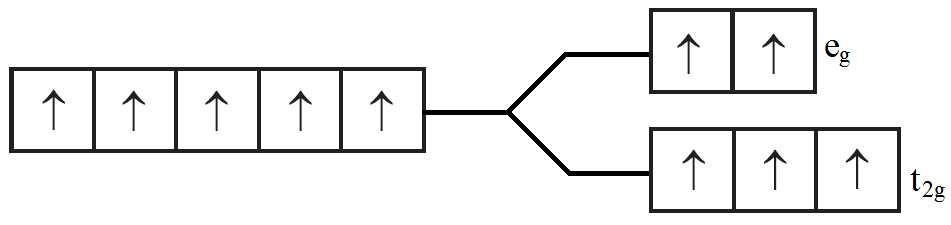
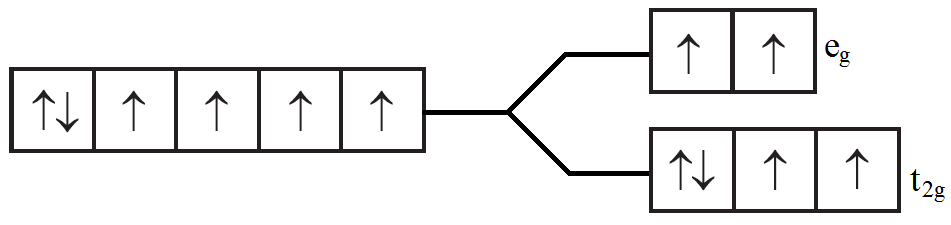
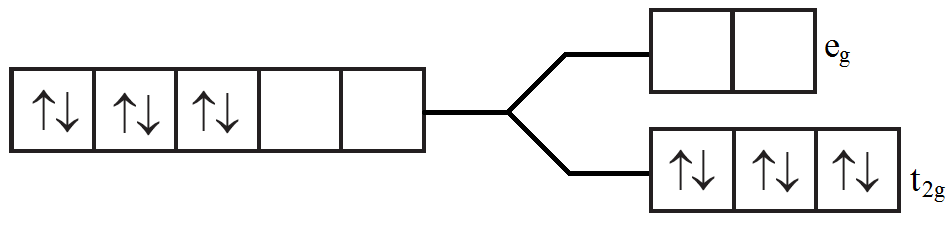
Give the electronic configuration of the following complexes on the basis of Crystal Field Splitting theory.
[CoF6]3-, [Fe(CN)6]4- and [Cu(NH3)6]2+
View full question & answer
Question 75 Marks
Match the complex ions given in Column I with the colours given in Column II and assign the correct code:
 
Column I (Complex ion)
 
Column II (Colour)
a.
[Co(NH3)6]3+
1.
Violet
b.
[Ti(H2O)6]3+
2.
Green
c.
[Ni(H2O)6]2+
3.
Pale blue
d.
[Ni(H2O)4(en)]2+ (aq)
4.
Yellowish orange
 
 
5.
Blue
Code:
  1. A (1), B (2), C (4), D (5).
  2. A (4), B (3), C (2), D (1).
  3. A (3), B (2), C (4), D (1).
  4. A (4), B (1), C (2), D (3).
Answer
  1. A (4), B (1), C (2), D (3).
 
Column I (Complex ion)
 
Column II (Colour)
a.
[Co(NH3)6]3+
4.
Yellowish orange
b.
[Ti(H2O)6]3+
1.
Violet
c.
[Ni(H2O)6]2+
2.
Green
d.
[Ni(H2O)4(en)]2+ (aq)
3.
Pale blue
View full question & answer
Question 85 Marks
Match the coordination compounds given in Column I with the central metal atoms given in Column II and assign the correct code:
 
Column I (Coordination Compound)
 
Column II (Central metal atom)
a.
Chlorophyll
1.
Rhodium
b.
Blood pigment
2.
Cobalt
c.
Wilkinson catalyst
3.
Calcium
d.
Vitamin B12
4.
Iron
 
 
5.
Magnesium
Code:
  1. A (5), B (4), C (1), D (2).
  2. A (3), B (4), C (5), D (1).
  3. A (4), B (3), C (2), D (1).
  4. A (3), B (4), C (1), D (2).
Answer
  1. A (5), B (4), C (1), D (2).
 
Column I (Coordination Compound)
 
Column II (Central metal atom)
a.
Chlorophyll
5.
Magnesium
b.
Blood pigment
4.
Iron
c.
Wilkinson catalyst
1.
Rhodium
d.
Vitamin B12
2.
Cobalt
View full question & answer
Question 95 Marks
Using crystal field theory, draw energy level diagram, write electronic configuration of the central metal atom/ion and determine the magnetic moment value in the following:
  1. $[\text{CoF}_6]^{3-}, [\text{Co(H}_2\text{O})_6]^{2+}, [\text{Co(CN)}_6]^{3-}$
  2. $[\text{FeF}_6]^{3-}, [\text{Fe(H}_2\text{O})_6]^{2+}, [\text{Fe(CN})_6]^{4-}$
View full question & answer