Question
Match the items given in Column I and Column II.
 
Column I
 
Column II
i.
Saturated solution
a.
Solution having same osmotic pressure at a given temperature as that of given solution.
ii.
Binary solution
b.
A solution whose osmotic pressure is less than that of another.
iii.
Isotonic solution
c.
Solution with two components.
iv.
Hypotonic solution
d.
A solution which contains maximum amount of solute that can be dissolved in a given amount of solvent at a given temperature.
v.
Solid solution
e.
A solution whose osmotic pressure is more than that of another.
vi
Hypertonic solution
f.
A solution in solid phase.

Need a full question paper?

Generate a complete, print-ready paper with questions like this in minutes — across 16+ boards, with answer keys.

Start Generating Free

Similar questions

i. Tert-Butylamine cannot be prepared by the action of NH3 on tert-butyl bromic. Explain why?
ii. Suggest a convenient method for the preparation of tert-butylamine.
Explain the following reactions of phenol :
(i) Nitration
(ii) Gatterman aldehyde synthesis
(iii) Fries rearrangement
(iv) Reaction with mercuric acetate.
Specify the oxidation numbers of the metals in the following coordination entities:
i. $\left[ Co \left( H _2 O \right)( CN )( en )_2\right]^{2+}$
ii. $\left[ Pt ( Cl )_4\right]^{2-}$
iii. $K _3\left[ Fe ( CN )_6\right]$
iv. $\left[ Cr \left( NH _3\right)_3 Cl _3\right]$
Match the coordination compounds given in Column I with the central metal atoms given in Column II and assign the correct code:
 
Column I (Coordination Compound)
 
Column II (Central metal atom)
a.
Chlorophyll
1.
Rhodium
b.
Blood pigment
2.
Cobalt
c.
Wilkinson catalyst
3.
Calcium
d.
Vitamin B12
4.
Iron
 
 
5.
Magnesium
Code:
  1. A (5), B (4), C (1), D (2).
  2. A (3), B (4), C (5), D (1).
  3. A (4), B (3), C (2), D (1).
  4. A (3), B (4), C (1), D (2).
Explain the various uses of lanthanoids.
Answer the following questions:
Assign reasons for the following:
  1. In the series Sc (Z = 21) to Zn (Z = 30), the enthalpy of atomisation of Zn is the lowest.
  2. Zr and Hf have almost identical radii.
  3. Transition metals show variable oxidation states.
  4. The E°M2+/M value for copper is positive (+0.34 V).
Why is it not possible to obtain pure ethanol by fractional distillation? What general name is given to binary mixtures which show deviation from Raoult’s law and whose components cannot be separated by fractional distillation. How many types of such mixtures are there?
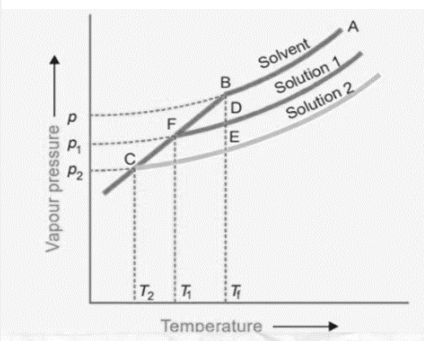
(a). An experiment was carried out in the laboratory, to study depression in freezing point. 1M aqueous solution of Al(NO3)3 and 1 M aqueous solution of glucose were taken. From the given figure identify solution 1 and solution 2. Give a plausible reason for your answer
Image
(b). The osmotic pressure of a solution of cane sugar was found to be 2.46 atm at 300 K. If the solution was diluted five times, calculate the osmotic pressure at the same temperature.
How can the osmotic pressure of the given cane sugar solution be decreased without changing its volume? Give a reason for your answer.
Attempt any five of the following:
(a) What are Purines and Pyrimidines? Name the purines and Pyrimidines present in DNA and RNA nucleic Acids.
(b) Write the full forms of DNA and RNA.
(c) Name the vitamin whose deficiency causes convulsions.
(d) Which vitamin B group can be stored in our body?
(e) (i). What is the difference between a nucleoside and nucleotide?
(ii). Write one difference between a-helix and ẞ-pleated sheet structures of protein.
(f) What are nucleic acids? Why two strands in DNA are not identical but are complementary?
(g) Some enzymes are named after the reaction, where they are used. What name is given to the class of enzymes which catalyse the oxidation of one substrate with simultaneous reduction of another substrate?
Discuss electrochemical principle regarding rusting of iron.