Question
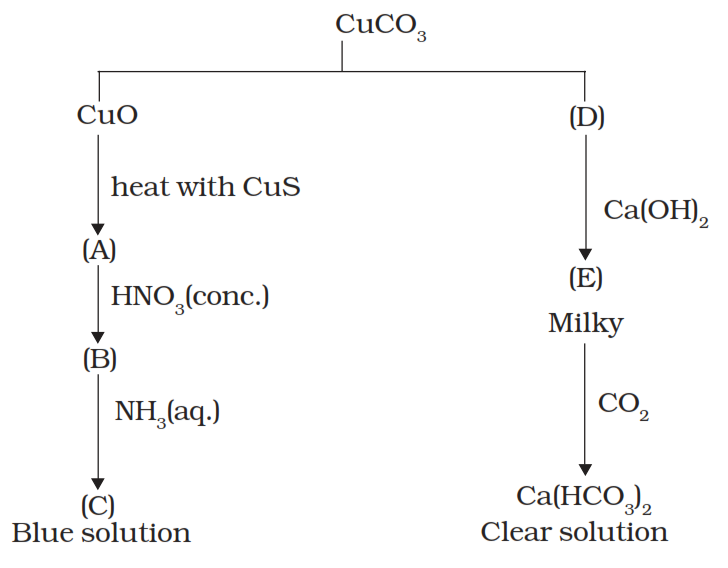
Identify $A$ to $E$ and also explain the reactions involved.

Answer

$\ce{A = CuB = Cu(NO_3)_2}$
$\ce{C = [Cu(NH_3)_4](NO_2)_2}$
$\ce{D = CO_2}$
$\ce{E = CaCO_3}$
$\ce{F = Cu_2[Fe(CN)_6]}$
$\ce{G = Ca(HCO_3)_2}$
$\text{CuCO}_3\rightarrow\text{CuO}+\text{CO}_2\\ \ \ \ \ \ \ \ \ \ \ \ \ \ \ \ \ \ \ \ \ \ \ \ \ \ \ \ \ \ \ \ \ \ \ ^{\text{(D)}}$
$\text{CuO}+\text{CuS}\rightarrow\text{Cu}+\text{SO}_2\\ \ \ \ \ \ \ \ \ \ \ \ \ \ \ \ \ \ \ \ \ \ \ \ \ \ \ \ \ ^{\text{(A)}}$
$\text{Cu}+\text{4HNO}_3\text{(Conc.)}\rightarrow[\text{Cu(NO}_3)_2+2\text{NO}+2\text{H}_2\text{O}\\ \ \ \ \ \ \ \ \ \ \ \ \ \ \ \ \ \ \ \ \ \ \ \ \ \ \ \ \ \ \ \ \ \ \ \ \ \ \ \ \ \ \ \ \ \ \ \ \ \ \ ^\text{(B)}$
$\text{Cu}^{2+}+\text{NH}_3\rightarrow[\text{Cu(NH}^3)^4]\\ \ \ \ ^\text{(B)} \ \ \ \ \ \ \ \ \ \ \ \ \ \ \ \ \ \ \ \ \ \ \ \ \ \ \ \ \ \ ^\text{(C)}$
$\text{Ca(OH})_2+\text{CO}_2\rightarrow\text{CaCO}_3+\text{H}_2\text{O}\\ \ \ \ \ \ \ \ \ \ \ \ \ \ \ \ \ \ \ \ \ ^\text{(D)} \ \ \ \ \ \ \ \ \ \ \ \ \ ^\text{(E)}$
$\text{CaCO}_3+\text{H}_2\text{O}+\text{CO}_2\rightarrow\text{Ca(HCO}_3)_2$

Need a full question paper?

Generate a complete, print-ready paper with questions like this in minutes — across 16+ boards, with answer keys.
Start Generating Free

Similar questions

What is the difference between osmosis and diffusion?
Graphically explain the effect of temperature on the rate constant of reaction. How can this temperature effect on rate constant be represented quantitatively?
  1. Give reasons for the following:
  1. $Mn^{3+ }$ is a good oxidizing agent.
  2. $ E^0 m^{2+} / M $ values are not regular for first row transition metals. $(3d$ series$)$
  3. Although $‘F’$ is more electronegative then $‘O’$, the highest Mn fluoride is $Mnf_4$, whereas the highest oxide is $Mn_2O_7$.
  1. Complete the following equations:
$\text{2CrO}_{4}^{2}+\text{2H}^{+}\rightarrow$
$\text{KMnO}_{4}\xrightarrow{heat}$ 
  1. How is the variability in oxidation states of transition metals different from that of the $p-$block elements?
  2. Out of $Cu^+$ and $Cu^{2+}$, which ion is unstable in aqueous solution and why?
  3. Orange colour of $Cr_2O_7^{2–}$ ion changes to yellow when treated with an alkali. Why?
  4. Chemistry of actinoids is complicated as compared to lanthanoids. Give two reasons.
An organic compound contains $69.77 \%$ carbon, $11.63 \%$ hydrogen and rest oxygen. The molecular mass of the compound is 86 . It does not reduce Tollens' reagents but forms an addition compound with sodium hydrogen sulphite and give positive iodoform test on vigorous oxidation it gives ethanoic and propanoic acid. Write the possible structure of the compound.
Explain the different methods of preparing haloakanes from alcohols.
  1. Give three points of difference between lanthanoids and actinoids.
  2. Give reason and select one atom$/$ion which will exhibit asked property:
  1. $Sc^{3+}$ or $Cr^{3+} ($Exhibit diamagnetic behaviour$).$
  2. $Cr$ or $Cu ($High melting and boiling point$).$
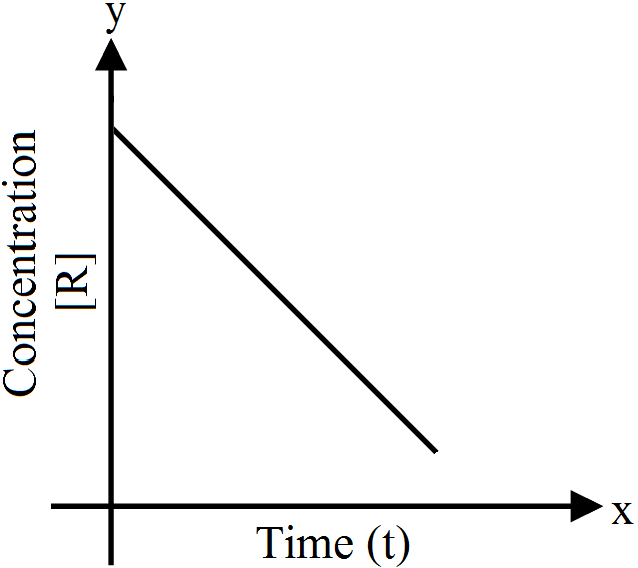
Consider the reaction $\text{R}\xrightarrow{\ \ \text{k}\ \ } \text{P}.$ The change in concentration of $R$ with time is shown in the following plot:
  1. Predict the order of the reaction.
  2. Derive the expression for the time required for the completion of the reaction.
  3. What does the slope of the above line indicate?
When kept in water, raisin swells in size. Name and explain the phenomenon involved with the help of a diagram. Give three applications of the phenomenon.
Write two applications of electrochemical series.