Question
Match the species given in Column I with the shape given in Column II and mark the correct option.
  Column I   Column II
(A) $\text{SF}_4$ (1) Tetrahedral
(B) $\text{BrF}_3$ (2) Pyramidal
(C) $\text{BrO}_3^-$ (3) Sea-saw shaped
(D) $\text{NH}_4^+$ (4) Bent T-shaped
  1. A (3) B (2) C (1) D (4)
  2. A (3) B (4) C (2) D (1)
  3. A (1) B (2) C (3) D (4)
  4. A (1) B (4) C (3) D (2)

Answer

  Column I   Column II
(A) $\text{SF}_4$ (3) Sea-saw shaped
(B) $\text{BrF}_3$ (4) Bent T-shaped
(C) $\text{BrO}_3^-$ (2) Pyramidal
(D) $\text{NH}_4^+$ (1) Tetrahedral
  1. A (3) B (4) C (2) D (1)
Explanation:
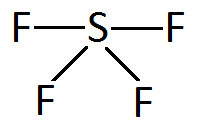
  1.  
Species: $\text{SF}_4$
Shape: Sea-saw shaped
Structure
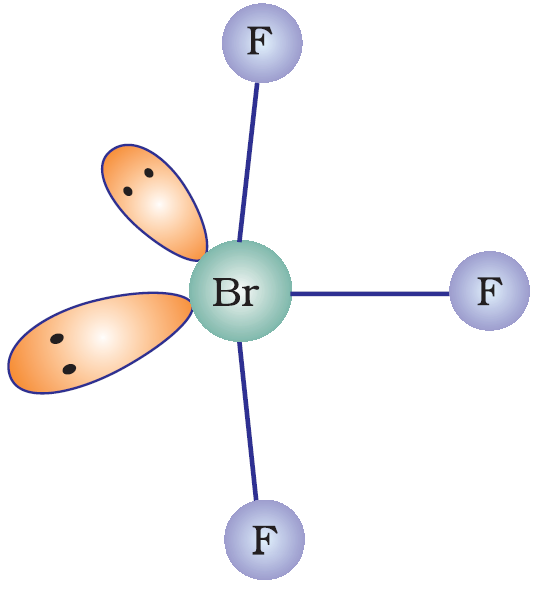
  1.  
Species: $\text{BrF}_3$
Shape: Bent T-shaped
Structure:
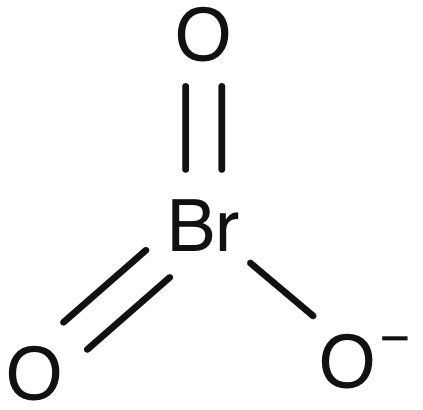
  1.  
Species: $\text{BrO}_3^-$
Shape: Pyramidal
Structure:
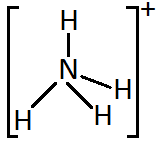
  1.  
Species: $\text{NH}_4^+$
Shape: Tetrahedral
Structure:

Need a full question paper?

Generate a complete, print-ready paper with questions like this in minutes — across 16+ boards, with answer keys.

Start Generating Free

Similar questions

An element has fcc structure with a cell edge 200pm. Calculate the density of element, if $200\ g$ of the element contains $24 \times 1023$ atoms.
Answer the following questions: For $M^{2+}/M$ and $M^{3+}/M^{2+}$^ systems, $E^\circ $ values for some metals are as follows:
$Cr^{2+}/Cr = - 0.9 V$ $Cr^{3+}/Cr^{2+} = - 0.4 V$
$Mn^{2+}/Mn = 0 1.2 V$ $Mn^{3+}/Mn^{2+} = +1.5 V$
$Fe^{2+}/Fe = - 0.4 V$ $Fe^{3+}/Fe^{2+} = +0.8 V$
Use this data to comment upon:
  1. The stability of $Fe^{3+}$​​​​​​​^ in acid solution as compared to that of $Cr^{3+}$​​​​​​​^ and $Mn^{3+}.$
  2. The ease with which iron can be oxidised as compared to the similar process for either Cr or Mn metals.
Match the solutions given in Column I and the colours given in Column II.
 
Column I
(Aqueous solution of salt)
 
Column II
(Colour)
$(i)$
$FeSO_4.7H_2O$
$(a)$
Green
$(ii)$
$NiCl_2.4H_2O$
$(b)$
Light pink
$(iii)$
$MnCl_2.4H_2O$
$(c)$
Blue
$(iv)$
$CoCl_2.6H_2O$
$(d)$
Pale green
$(v)$
$Cu_2Cl_2$
$(e)$
Pink
 
 
$(f)$
Colourless
$(a).$ Out of formic acid and acetic acid, which one will give the $HVZ$ reaction? Give a suitable reason in support of your answer and write the chemical reaction involved.
$(b).$ Alcohols are acidic but they are weaker acids than water. Arrange various isomers of butanol in the increasing order of their acidic nature. Give a reason for the same.
$(c).$ An organic compound $A$ which is a Grignard reagent is used to obtain $2-$methylbutan$-2-ol$ on reaction with a carbonyl compound $'B \ '.$ Identify $'A \ '$ and $'B \ '.$ Write the equation for the reaction between $A$ and $B.$
Explain fuel cell in detail and explain the shortcomings of power generation from thermal plants.
Magnetic properties of coordination compounds. Explain in detail.
Match the items of Column I and Column II.
  Column I   Column II
(i) Mathematical expression for rate of reaction. (a) Rate constant.
(ii) Rate of reaction for zero order reaction is equal to. (b) Rate law.
(iii) Units of rate constant for zero order reaction is same as that of. (c) Oder of slowest step.
(iv) Order of a complex reaction is determined by. (d) Rate of a reaction.
Explain the limitations of valence bound theory.
$(a).$ While giving intravenous injections to the patients, the doctors take utmost care of the concentration of the solution used. Why is it necessary to check the concentration of the solution?
$(b).$ A solution of phenol was obtained by dissolving $2 \times10^{-2} \ kg$ of phenol in $1 \ kg$ of benzene. Experimentally it was found to be $73\%$ associated. Calculate the depression in the freezing point recorded.
Explain the IUPAC method of nomenclature coordination compounds with examples.