MCQ
Materials that allow electrons to flow through them are known as:
  • A
    Insulator
  • B
    Conductors
  • C
    Electrolytes
  • D
    Bases

Answer

  1. Conductors

Need a full question paper?

Generate a complete, print-ready paper with questions like this in minutes — across 16+ boards, with answer keys.
Start Generating Free

Similar questions

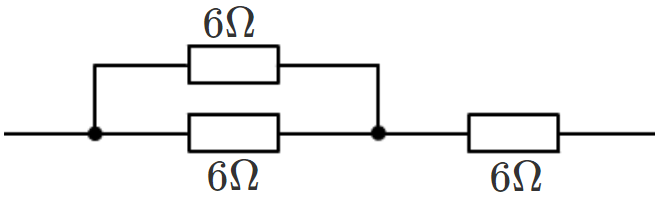
The diagram below shows part of a circuit:

If this arrangement of three resistors was to be replaced by a single resistor, its resistance should be:
The term " accommodation" as applied to the eye, refers to its ability to:
  1. Control the light intensity falling on the retina.
  2. Erect the inverted image formed on the retina.
  3. Vary the focal length of the lens.
  4. Vary the distance between the lens and retina.
A student has obtained an image of a distant object on a screen to determine the focal length Fl of the given lens. His teacher after checking the image, gave him another lens of focal length F2 and asked to focus the same object on the same screen. The student found that to obtain a sharp image he has to move the lens away from the screen. From this finding we may conclude that both the lenses given to the student were:
If the focal length of a spherical mirror is 12.5cm, its radius of curvature will be:
A person cannot see the distant objects clearly (though he can see the nearby objects clearly). He is suffering from the defect of vision called:
  1. Cataract.
  2. Hypermetropia.
  3. Myopia.
  4. Presbyopia.
The resistance of a wire of length 300m and cross-section area 1.0mm2 made of material of resistivity $1.0\times10−7 Ω\ \text{m}$ is:
  1. $2 Ω$
  2. $3 Ω$
  3. $20 Ω$
  4. $30 Ω$
n order to obtain a magnification of, −0.6 (minus 0.6) with a concave mirror, the object must be placed:
  1. At the focus.
  2. Between pole and focus.
  3. Between focus and centre of curvature.
  4. Beyond the centre of curvature.
The figure given below shows three resistors?


Their combined resistance is:

  1. $1\frac{5}{7}\Omega$

  2. $14\Omega$

  3. $6\frac{2}{3}\Omega$

  4. $7\frac{1}{2}\Omega$

Which of the following units could be used to measure electric charge?
  1. Ampere.
  2. Joule.
  3. Volt.
  4. Coulomb.
Linear magnification (m) produced by a rear view mirror fitted in vehicles: