Question
Maximum Z = 4x + 3y
Subject to
$3\text{x}+4\text{y}\leq24$
$8\text{x}+6\text{y}\leq48$
$\text{x}\leq5$
$\text{y}\leq6$
$\text{x},\text{y}\geq0$
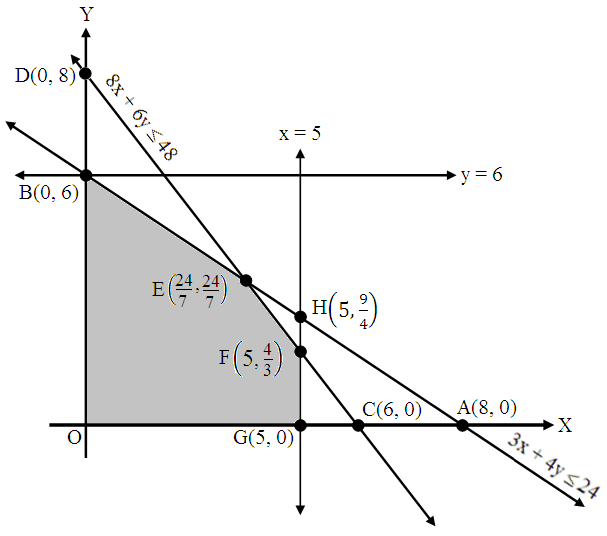
Answer

We need to maximize Z= 4x + 3y
First, we will convert the given inequations into equations, we obtain the following equations:
3x + 4y = 24, 8x + 6y = 48, x = 5, y = 6, x = 0 and y = 0.
The line 3x + 4y = 24 meets the coordinate axis at A(8, 0) and B(0, 6).
Join these points to obtain the line 3x + 4y = 24.
Clearly, (0, 0) satisfies the inequation $3\text{x}+4\text{y}\leq24$.
So, the region in xy-plane that contains the origin represents the solution set of the given equation.
The line 8x + 6y = 48 meets the coordinate axis at C(6, 0) and D(0, 8).
Join these points to obtain the line 8x + 6y = 48.
Clearly, (0, 0) satisfies the inequation $8\text{x}+6\text{y}\leq48$.
So, the region in xy-plane that contains the origin represents the solution set of the given equation.
x = 5 is the line passing through x = 5 parallel to the Y axis.
y = 6 is the line passing through y = 6 parallel to the X axis.
Region represented by $\text{x}\geq0$ and $\text{y}\geq0$: Since, every point in the first quadrant satisfies these inequations.
So, the first quadrant is the region represented by the inequations.
These lines are drawn using a suitable scale.

The corner points of the feasible region are O(0, 0), G(5, 0), $\text{F}\Big(5,\frac{4}{3}\Big),\text{E}\Big(\frac{24}{7},\frac{24}{7}\Big)$ and B(0, 6).
The values of Z at these corner points are as follows.
$\text{Corner point}$ $\text{Z}=4\text{x}+3\text{y}$
$\text{O}(0, 0)$ $4\times0+3\times0=0$
$\text{G}(5, 0)$ $4\times5+3\times0=20$
$\text{F}\Big(5,\frac{4}{3}\Big)$ $4\times5+3\times\frac{4}{3}=24$
$\text{E}\Big(\frac{24}{7},\frac{24}{7}\Big)$ $4\times\frac{24}{7}+3\times\frac{24}{7}=\frac{196}{7}=24$
$\text{B}(0, 6)$ $4\times0+3\times6=18$
We see that the maximum value of the objective function Z is 24 which is at $\text{F}\Big(5,\frac{4}{3}\Big)$ and $\text{E}\Big(\frac{24}{7},\frac{24}{7}\Big)$.
Thus. the optimal value of is 24.

Need a full question paper?

Generate a complete, print-ready paper with questions like this in minutes — across 16+ boards, with answer keys.

Start Generating Free

Similar questions

Solve the following differential equation:
$\left(1+x^2\right) d y+2 x y\ d x=\cot x\ d x ; x \neq 0$
Show that the points whose position vectors are $-2\hat{\text{i}}+3\hat{\text{j}},\hat{\text{i}}+2\hat{\text{j}}+3\hat{\text{k}}$ and $7\hat{\text{i}}-\hat{\text{k}}$ are collinear.
If sin y = x sin (a + y), prove that $\frac{\text{dy}}{\text{dx}}=\frac{\sin^{2}\text{(a + y)}}{\sin\text{a}}.$
Discuss the continuity of $\text{f(x)}=\sin|\text{x}|$
Find the equation of the curve which passes through the point (2, 2) and satisfies the differential equation $\text{y}-\text{x}\frac{\text{dy}}{\text{dx}}=\text{y}^{2}+\frac{\text{dy}}{\text{dx}}.$
Evaluate the following integrals:$\int(\text{x}+1)\text{e}^{\text{x}}\log(\text{xe}^{\text{x}})\text{dx}$
If $\vec{\text{a}}=\text{a}_1\hat{\text{i}}+\text{a}_2\hat{\text{j}}+\text{a}_3\hat{\text{k}},\vec{\text{b}}=\text{b}_1\hat{\text{i}}+\text{b}_2\hat{\text{j}}+\text{b}_3\hat{\text{k}}$ and $\vec{\text{c}}=\text{c}_1\hat{\text{i}}+\text{c}_2\hat{\text{j}}+\text{c}_3\hat{\text{k}},$ then verify that $\vec{\text{a}}\times\big(\vec{\text{b}}+\vec{\text{c}}\big)=\vec{\text{a}}\times\vec{\text{b}}+\vec{\text{a}}\times\vec{\text{c}}.$
Find the inverse of the following matrices by using elementry row transformation:$\begin{bmatrix}1 & 6 \\ -3 & 5 \end{bmatrix}$
Find the intervals in which the function f given by
f(x) = sin x + cos x, 0 < x < 2 $\pi$.
is strictly increasing or strictly decreasing.
Solve the following systems of homogeneous linear equations by matrix method:
$3x - y + 2z = 0$
$4x + 3y + 3z = 0$
$5x + 7y + 4z =0$