Question
Maximum Z = 4x + 3y
Subject to
$3\text{x}+4\text{y}\leq24$
$8\text{x}+6\text{y}\leq48$
$\text{x}\leq5$
$\text{y}\leq6$
$\text{x},\text{y}\geq0$
Answer

We need to maximize Z= 4x + 3y
First, we will convert the given inequations into equations, we obtain the following equations:
3x + 4y = 24, 8x + 6y = 48, x = 5, y = 6, x = 0 and y = 0.
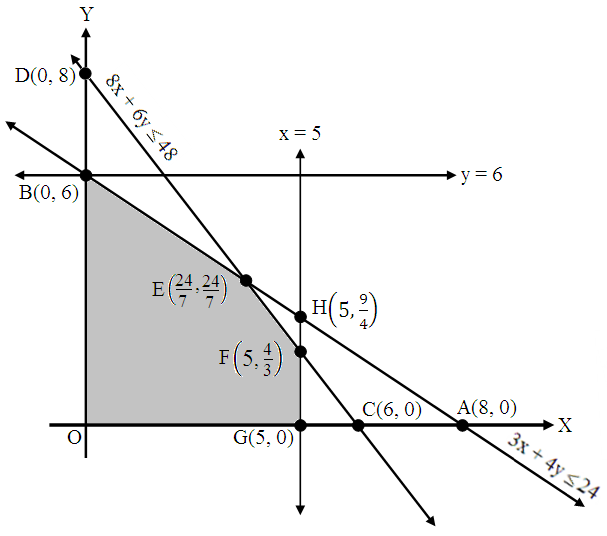
The line 3x + 4y = 24 meets the coordinate axis at A(8, 0) and B(0, 6).
Join these points to obtain the line 3x + 4y = 24.
Clearly, (0, 0) satisfies the inequation $3\text{x}+4\text{y}\leq24$.
So, the region in xy-plane that contains the origin represents the solution set of the given equation.
The line 8x + 6y = 48 meets the coordinate axis at C(6, 0) and D(0, 8).
Join these points to obtain the line 8x + 6y = 48.
Clearly, (0, 0) satisfies the inequation $8\text{x}+6\text{y}\leq48$.
So, the region in xy-plane that contains the origin represents the solution set of the given equation.
x = 5 is the line passing through x = 5 parallel to the Y axis.
y = 6 is the line passing through y = 6 parallel to the X axis.
Region represented by $\text{x}\geq0$ and $\text{y}\geq0$: Since, every point in the first quadrant satisfies these inequations.
So, the first quadrant is the region represented by the inequations.
These lines are drawn using a suitable scale.

The corner points of the feasible region are O(0, 0), G(5, 0), $\text{F}\Big(5,\frac{4}{3}\Big),\text{E}\Big(\frac{24}{7},\frac{24}{7}\Big)$ and B(0, 6).
The values of Z at these corner points are as follows.
$\text{Corner point}$ $\text{Z}=4\text{x}+3\text{y}$
$\text{O}(0, 0)$ $4\times0+3\times0=0$
$\text{G}(5, 0)$ $4\times5+3\times0=20$
$\text{F}\Big(5,\frac{4}{3}\Big)$ $4\times5+3\times\frac{4}{3}=24$
$\text{E}\Big(\frac{24}{7},\frac{24}{7}\Big)$ $4\times\frac{24}{7}+3\times\frac{24}{7}=\frac{196}{7}=24$
$\text{B}(0, 6)$ $4\times0+3\times6=18$
We see that the maximum value of the objective function Z is 24 which is at $\text{F}\Big(5,\frac{4}{3}\Big)$ and $\text{E}\Big(\frac{24}{7},\frac{24}{7}\Big)$.
Thus. the optimal value of is 24.

Need a full question paper?

Generate a complete, print-ready paper with questions like this in minutes — across 16+ boards, with answer keys.

Start Generating Free

Similar questions

Differentiate $\sin^{-1}\Big(\frac{2\text{x}}{1+\text{x}^2}\Big)$ with respect to $\tan^{-1}\Big(\frac{2\text{x}}{1-\text{x}^2}\Big),$ if -1 < x < 1.
Solve the following differential equation:
$\text{x}\frac{\text{dy}}{\text{dx}}+2\text{y}=\text{x}\cos\text{x}$
Find the inverse of $\left[\begin{array}{lll}1 & 2 & 3 \\ 1 & 1 & 5 \\ 2 & 4 & 7\end{array}\right]$ by elementary row transformations.
Solve the following differential equations:
$\frac{\text{dy}}{\text{dx}}=1+\text{x}^2+\text{y}^2+\text{x}^2\text{y}^2,\text{y}(0)=1$
Evaluate the following integrals as limit of sum:$\int\limits^{\frac{\pi}{2}}_{0}\sin\text{x dx}$
If either $\vec{\text{a}}=\vec{0}$ or $\vec{\text{b}}=\vec{0},$ then $\vec{\text{a}}.\vec{\text{b}}=0.$ But the converse need not be true. Justify your answer with an example.
Find the shortest distance between the following pairs of lines whose vector equation are:
$\vec{\text{r}}=\big(3\hat{\text{i}}+5\hat{\text{j}}+7\hat{\text{k}}\big)+\lambda\big(\hat{\text{i}}-2\hat{\text{j}}+7\hat{\text{k}}\big)$ and $\vec{\text{r}}=-\hat{\text{i}}-\hat{\text{j}}-\hat{\text{k}}+\mu\big(7\hat{\text{i}}-6\hat{\text{j}}+\hat{\text{k}}\big)$
Find the maximum and minimum value of 2x + y subject to the constraints:

$\text{x}+3\text{y}\geq6,\text{x}-3\text{y}\leq3,3\text{x}+4\text{y}\leq24,$ $-3\text{x}+2\text{y}\leq6,5\text{x}+\text{y}\geq5,\text{x},\text{y}\geq0$
Find the distance between the lines $l_1$ and$ l_2$​​​​​​​ given by$\vec{\text{r}}=\hat{\text{i}}+2\hat{\text{j}}-4\hat{\text{k}}+\lambda\big(2\hat{\text{i}}+3\hat{\text{j}}+6\hat{\text{k}}\big)$ and, $\vec{\text{r}}=3\hat{\text{i}}+3\hat{\text{j}}-5\hat{\text{k}}+\mu\big(2\hat{\text{i}}+3\hat{\text{j}}+6\hat{\text{k}}\big)$
A line passes through (3, -1, 2) and is perpendicular to lines

$\bar{r}=(\hat{i}+\hat{j}-\hat{k})+\lambda(2 \hat{i}-2 \hat{j}+\hat{k})$ and $\bar{r}=(2 \hat{i}+\hat{j}-3 \hat{k})+\mu(\hat{i}-2 \hat{j}+2 \hat{k})$. Find its equation.