Question
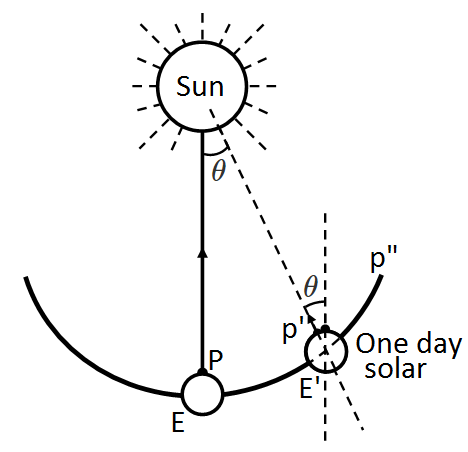
Mean solar day is the time interval between two successive noon when sun passes through zenith point (meridian). Sidereal day is the time interval between two successive transit of a distant star through the zenith point (meridian). By drawing appropriate diagram showing earth’s spin and orbital motion, show that mean solar day is four minutes longer than the sidereal day. In other words, distant stars would rise 4 minutes early every successive day.
Answer

According to the diagram alongside, when the earth revolves about its polar axis in one sidereal day, it also moves from E to E’ around the sun due to translational motion and the point P’ is at P’’. When the Earth still rotates through an angle about its axis to complete one solar day until the point P’ is at P”, again facing the sun.
Earth advances in its orbit by approximately 1° every day, i.e. in 24 hours. Then, it will have to rotate by 361° (which we define as 1 day) to have the sun at zenith point again, $\therefore$ Time taken to traverse $1^0=\frac{24\text{h}}{361^0}\times1^0\frac{24\times60\times6\text{s}}{361}=239.3\text{s}$ i.e., 239.3s = 3 min 59.3s ≈ 4 min Hence, distante stars would rise 4 minutes early every successive day.

Need a full question paper?

Generate a complete, print-ready paper with questions like this in minutes — across 16+ boards, with answer keys.

Start Generating Free

Similar questions

$4\times10^{23}$ tritium atoms are contained in a vessel. The half-life of decay tritium nuclei is 12.3y. Find:
  1. The activity of the sample.
  2. The number of decay in the next 10 hours.
  3. The number of decays in the next 6.15y.
One end of a long string of linear mass density $8.0 \times 10^{–3}kg m^{–1}$ is connected to an electrically driven tuning fork of frequency $256Hz$. The other end passes over a pulley and is tied to a pan containing a mass of $90kg$. The pulley end absorbs all the incoming energy so that reflected waves at this end have negligible amplitude. At $t = 0$, the left end (fork end) of the string $x = 0$ has zero transverse displacement $(y = 0)$ and is moving along positive y-direction. The amplitude of the wave is $5.0cm$. Write down the transverse displacement y as function of x and t that describes the wave on the string.
In vector combination, commutative and associative rules are followed. Explain.
A train running at 108km/h towards east whistles at a dominant frequency of 500Hz. Speed of sound in air is 340m/s.
  1. What frequency will a passenger sitting near the open window hear?
  2. What frequency will a person standing near the track hear whom the train has just passed?
  3. A wind starts blowing towards east at a speed f 36km/h. Calculate the frequencies heard by the passenger in the train and by the person standing near the track.
Doubly-ionised helium ions are projected with a speed of $10km/s^{-1}$ in a direction perpendicular to a uniform magnetic field of magnitude 1.0T. Find
  1. The force acting on an ion.
  2. The radius of the circle in which it circulates.
  3. The time taken by an ion to complete the circle.
A particle of mass m and charge q is released from the origin in a region in which the electric field and magnetic field are given by
$\overrightarrow{\text{B}}=-\text{B}_0\overrightarrow{\text{j}}$ and $\overrightarrow{\text{E}}=\text{E}_0\overrightarrow{\text{k}}.$ Find the speed of the particle as a function of its z-coordinate.
Establish the following vector inequalities geometrically or otherwise: $|\text{a}-\text{b}|\le|\text{a}|+|\text{b}|$ When does the equality sign above apply?
Two identical steel cubes (masses $50g$, side $1cm$) collide head-on face to face with a speed of $10cm/ s$ each. Find the maximum compression of each. Young’s modulus for steel = $Y = 2 \times 1011 N/ m^2$.
A heater coil is to be constructed with a nichrome wire $(\rho=1.0\times10^{-6}\Omega-\text{m})$which can operate at 500W when connected to a 250V supply.
  1. What would be the resistance of the coil?
  2. If the cross-sectional area of the wire $0.5mm^2$, what length of the wire will be needed?
  3. If the radius of each turn is 4.0mm, how many turns will be there in the coil?
An incident wave and a reflected wave are represented by
$\xi_1=\text{a}\sin\frac{2\pi}{\lambda}(\nu\text{t}-\text{x})$
$\xi_2=\text{a}\sin\frac{2\pi}{\lambda}(\nu\text{t}+\text{x})$
Derive the equation of the stationary wave, and calculate the position of the nodes and antinodes.