Question
Mean solar day is the time interval between two successive noon when sun passes through zenith point (meridian). Sidereal day is the time interval between two successive transit of a distant star through the zenith point (meridian). By drawing appropriate diagram showing earth’s spin and orbital motion, show that mean solar day is four minutes longer than the sidereal day. In other words, distant stars would rise 4 minutes early every successive day.

Answer

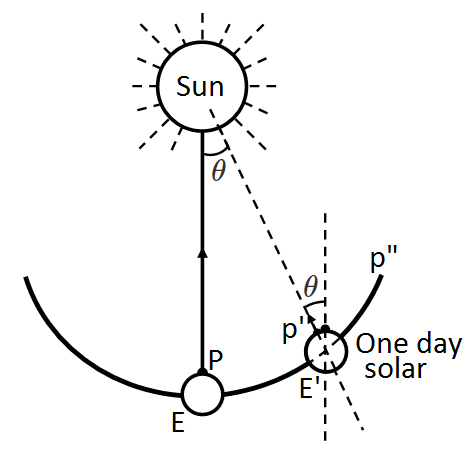
According to the diagram alongside, when the earth revolves about its polar axis in one sidereal day, it also moves from E to E’ around the sun due to translational motion and the point P’ is at P’’.
When the Earth still rotates through an angle about its axis to complete one solar day until the point P’ is at P”, again facing the sun.
Earth advances in its orbit by approximately 1° every day, i.e. in 24 hours. Then, it will have to rotate by 361° (which we define as 1 day) to have the sun at zenith point again,
$\therefore$ Time taken to traverse $1^0=\frac{24\text{h}}{361^0}\times1^0\frac{24\times60\times6\text{s}}{361}=239.3\text{s}$
i.e., 239.3s = 3 min 59.3s ≈ 4 min
Hence, distante stars would rise 4 minutes early every successive day.

Need a full question paper?

Generate a complete, print-ready paper with questions like this in minutes — across 16+ boards, with answer keys.

Start Generating Free

Similar questions

Obtain an expression for the linear acceleration of a cylinder rolling down an inclined plane and hence find the condition for the cylinder to roll down without slipping.
A particle of mass 1kg moving with a velocity $\text{V}_1=(3\hat{\text{i}}-2\hat{\text{J})}\text{m/ s}$ experience a perfectly inelastic collision with another particle of mass 2kg having velocity $\text{v}_2=4\hat{\text{j}}-6\hat{\text{k}}\text{m/ s}$. Find the velocity and speed of the particle formed.
Establish a relationship between angular momentum (L), moment of inertia (I) and angular velocity $(\omega)$.
Two masses 8 kg and 12 kg are connected at the two ends of a light inextensible string that goes over a frictionless pulley. Find the acceleraton of the masses, and the tension in the string when the masses are released.
Consider the case of two bodies of mass m1 and m2 connected by a string and placed on a smooth horizontal surface as shown. Calculate the acceleration of the system, and tension in the string when the force F is applied on m2.

The temperature and humidity of air are 27°C and 50% on a particular day. Calculate the amount of vapour that should be added to 1 cubic metre of air to saturate it. The saturation vapour pressure at 27°C = 3600Pa.
A hoop of radius 2m weighs 100kg. It rolls along a horizontal floor so that its centre of mass has a speed of 20cm/s. How much work has to be done to stop it?
Consider the situation of the previous problem:
  1. Find the tension in the string in equilibrium.
  2. Suppose the ball is slightly pushed aside and released. Find the time period of the small oscillations.
A hole is drilled in a copper sheet. The diameter of the hole is 4.24cm at 27.0 °C. What is the change in the diameter of the hole when the sheet is heated to 227°C? Coefficient of linear expansion of copper = 1.70 × 10⁻⁵ K-1.
Find the expression for kinetic energy, potential energy and total energy of a particle executing SHM.