Question
Establish a relationship between angular momentum (L), moment of inertia (I) and angular velocity $(\omega)$.
Answer

self

Need a full question paper?

Generate a complete, print-ready paper with questions like this in minutes — across 16+ boards, with answer keys.

Start Generating Free

Similar questions

A transverse harmonic wave on a string is described by
$
y(x, t)=3.0 \sin \left(36 t+0.018 x+\frac{\pi}{4}\right)
$
where $x$ and $y$ are in cm and $t$ in s. The positive direction of $x$ is from left to right.
(a) Is this a travelling wave or a stationary wave?
If it is travelling, what are the speed and direction of its propagation?
(b) What are its amplitude and frequency?
(c) What is the initial phase at the origin?
(d) What is the least distance between two successive crests in the wave?
When a metal plate is exposed to a monochromatic beam of light of wavelength 400nm, a negative potential of 1.1V is needed to stop the photocurrent. Find the threshold wavelength for the metal.
A thin circular loop of radius R rotates about its vertical diameter with an angular frequency $\omega.$ Show that a small bead on the wire loop remains at its lowermost point for $\omega\le\sqrt{\frac{\text{g}}{\text{R}}}.$ What is the angle made by the radius vector joining the centre to the bead with the vertical downward direction for $\omega=\sqrt{\frac{2\text{g}}{\text{R}}}?$ Neglect friction.
Prove that with constant angular speed a radius the perpendicular to the point of rotation of a person rotating in a circular path performs simple harmonic motion. Also find the equation of this motion.
Suppose the second charge in the previous problem is -1.0 × 10-6C. Locate the position where a third charge will not experience a net force.
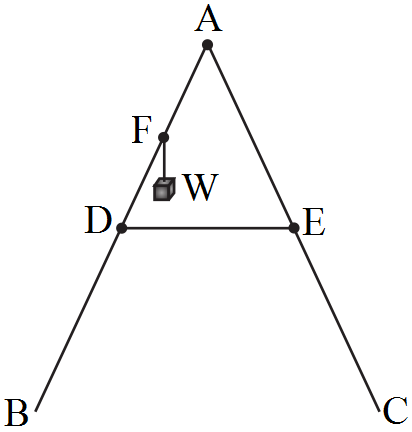
As shown in the two sides of a step ladder BA and CA are 1.6m long and hinged at A. A rope DE, 0.5m is tied half way up. A weight 40kg is suspended from a point F, 1.2m from B along the ladder BA. Assuming the floor to be frictionless and neglecting the weight of the ladder, find the tension in the rope and forces exerted by the floor on the ladder. (Take g = 9.8m/s2)
(Hint: Consider the equilibrium of each side of the ladder separately).

Figure shows a smooth track which consists of a straight inclined part of length 1 joining smoothly with the circular part. A particle of mass m is projected up the incline from its bottom.
  1. Find the minimum projection-speed v0, for which the particle reaches the top of the track.
  2. Assuming that the projection-speed is 2v0 and that the block does not lose contact with the track before reaching its top, find the force acting on it when it reaches the top.
  3. Assuming that the projection-speed is only slightly greater than v0, where will the block lose contact with the track?
A projectile is fired horizontally with a velocity of $98 ms^{-1}$ from the hill 490 m high. Find
i. time taken to reach the ground
ii. the distance of the target from the hill and
iii. the velocity with which the projectile strikes the ground.
Consider the situation of the previous problem.
  1. Calculate the force needed to keep the sliding wire moving with a constant velocity v.
  2. If the force needed just after t = 0 is F0, find the time at which the force needed will be $\frac{\text{F}_0}{2}.$
A source emitting sound at frequency 4000Hz, is moving along the Y-axis with a speed of 22m/s. A listener is situated on the ground at the position (660m, 0). Find the frequency of the sound received by the listener at the instant the source the origin. Speed of sound in air = 330m/s.