Question
Mention three important features of fossils which help in the study of evolution.

Answer

Fossils are remains or impressions of past organisms that are found in the rocks. Fossils of lower strata belong to early periods while those of upper strata are of later periods. Arranging the fossils stratumwise will indicate the occurrence of different forms of life at different times. It is found that the early fossils generally belong to simple organisms. Complexity and elaboration increased gradually with evolution. Evolution has never been linear or straight. A number of variants or branches appeared, some of which were more complex while others were less complex. Fossils indicate the path of evolution of different groups.They can indicate the phylogeny of some organisms, e.g, Horse, Elephant.
Some fossils have characteristics intermediate between two groups, e.g., toothed bird Archaeopteryx. They indicate how one group has evolved from another.
Need a full question paper?

Generate a complete, print-ready paper with questions like this in minutes — across 16+ boards, with answer keys.

Start Generating Free

Similar questions

An object is placed 10cm from a lens of focal length 5cm. Draw the ray diagrams to show the formation of image if the lens is:
  1. Converging, and
  2. Diverging.
What do you understand by the term ‘evolution’? State Darwin’s theory of evolution.
Explain the three pathways of breakdown in living organisms.
The liquid connective tissue A circulates in our body continuously without stopping. This tissue contains a pigment B which imparts it a colour C. The tissue A consists of four components D, E, F and G. The component D fights infection and protects us from diseases. The component E helps in the clotting of tissue A if a person gets a cut. The component F is a liquid which consists mainly of water with many substances dissolved in it and component G carries oxygen from the lungs to all the parts of the body.
  1. What is (i) tissue A, (ii) pigment B and (iii) colour C?
  2. Name (i) D, (ii) E, (iii) F and (iv) G.
  3. Name one substance (other than oxygen) which is transported by tissue A in the human body.
  4. Which two components of tissue A are the cells without nucleus?
  5. Name any two organisms (animals) which do not have liquid like A in their body.
  1. In tabular form, differentiate between ethanol and ethanol acid under the following heads:
  1. Physical state.
  2. Taste.
  3. $NaHCO_3$ test.
  4. Ester test.
  1. Write a chemical reaction to show dehydration of ethanol.
With the help of labelled diagrams, describe an activity to show that acids produce ions only in aqueous solutions.
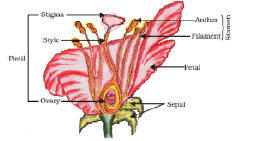
The labelled diagram of a flower is shown below:
Image

Using the above diagram, answer the following questions:
i. Where is the egg cell present in a flower?
ii. Which part of the flower produces pollen grains?
iii. What is the difference between a uni-sexual and a bisexual flower?
iv. What happens when a pollen grain falls on the stigma of the carpel?
v. How a zygote is formed in a flower?
  1. Draw the structure of a neuron and label the following on it: Nucleus, Dendrite, Cell body and Axon.
  2. Name the part of neuron:
  3. Where information is acquired.
  4. Through which information travels as an electrical impulse.
The stem of a fruit tree X fixed in soil is cut in a slanting way. The upper part of stem of another fruit tree Y of different variety of same species is also cut in a slanting way. The cut stem of tree Y, without roots but having some leaves, is placed over the rooted cut stem of tree X in such a way that their cut surfaces fit together properly. While joining the two cut stems, care is taken to make sure that the layer Z of one cut stem is in contact with layer Z of the other cut stem. The joint of cut stem is The stem of a fruit tree X fixed in soil is cut in a slanting way. The upper part of stem of another fruit bound tightly with a piece of cloth and covered properly with polythene. Soon the cut heals and the two stems grow together and become one fruit tree producing leaves, flowers and fruits.
  1. What is the name of this method of producing plants or trees?
  2. What name is given to the cut stem of tree X having roots?
  3. What name is given to the cut stem of tree Y which has no roots but has some leaves?
  4. Name the layer Z.
  5. Why should the layer Z of one cut stem be in contact with the layer Z of the other cut stem?
  6. Name any four fruit trees which are usually bred by this technique.
  7. State any one advantage of producing fruit trees by this technique.