MCQ
Methanol and ethanol are miscible in water due to
  • A
    Covalent character
  • Hydrogen bonding character
  • C
    Oxygen bonding character
  • D
    None of these

Answer

Correct option: B.
Hydrogen bonding character
b
(b)Hydrogen bonding : $\mathop {\mathop O\limits_{\mathop |\limits_R }^{\delta - } - \mathop H\limits^{\delta + } }\limits_{{\rm{Alcohol}}\,\,} ....\mathop {\mathop O\limits_{\mathop |\limits_H }^{\delta - } - \mathop H\limits^{\delta + } }\limits_{{\rm{Water}}} .....\mathop {\mathop O\limits_{\mathop |\limits_R }^{\delta - } - \mathop H\limits^{\delta + } }\limits_{{\rm{Alcohol}}} $
 

Need a full question paper?

Generate a complete, print-ready paper with questions like this in minutes — across 16+ boards, with answer keys.

Start Generating Free

Similar questions

The increasing order of the crystal field splitting power of some common ligands is
Structure of $S_2Cl_2$ is analogous to
Activation energy of a chemical reaction can be determined by
The correct $IUPAC$ name of the compound :

$\begin{array}{*{20}{c}}
{C{H_3}\,\,\,\,\,\,\,\,\,\,\,\,\,\,\,\,\,\,\,\,\,\,C{H_3}\,\,\,\,\,\,\,\,\,\,}\\
{|\,\,\,\,\,\,\,\,\,\,\,\,\,\,\,\,\,\,\,\,\,\,\,\,\,\,\,\,\,\,|\,\,\,\,\,\,\,\,\,\,\,\,\,\,\,}\\
{C{H_3} - C{H_2} - C = C - CH - C - C{H_2} - C{H_2} - C{H_3}}\\
{|\,\,\,\,\,\,\,\,\,}\\
{{C_2}{H_5}}
\end{array}$
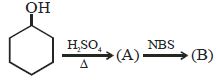
product $(B)$ is
For a first order reaction, the time required for completion of $90\, \%$ reaction is $'x'$ times the half life of the reaction. The value of $'x'$ is $........\,.$ (Given: $\ln 10=2.303$ and $\log 2=0.3010$ )
Catalyst $A$ reduces the activation energy for a reaction by $10\, k\,J\, mol ^{-1}$ at $300\, K$. The ratio of rate $\frac{ k _{ T }, \text { Catalysed }}{ k _{ T }, \text { Uncatalysed }}$ is $e ^{ x }$ [nearest integer $]$

[Assume theat the pre-exponential factor is same in both the cases.

Given $R =8.31 \,J\, K ^{-1} \,mol ^{-1}$ ]

In the extraction of zinc which gas is burnt in the jackets surrounding the retorts
The $IUPAC$ name of $\begin{matrix}
   \,\,\,\,\,\,\,\,\,\,\,\,\,\,\,\,\,\,\,\,\,\,\,\,\,\,\,\,\,\,\,\,\,\,\,\,\,\,\,\,\,\,\,\,\,\,\,\,\,\,\,\,\,\,\,\,\,C{{H}_{3}}\,  \\
   \,\,\,\,\,\,\,\,\,\,\,\,\,\,\,\,\,\,\,\,\,\,\,\,\,\,\,\,\,\,\,\,\,\,\,\,\,\,\,\,\,\,\,\,\,\,\,\,\,\,|  \\
   C{{H}_{3}}-C{{H}_{2}}-CH-CH-C-C{{H}_{3}}  \\
   \,\,\,\,\,\,\,\,\,\,\,\,\,\,\,\,\,\,\,\,\,|\,\,\,\,\,\,\,\,\,\,\,\,\,|\,\,\,\,\,\,\,\,\,\,\,\,|\,  \\
   \,\,\,\,\,\,\,\,\,\,\,\,\,\,\,\,\,\,\,\,\,\,\,Cl\,\,\,\,\,\,\,\,C{{H}_{3}}\,\,\,OH  \\
\end{matrix}$ is
For the following compounds, choose the incorrect option ? 

$\mathop {C{H_3} - N{H_2}}\limits_{(P)} \,\,\,\,\,\,\,\,\,\,\,\mathop {Ph - N{H_2}}\limits_{(Q)} $