Question
Microbes are useful in household products. Explain this with suitable examples

Answer

Get the step-by-step solution for this question inside the Vidyadip app.

Get the answer in the app

Need a full question paper?

Generate a complete, print-ready paper with questions like this in minutes — across 16+ boards, with answer keys.

Start Generating Free

Similar questions

Read the following and answer any four questions from (i) to (v) given below:
Population is defined as the total number of individuals of a species present in a particular area at a given time. 'The scientific study of human population is called demography. The rapid increase in population over a relatively short period is called population explosion. Four basic processes are involved in increase or decrease in the population size. Population shows two types of growth; exponential and logistic.
  1. Which of the following factors are responsible for population explosion?
  1. Decrease in number of people of reproducible age.
  2. Decline in infant mortality rate.
  3. Increase in maternal mortality rate.
  4. Rapid decline in death rate.
  1. A and B
  2. B and C
  3. B and D
  4. A and D
  1. What is the shape of curve showing logistic growth?
  1. Sigmoid.
  2. J-shape.
  3. Linear.
  4. Hyperbola.
  1. What is immigration?
  1. Number of individuals of the population who left the habitat.
  2. Number of individuals that have come into the habitat.
  3. Number of individuals of a species per unit area at given time.
  4. Number of births per 1000 individuals.
  1. Equation of Verhulst-Pearl logistic growth is:
  1. $\frac{\text{dN}}{\text{dt}}=\text{rN}$
  2. $\frac{\text{dN}}{\text{dt}}=\frac{\text{K-N}}{\text{k}}$
  3. $\frac{\text{dN}}{\text{dt}}=\text{rN}\Big(\frac{\text{K-N}}{\text{k}}\Big)$
  4. $\frac{\text{dN}}{\text{dt}}=\text{rN}\Big(1-\frac{\text{K-N}}{\text{k}}\Big)\text{r}$
  1. Which of the following contributes to decrease in population?
  1. Fertility.
  2. Natality.
  3. Social mobility.
  4. Emigration.
Read the following and answer any four questions from (i) to (v) given below:

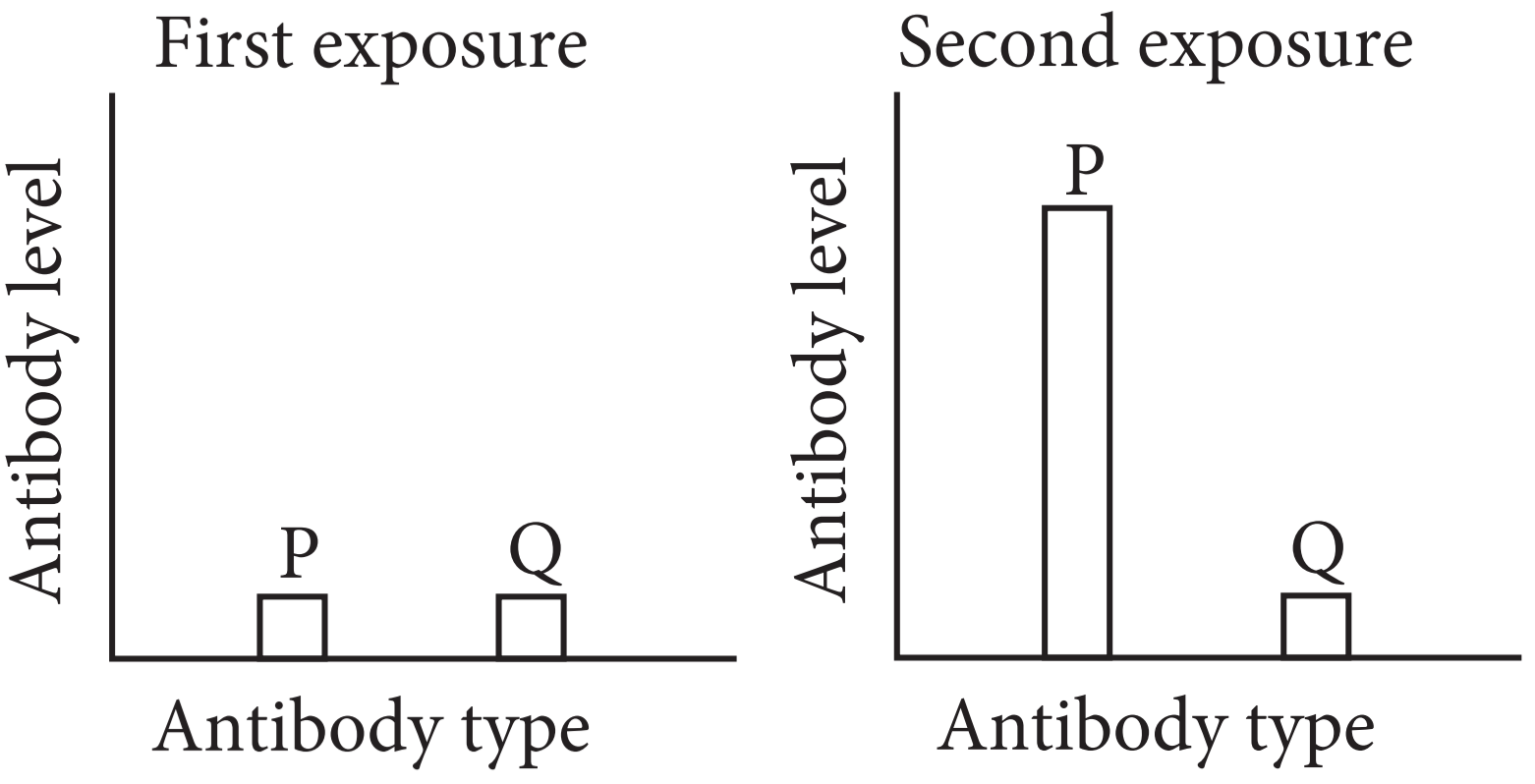
In a study to test a new vaccine against a viral disease, mouse model testing is done. In this process, mice are vaccinated and their blood samples were tested. Mice developed mild disease symptom. After few days those mice were again infected with the virus. This time they do not show any disease symptoms. Their blood samples were tested. Two graphs show antibody concentration for the first and second infection in mice blood.

Based on the above information, answer the following questions.

  1. P and Qin the given graphs indicate.
  1. IgM and IgG respectively.
  2. IgG and IgM respectively
  3. IgG and IgM respectively
  4. IgM and IgA respectively.
  1. Which form of pathogen is used in vaccination?
  1. Activated and strong pathogenic antigen.
  2. Inactivated and weakened pathogenic antigen.
  3. Hyperactive and strong pathogen.
  4. Preformed antibodies.
  1. Which of the following is incorrect for P?
  1. It is the most abundant class of lg.
  2. It is found in blood, lymph, and intestine.
  3. It is unable to cross the placental barrier.
  4. It is a monomer.
  1. How does vaccination work?
  1. The immune system produces antibodies which stay in the blood.
  2. Memory lymphocytes remain in the body to fight off any future infection with the same pathogen.
  3. The dead pathogen stays in the body and constantly stimulates the immune system.
  4. All of these.
  1. Assertion: Mice do not show any disease symptoms during second exposure to the pathogenic virus.

Reason: The antibody production is accelerated and more intense during secondary immune response.

  1. Both assertion and reason are true, and reason is the correct explanation of assertion.
  2. Both assertion and reason are true, but reason is not the correct explanation of assertion.
  3. Assertion is true, but reason is false.
  4. Both assertion and reason are false.
Read the following text carefully and answer the questions that follow:
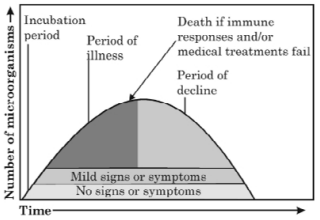
When a microorganism invades a host, a definite sequence of events usually occur leading to infection and disease, causing suffering to the host. This process is called pathogenesis. Once a microorganism overcomes the defense system of the host, development of the disease follows a certain sequence of events as shown in the graph. Study the graph given below for the sequence of events leading to appearance of a disease and answer the questions that follow:
Image
i. In which period, according to the graph there are maximum chances of a person transmitting a disease/infection and why? (1)
ii. Study the graph and write what is an incubation period. Name a sexually transmitted disease that can be easily transmitted during this period. Name the specific type of lymphocytes that are attacked by the pathogen of this disease. (1)
iii. Draw a schematic labelled diagram of an antibody. (2)
OR
In which period, the number of immune cells forming antibodies will be the highest in a person suffering from pneumonia?
Name the immune cells that produce antibodies. (2)
With labeled diagrams describe the mechanism of Pollen-pistil Interaction.
Read the following and answer any four questions from (i) to (v) given below:

Oral administration of small doses of hormones is contraceptive method used by the females. They are used in the form of tablets and hence called the pills. The oral pills are two types; mini pills and combined pills.

  1. Mini pills contain:
  1. Estrogen only.
  2. Progestin only.
  3. Combination of progesterone-estrogen.
  4. Inhibin.
  1. How do hormonal pills prevent pregnancy?
  1. By phagocytosing the sperms.
  2. By inhibiting ovulation.
  3. By preventing sperms from entering the vagina.
  4. All of these.
  1. Pill containing non-steroidal preparation, centchroman is:
  1. Mala D.
  2. Mala N.
  3. I-Pill.
  4. Saheli.
  1. Which among the following is incorrect for oral contraceptives?
  1. Oral pills alter the uterine endometrium and make it unsuitable for implantation.
  2. Oral pills have to be taken daily for 7 days starting within first five days of menstrual cycle.
  3. Oral pills increase the risk of intravascular clotting.
  4. Oral pills contain either progestin alone or combination of progestogen and estrogen.
  1. Assertion: Mala D, a combined contraceptive pill, have to be taken daily without a break.

Reason: Mala D contains synthetic progesterone and estrogen.

  1. Both assertion and reason are true, and reason is the correct explanation of assertion.
  2. Both assertion and reason are true, but reason is not the correct explanation of assertion.
  3. Assertion is true, but reason is false.
  4. Both assertion and reason are false.
Read the following and answer any four questions from (i) to (v) given below:
The first menstruation is called menarche, that usually occurs between 12 and 15 years. In human females, menstruation is repeated at an average interval of about 28/29 days and is called menstrual cycle. It is regulated by certain hormones, as pituitary gland is stimulated by releasing factors produced in the hypothalamus. The hormones produced by pituitary gland influence the ovaries. The hormones secreted by the ovaries affect the walls of the uterus.
  1. The breakdown of endometrium is characteristic of:
  1. Proliferative phase.
  2. Luteal phase.
  3. Ovulatory phase.
  4. Menstrual phase.
  1. Which days of the menstrual cycle marks the proliferative phase?
  1. 1-5
  2. 15-28
  3. 6-13
  4. 10-14
  1. Which of the following occurs during secretory phase?
  1. Empty Graafian follicle changes into corpus luteum.
  2. Primary follicle changes into Graafian follicle.
  3. Endometrium rebuilds and estrogen secretion increases.
  4. LH surge, inducing release of an ovum.
  1. Identify the hormones that attain peak level during ovulatory phase.
  1. FSH.
  2. Progesterone.
  3. LH.
  4. Both (a) and (c).
  1. Withdrawal of which hormone causes degeneration of corpus luteum?
  1. FSH.
  2. LH.
  3. Progesterone.
  4. Estrogen.
Explain exponential growth equation with well labeled diagram.###Explain exponential growth.
Explain packaging of DNA Helix###Explain the formation of nucleosome in Eukaryotic cell
Read the following text carefully and answer the questions that follow:
Cleavage is the series of rapid mitotic divisions in zygote and forms blastula. The 2, 4, 8, 16 daughter cells are called blastomeres. Embryo with 64 blastomeres is known as blastocyst and has blastocoel cavity. Blastocyst gets implanted in uterine wall and leads to pregnancy.
i. Why the cells of the inner cell mass of blastocyst are called stem cells? (1)
ii. At which stage of embryonic development trophoectoderm develops? (1)
iii. What is the site of implantation? (2)
OR
What is the correct sequence of various structures formed during embryonic development? (2)
Explain with diagram - Hershey and Chase experiment.###On the basis of experimental proof explain the diagram that DNA is genetic material.###How did Hershey and Chase differentiate between DNA and protein in their experiment while proving that DNA is the genetic material?