MCQ
$M{L^{ - 1}}{T^{ - 2}}$ represents
  • A
    Stress
  • B
    Young's Modulus
  • C
    Pressure
  • All the above three quantities

Answer

Correct option: D.
All the above three quantities
d
Here stress $=f / A$

Pressure $=f / A$

So, $[$ stress $]=[$ Pressuue $]=\left[M L^{-1} T^{-2}\right]$

Hiso, $Y=\frac{\text { stress }}{\text { strain }}$ (strain is dimensionliss)

$\therefore Y=f / A=\left[M L^{-1} T^{-2}\right]$

$\therefore$ All the there has seme dimenion equals $\left[ HL ^{-1} T^{-2}\right]$

Need a full question paper?

Generate a complete, print-ready paper with questions like this in minutes — across 16+ boards, with answer keys.
Start Generating Free

Similar questions

The force $F$ is given in terms of time $t$ and displacement $x$ by the equation $F = A\,cos\,Bx + C\,sin\,Dt.$ The dimensional formulae of $D/B$ is
Mark the correct options:
If wavelength of maximum intensity of radiation emitted by Sun and Moon are $0.5 \times 10^{-4} \,m$ and $10^{-4}\,m$ respectively, then the ratio of their temperature is ............
In Guericke's experiment to show the effect of atmospheric pressure, two copper hemispheres were tightly fitted to each other to form a hollow sphere and the air from the sphere was pumped out to create vacuum inside. If the radius of each hemisphere is $R$ and the atmospheric pressure is $p$, then the minimum force required (when the two hemispheres are pulled apart by the same force) to separate the hemispheres is
An ideal heat engine exhausting heat at ${77^o}C$ is to have a $30\%$ efficiency. It must take heat at ...... $^oC$
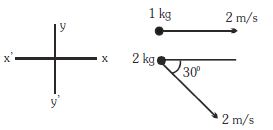
The velocity of centre of mass of the system as shown in the figure is
One litre of Helium gas at a pressure $76\, cm$ of $Hg$ and temperature ${27}^\circ$ is heated till its pressure and volume are doubled. The final temperature attained by the gas is ..... $^oC$
The minimum distance of reflector surface from the source for listening the echo of sound is ..... $m$
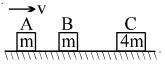
Three blocks are initially placed as shown in the figure. Block $A$ has mass $m$ and initial velocity $v$ to the right. Block $B$ with mass $m$ and block $C$ with mass $4m$ are both initially at rest. Neglect friction. All collisions are elastic. The final velocity of block $A$ is
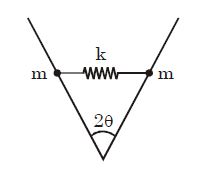
Two particles of mass $m$ are constrained to move along two horizontal frictionless rails that make an angle $2\theta $ with respect to each other. They are connected by a spring with spring constant $k$ . The angular frequency of small oscillations for the motion where the two masses always stay parallel to each other (that is the distance between the meeting point of the rails and each particle is equal) is