MCQ
$[Mn(CO)_4 NO]$ is diamagnetic because
  • A
    $Mn$ metal is diamagnetic in free state
  • B
    $Mn$ is in $+1$ oxidation state in this complex
  • C
    $NO$ is present as positive ligand
  • All of the above

Answer

Correct option: D.
All of the above
d
$[\overset{+1}{\mathop{Mn}}\,{{(CO)}_{4}}(N{{O}^{-}})]:$ Paramagnetic due to presence of unpaired $e^-s$ in $NO^-$

$[\overset{-1}{\mathop{Mn}}\,{{(CO)}_{4}}(N{{O}^{+}})]:$ No unpaired $e^-$ either  on ligands or on $\overset{-1}{\mathop{Mn}}$ hence it is diamagnetic

Need a full question paper?

Generate a complete, print-ready paper with questions like this in minutes — across 16+ boards, with answer keys.
Start Generating Free

Similar questions

Product of the reaction is
One mole of the complex compound $Co(NH_3)_5Cl_3,$ gives $3$ moles of ions on dissolution in water. One mole of the same complex reacts with two moles of $AgNO_3$ solution to yield two moles of $AgCl(s).$ The structure of the complex is :-
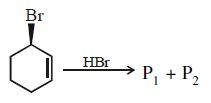
$P_1$ & $P_2$ are major dibromo products. What is the relationship between $P_1$ & $P_2$.
Identify total number of structural isomers with $C_5H_{12}$ molecular formula ?
Assertion : Anilinium chloride is more acidic than ammonium chloride.
Reason : Anilinium ion is resonance stabilized
Which of the following compound can give positive iodoform test when treated with aqueous KOH solution followed by potassium hypoiodite.
The reaction $2 NO + Br _2 \rightarrow 2 NOBr$

takes places through the mechanism given below :

$NO + Br _2 \Leftrightarrow NOBr _2 \text { (fast) }$

$NOBr _2+ NO \rightarrow 2 NOBr \text { (slow) }$

The overall order of the reaction is $.....$.

Phenol condenses with phthalic anhydride in presence of conc. $H_2SO_4$ to form
A $0.5\,M\,NaOH$ solution offers a resistance of $31.6\,ohm$ in a conductivity cell at room temperature. What shall be the approximate molar conductance of this $NaOH$ solution if cell constant of the cell is $0.367\,cm^{-1}$. ............ ${\rm{S}}\,{\rm{c}}{{\rm{m}}^2}{\rm{mo}}{{\rm{l}}^{ - 1}}$
The following data are obtained when dinitrogen and dioxygen react together to form different compounds

Mass of dinitrogen Mass of dioxygen
$14\, g$ $16\, g$
$14\, g$ $32\, g$
$28\, g$ $32\, g$
$28\, g$ $80\, g$

Which law of chemical combination is obeyed by the above experimental data ?